
Why High Dividend Yields in BDCs Like MSDL and BXSL Are Not Enough to Offset Total Return Underperformance
Business development companies (BDCs) such as Morgan Stanley Direct Lending Fund (MSDL) and Blackstone Secured Lending Fund (BXSL) have long attracted income-seeking investors with their lofty dividend yields. However, a closer examination of these funds reveals that their high yields-11.8% for MSDLMSDL-- and 9.6% for BXSL- according to fund data are increasingly insufficient to offset broader underperformance in total returns. This underperformance stems from three critical factors: persistent discounts to net asset value (NAV), deteriorating credit quality in their portfolios, and heightened sensitivity to Federal Reserve policy shifts.
Discount to NAV: A Symptom of Structural Weakness
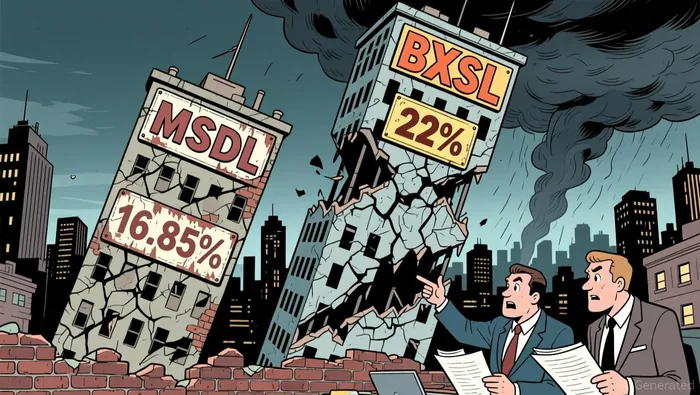
Both MSDL and BXSLBXSL-- trade at significant discounts to NAV, with MSDL at 16.85% and BXSL at 22% as of late 2025. These discounts are not merely market anomalies but reflect deeper challenges in capital deployment and portfolio performance. For MSDL, net investment income barely covers its 11.8% yield, leaving little room for reinvestment. BXSL's 22% discount is even more alarming, as its NAV per share has fallen to $27.15 due to realized and unrealized losses, signaling a loss of confidence in its ability to generate consistent returns.
Such discounts erode total returns because they imply that the market values the funds' assets far below their stated NAV. Even if dividends remain stable, the widening gap between price and NAV reduces the likelihood of capital appreciation-a critical component of total returns. As one analyst notes, "High yields alone cannot compensate for the drag of a deteriorating NAV."
Credit Quality: BXSL's Edge and MSDL's Gaps
Credit quality plays a pivotal role in determining a BDC's resilience. BXSL's portfolio is 92% composed of private loans, with an average issuer LTM EBITDA of $256 million- well above the private credit market average. This robust credit profile, combined with a low non-accrual rate (not explicitly stated but implied by its strong EBITDA metrics), positions BXSL to weather economic cycles better than its peers. By contrast, MSDL's median portfolio EBITDA is $86.8 million, and its non-accrual rate stands at 0.7% of total investments according to Q2 2025 results. While these metrics are not disastrous, they lag behind BXSL's, suggesting a higher risk of defaults or downgrades in a stressed environment.
Moreover, BXSL's access to Blackstone's extensive network of 550+ sponsor relationships ensures a steady pipeline of high-quality deals. MSDL, while benefiting from Morgan Stanley's expertise, lacks comparable transparency on its loan-to-value (LTV) ratios and refinancing activity. A weighted average LTV of 40% for MSDL indicates conservative leverage, but without data on its refinancing success, it remains unclear how effectively the fund can sustain its yields during liquidity crunches.
Fed Sensitivity: A Double-Edged Sword
The Federal Reserve's cautious approach to rate cuts- projected to reach 3.5% by year-end 2025-presents mixed implications for MSDL and BXSL. BXSL's floating-rate structure and adjusted distribution strategy (9.6% annualized yield post-125bps rate cuts) allow it to adapt swiftly to lower rates. This flexibility is critical, as lower rates improve borrowers' interest coverage ratios up to 2.0x in Q3 2025, enhancing credit stability.
MSDL, however, faces a more nuanced challenge. While its floating-rate loans benefit from reduced borrower costs in a low-rate environment, its performance is heavily tied to refinancing demand and middle-market M&A activity according to Morgan Stanley analysis. If rate cuts are delayed or shallow, as suggested by strong GDP growth and low volatility, MSDL's ability to capitalize on these trends will be constrained. The fund's reliance on macroeconomic conditions makes it more vulnerable to policy missteps than BXSL, which has already aligned its distributions with a lower-rate paradigm.
Conclusion: Beyond the Yield
For investors, the lesson is clear: high dividend yields in BDCs like MSDL and BXSL are not a panacea for total return underperformance. Structural discounts to NAV, uneven credit quality, and divergent responses to Fed policy all contribute to a landscape where income alone cannot offset capital erosion. While BXSL's stronger credit metrics and adaptive strategies give it an edge, both funds underscore the need for a holistic evaluation of BDCs-one that balances yield with portfolio resilience and macroeconomic alignment. In an era of shifting interest rates and economic uncertainty, the days of relying solely on high yields are over.





Comentarios
Aún no hay comentarios