
The High Cost of Credit Card Debt vs. Investment Returns: A 2025 Guide to Strategic Financial Priorities
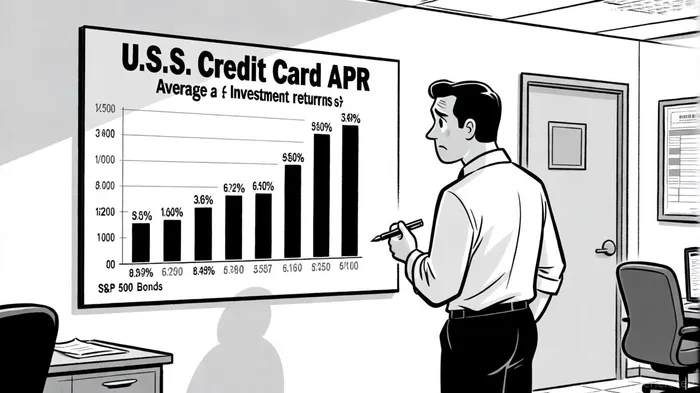
In 2025, the average U.S. credit card interest rate stands at 22.73%, with some cards charging as high as 36% [1]. Meanwhile, the S&P 500 index fund returned 8.69% for the year, and bond investments like the Vanguard Total Bond Market ETF (BND) averaged 4.4% over five years [2][3]. This stark disparity underscores a critical financial dilemma: Should individuals prioritize paying off high-interest debt or allocate funds to investments?
Opportunity Cost: The Hidden Tax on Debt
The opportunity cost of carrying credit card debt is staggering. For every dollar invested in the S&P 500 at 8.69%, a cardholder paying 22.73% APR effectively loses 14.04% in potential wealth creation. Over time, compounding exacerbates this loss. For example, a $10,000 balance at 22.73% APR would incur $2,273 in interest annually, while the same amount invested in the S&P 500 would grow by $869—netting a $1,404 disadvantage. This gap widens further when considering conservative long-term forecasts: Vanguard predicts U.S. equities will yield 2.8%-4.8% over the next decade, while BlackRockBLK-- anticipates 3.7% for bonds [4].
Asset Allocation Strategy: Debt First, Then Invest
A disciplined asset allocation strategy demands prioritizing high-interest debt repayment before aggressive investing. Here's why:
1. Certainty vs. Uncertainty: Credit card interest rates are fixed and guaranteed, while investment returns are volatile. Paying 22.73% debt effectively guarantees a 22.73% return on the capital used to eliminate it—a risk-free gain compared to the uncertain returns of stocks or bonds [5].
2. Psychological Relief: High-interest debt creates financial stress, often leading to suboptimal decisions. Eliminating it frees mental bandwidth for strategic investing [6].
3. Liquidity Constraints: Emergency funds should remain untouched, but non-essential investments (e.g., speculative stocks) should pause until debt is manageable.
Tactical Approaches to Debt-Reduction
While the math favors debt repayment, tactical strategies can optimize the process:
- Balance Transfers: Cards offering 0% APR for 15 months (e.g., Chase Freedom Unlimited®) can buy time to pay down balances without accruing interest [7].
- Negotiation: Contacting issuers to request lower rates is often overlooked but effective, particularly for those with improving credit scores [8].
- Consolidation: Personal loans with fixed rates below 10% can replace high-APR debt, though fees and terms must be scrutinized [9].
When to Invest While in Debt
Exceptions exist for low-interest debt (e.g., student loans at 4-6%) or tax-advantaged investments like 401(k)s with employer matches. However, credit card debt—charging over 20%—demands immediate attention. As one expert notes, “Investing in high-cost debt is like pouring money into a leaky bucket. Plug the leak first” [10].
Conclusion: A 2025 Imperative
With credit card rates hovering near 23% and investment returns trending downward, 2025 demands a recalibration of financial priorities. Eliminating high-interest debt is not merely a budgeting exercise—it is an investment in future wealth. Once debt is under control, a diversified portfolio of stocks and bonds can then be pursued with a clearer, more stable foundation.







Comentarios
Aún no hay comentarios