
The Hidden Risks of Validator Trust in DeFi and Ethereum's Future Security Challenges
On-Chain Security: A Pillar of Trust
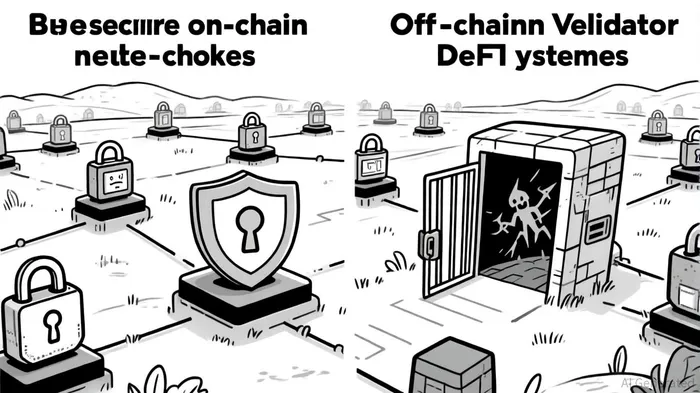
Ethereum's consensus mechanism, now proof-of-stake (PoS), provides strong protections against 51% attacks by ensuring invalid blocks cannot be validated, as Vitalik Buterin has noted. This on-chain security is a foundational strength, preserving the blockchain's integrity even during network stress. For instance, Ethereum co-founder Vitalik Buterin has emphasized that the protocol's design prevents malicious actors from altering historical data or double-spending assets.
However, this security does not extend to off-chain processes. Validators-nodes responsible for processing external data like price oracles-operate outside the blockchain's cryptographic guarantees. Buterin has warned that these off-chain dependencies create "points of failure" where collusion or software errors could feed false data into DeFi protocols. Historical incidents, such as the 2020 oracleADA-- errors in bZx and Compound, demonstrate how such vulnerabilities can trigger millions in losses.
Off-Chain Validator Risks: A Growing Threat
The reliance on off-chain validators has intensified as Layer 2 networks handle nearly 90% of Ethereum transactions by 2025. These networks depend on trusted validators to process and verify transactions, creating new attack vectors. For example, the Radiant Capital hack in October 2024 resulted in a $53 million loss, with $10.8 million laundered through privacy tools like Tornado Cash. This incident highlighted the difficulty of tracing illicit transactions when off-chain validators are compromised.
Quantitative data underscores the scale of these risks. In 2023, DeFi losses totaled $1.95 billion, with off-chain attack vectors accounting for 57% of the damage. By mid-2025, access control exploits alone drained $1.83 billion, while phishing and social engineering schemes added $600 million, according to the Hacken 2025 report. These figures reveal a systemic issue: as DeFi platforms scale, their exposure to off-chain validator failures grows exponentially.
Mitigation Strategies: Balancing Innovation and Security
To address these challenges, developers and investors are exploring solutions that bridge on-chain and off-chain trust. Decentralized oracle networks (DONs), such as ChainlinkLINK--, aggregate data from multiple sources to reduce single points of failure. Additionally, projects like EigenLayerEIGEN-- and Lido are innovating within Ethereum's PoS framework. EigenLayer allows validators to secure multiple protocols through restaking, enhancing decentralization, while Lido's liquid staking tokens (stETH) provide liquidity without locking up assets, as discussed in a 2024 arXiv paper.
Buterin has also advocated for cryptographic proofs and verifiable on-chain mechanisms to minimize reliance on off-chain data. For example, Hyperliquid, a decentralized trading platform, recently shifted to on-chain validator voting to prevent centralized asset delisting decisions after a $6 million exploit. Such adaptations highlight the industry's push toward hybrid models that combine the efficiency of off-chain validation with the security of on-chain verification.
Investment Implications: Navigating the Risks
For investors, the key lies in assessing how projects balance on-chain and off-chain risks. Ethereum's price resilience-reaching $3,934 in October 2025 despite security challenges-suggests market confidence in its core infrastructure. However, DeFi platforms that over-rely on off-chain validators remain exposed to financial shocks.
Investors should prioritize projects with transparent governance, diversified validator ecosystems, and integration with DONs. For instance, platforms adopting EigenLayer's restaking model or Lido's liquidity solutions may offer better risk-adjusted returns. Conversely, protocols with centralized validator structures or opaque oracle systems warrant caution.
Conclusion
Ethereum's on-chain security remains a bedrock of trust, but the rise of off-chain validator vulnerabilities demands vigilance. As DeFi evolves, the interplay between cryptographic guarantees and external dependencies will define both opportunities and risks. By adopting robust mitigation strategies and scrutinizing project architectures, investors can navigate this complex landscape while supporting Ethereum's long-term resilience.






Comentarios
Aún no hay comentarios