
The Hidden Risks and Opportunities in XRP's Market Suppression and Institutional Play
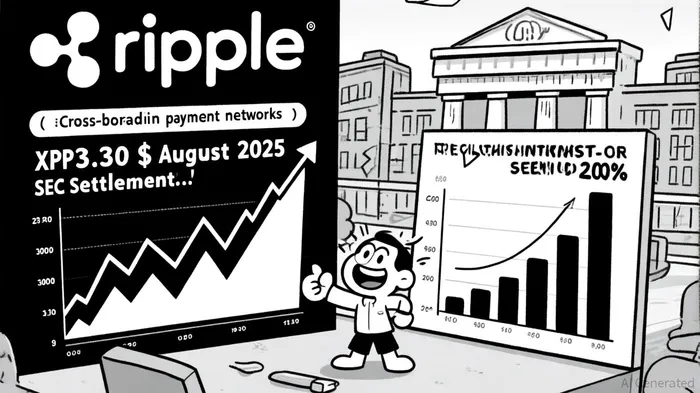
The XRPXRP-- market in 2025 exists in a paradoxical state: simultaneously buoyed by regulatory clarity and shadowed by allegations of institutional manipulation. The U.S. Securities and Exchange Commission's (SEC) August 2025 settlement with Ripple Labs—ending a four-year legal battle—has redefined XRP's legal status in the U.S., confirming that tokens traded on public exchanges are not securities [3]. This development has catalyzed a 55% price rally, with XRP breaching $3.30 and attracting renewed institutional interest [1]. Yet beneath this optimism lies a web of asymmetrical access and opaque market dynamics that could either accelerate XRP's adoption or entrench its volatility.
Regulatory Clarity as a Double-Edged Sword
The SEC's resolution has removed a critical overhang, enabling Ripple to pivot toward cross-border payment solutions and stablecoin innovation. Ripple's CEO, Brad Garlinghouse, has emphasized expanding its network of partners, including a recent custody agreement with BBVA in Spain [1]. This focus on utility—rather than speculative trading—aligns with broader trends in institutional crypto adoption. However, the settlement's terms, which included a $125 million fine, have not fully resolved concerns about regulatory arbitrage. For instance, while U.S. exchanges can now list XRP without securities liability, global markets remain fragmented, creating opportunities for selective market access by well-connected institutions [3].
The Shadow of Market Suppression
A contentious claim circulating in the XRP community suggests that CoinbaseCOIN--, one of the largest U.S. exchanges, may be suppressing XRP's price. Community member Stern Drew has highlighted a 0.87 correlation between Coinbase's XRP outflows and the token's repeated failure to break the $1.20 resistance level [1]. According to this theory, Coinbase allegedly executes strategic sales during low-liquidity hours and routes transactions through multiple wallets to obscure the source. If true, such tactics would represent a form of asymmetrical access, where institutional actors or affiliated entities benefit from price suppression. Ripple's CTO, David Schwartz, has dismissed these allegations, attributing XRP's price action to broader market forces [1]. However, the lack of regulatory scrutiny into these claims leaves room for skepticism.
Red Flags and Institutional Leverage
Recent on-chain data raises further questions. XRP inflows into Binance reached an all-time high in September 2025, potentially signaling accumulation by large players [3]. Simultaneously, the Total Value Locked (TVL) on the XRP Ledger (XRPL) has declined, reflecting waning interest in decentralized finance (DeFi) applications [3]. This divergence—between institutional accumulation and retail disengagement—highlights a growing asymmetry in market participation. Additionally, Google Trends data shows a sharp drop in public interest, suggesting that retail investors may be exiting the asset [3].
Asymmetrical Access and the Future of XRP
The interplay between institutional leverage and retail sentiment will likely define XRP's trajectory. Ripple's RLUSD stablecoin and cross-border payment solutions offer tangible utility, but their success hinges on adoption in high-cost corridors. Meanwhile, competition from stablecoins like USDCUSDC-- and emerging central bank digital currencies (CBDCs) could erode XRP's market share [1]. For investors, the key risk lies in the concentration of control: if a handful of institutions or exchanges dictate XRP's liquidity and price, retail investors face a significant disadvantage.
Conclusion: Navigating the Gray Zone
XRP's post-SEC landscape is a study in contrasts. Regulatory clarity has unlocked new opportunities, yet the specter of market suppression and asymmetrical access persists. For investors, the challenge lies in balancing optimism about XRP's utility with caution regarding its exposure to institutional influence. As Ripple's CEO has noted, the company's focus remains on product development rather than speculative hype [2]. However, until transparency around market practices improves, XRP will remain a high-risk, high-reward asset for those willing to navigate its gray zone.






Comentarios
Aún no hay comentarios