
The Hidden Risks of Leverage in Crypto Derivatives: Lessons from Recent $20+ Billion in Liquidations
The crypto derivatives market has long been a double-edged sword: a tool for hedging risk and a weapon for amplifying it. In 2025, this duality reached a boiling point when $150 billion in forced liquidations destabilized the entire ecosystem, exposing the systemic fragility of a market built on leverage and crowded positioning. This wasn't just a crash-it was a wake-up call for investors, regulators, and infrastructure providers to confront the structural flaws in how crypto derivatives are designed, traded, and managed.
The Leverage Overload: A System Built on Thin Ice
Crypto derivatives, particularly perpetual swaps, have become the dominant mechanism for price discovery in digital assets. By year-end 2025, the notional volume of these contracts had surged to $86 trillion, with open interest peaking at $235.9 billion before collapsing to $145.1 billion. This staggering scale is driven by leverage-often 50x or higher-that allows traders to control massive positions with minimal capital. But leverage is a magnifier, not just of gains, but of losses.
When macroeconomic shocks hit-such as President Trump's 100% tariff announcement on Chinese imports in October 2025-the market's overreliance on leverage turned a risk-off environment into a freefall. Spot prices plummeted, triggering margin calls and automated liquidations. The problem? These liquidations weren't isolated. They created a feedback loop: falling prices → forced selling → further price declines.
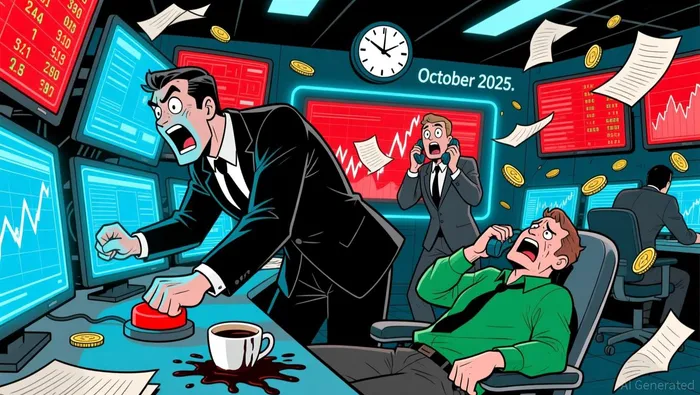
This is the crux of the issue: derivatives infrastructure is not designed for systemic stress. When leverage is concentrated in crowded long positions (as it was in October 2025), a single catalyst can unravel the entire stack. The result? A $150 billion liquidation event that wasn't just a market correction but a structural failure.
Lessons for Investors: Beyond the Hype
For retail and institutional investors alike, the 2025 crash offers three critical lessons:
1. Leverage is a liability multiplier: The notional value of derivatives often dwarfs the underlying asset's market cap. In crypto, this creates a system where price movements are driven by margin calls, not fundamentals.
2. Diversification is a myth in crowded markets: When 80% of open interest is in perpetual swaps with similar leverage ratios, a downturn becomes a domino effect.
3. Infrastructure must evolve: ADL and other risk-management tools need to be reengineered for systemic resilience-not just individual account safety.
The Path Forward: Building a Robust Ecosystem
The 2025 liquidation event isn't an indictment of crypto derivatives but a call to rebuild them. This means:
- Capping leverage to reduce systemic exposure.
- Strengthening liquidity buffers to absorb shocks.
- Decentralizing risk management to avoid single points of failure.
As the market matures, participants must recognize that leverage isn't a feature-it's a vulnerability. The $150 billion wiped out in 2025 wasn't just capital; it was a warning. Ignoring it would be the ultimate risk.







Comentarios
Aún no hay comentarios