
The Hidden Risk in SCHD: Overconcentration in Just 3 Sectors
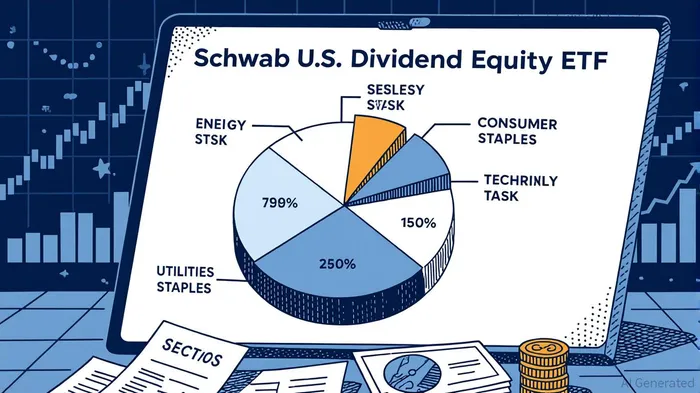
The Schwab U.S. Dividend Equity ETF (SCHD) has long been a favorite among income-focused investors for its high yield and focus on dividend-paying equities. As of Q3 2025, the fund's top three sectors—energy (19.2%), consumer staples (18.8%), and healthcare (15.6%)—account for over 53% of its total assets. While this concentration in defensive, high-yield sectors has historically delivered steady returns, it also exposes investors to significant risks in a macroeconomic environment marked by rising interest rates and sector-specific volatility.
The Case for Sector Concentration
SCHD's strategy is built on the premise that large-cap, dividend-paying companies in stable sectors can provide reliable income with lower volatility. Energy and consumer staples, for instance, are traditionally less sensitive to economic cycles than sectors like technology or industrials. Companies like ChevronCVX-- (CVX), PepsiCoPEP-- (PEP), and AltriaMO-- (MO) are staples of the fund, offering predictable cash flows and long histories of dividend growth. Healthcare, represented by AbbVieABBV-- (ABBV) and MerckMRK-- (MRK), further reinforces this defensive positioning.
However, this approach comes with a critical trade-off: overconcentration. The fund's top 10 holdings alone make up 41.24% of its portfolio, and its three largest sectors collectively dominate the allocation. While diversification is not inherently a virtue, the lack of balance in SCHD's sector exposure creates vulnerabilities that could undermine its long-term appeal.
Risks in a High-Rate Environment
Rising interest rates, a persistent theme in 2025, amplify the risks of sector concentration. Energy, for example, is cyclical and sensitive to commodity prices. A sharp drop in oil prices—driven by geopolitical tensions or a global economic slowdown—could erode the value of Chevron and ConocoPhillipsCOP-- (COP), which together account for 8.6% of the fund. Similarly, consumer staples, while defensive, face margin pressures from input costs and shifting consumer preferences.
Healthcare, though resilient, is not immune to regulatory headwinds. For instance, drug pricing reforms or reimbursement cuts could impact AbbVie's revenue, which is critical to the fund's dividend stream. Meanwhile, utilities—often a cornerstone of diversified dividend portfolios—are underrepresented in SCHD. Utilities typically offer stable yields and low volatility, yet the fund's exposure to this sector is minimal, leaving it less insulated from rate-driven market stress.
The Diversification Dilemma
SCHD's lack of diversification becomes more pronounced when compared to alternatives like the InvescoIVZ-- S&P 500 High Dividend Low Volatility ETF (SPHD). SPHD, for example, allocates 13.65% to utilities, a sector that thrives in high-rate environments due to its stable cash flows and low beta. By contrast, SCHD's negligible utility exposure limits its ability to hedge against interest rate risks.
Moreover, the fund's heavy reliance on energy and consumer staples creates a single-point-of-failure risk. If one of these sectors underperforms—say, due to a regulatory crackdown on fossil fuels or a shift in consumer spending—SCHD's returns could lag significantly behind broader market benchmarks. This is particularly concerning in a world where ESG (Environmental, Social, Governance) investing is reshaping capital flows.
Is SCHD Still a Core Holding?
For investors prioritizing passive income sustainability, SCHD's current structure raises questions. While its 3.72% yield is attractive, the fund's sector concentration could lead to uneven performance during macroeconomic shifts. For example, during the 2020 market crash, SCHD's energy-heavy portfolio suffered a -21.55% three-month return, far worse than the S&P 500's -12.8%.
To mitigate these risks, investors should consider rebalancing toward more diversified dividend strategies. A blended approach—pairing SCHD with ETFs like SPHD or the Vanguard High Dividend Yield ETF (VHY)—could provide broader sector coverage while maintaining yield. For instance, SPHD's 13.65% utility allocation and lower energy exposure (9.8%) offer a counterbalance to SCHD's overconcentration.
Conclusion: Balancing Yield and Resilience
SCHD remains a compelling option for income-focused investors, but its overreliance on three sectors demands caution. In a high-rate environment, the fund's lack of diversification could amplify volatility and reduce its ability to weather sector-specific downturns. While its defensive positioning in consumer staples and healthcare is a strength, the absence of utilities and the cyclical nature of energy create asymmetrical risks.
For a core dividend portfolio, a more balanced approach is advisable. Investors should consider allocating a portion of their dividend holdings to ETFs with broader sector exposure, ensuring that income streams are not overly reliant on a few industries. In the long run, resilience—rather than yield alone—will define the success of a passive income strategy.





Comentarios
Aún no hay comentarios