
The Hidden QE and Bitcoin's Next Rally: A Macro-Driven Investment Case
Bitcoin has long been dubbed "digital gold," but its price movements are increasingly shaped by the same macroeconomic forces that govern traditional markets. Over the past five years, the Federal Reserve's liquidity policies-ranging from quantitative tightening (QT) to reverse repo operations-have created a tug-of-war between risk-on and risk-off sentiment. Now, as the Fed signals a shift in its balance sheet strategy, the stage is set for Bitcoin's next rally.
The Fed's Liquidity Tightrope: QT Ends, but Reverse Repos Drain Cash
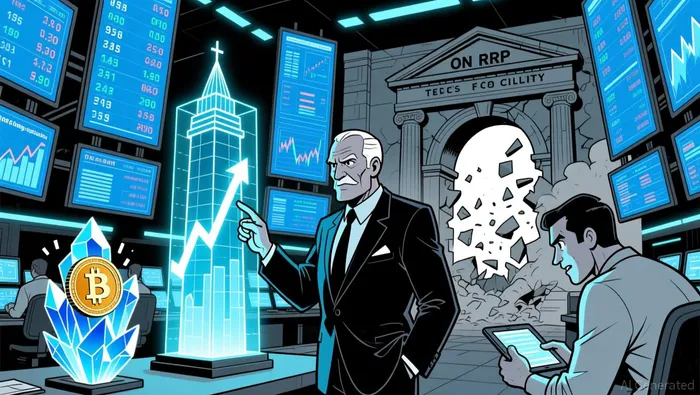
The Federal Reserve's decision to end its three-year QT program on December 1, 2025, marks a pivotal moment in its liquidity management strategy, according to Lookonchain. This move follows years of shrinking its balance sheet to combat inflation, but recent data shows the unintended consequences: bank reserves have plummeted to levels reminiscent of the 2019 liquidity crisis, and the overnight reverse repurchase (ON RRP) facility has nearly dried up, as Lookonchain notes.
However, the Fed's liquidity injections have been uneven. In October 2025, it stealthily injected $29.4 billion into the financial system via the Standing Repo Facility (SRF), a tool typically used during crises, according to Wral. This came amid a broader liquidity squeeze, as reverse repo operations-where banks park cash with the Fed-drained $75 billion from the system in late October and November 2025 alone, as Yahoo Finance reports. The result? A paradox: while the Fed is signaling long-term liquidity support, short-term funding conditions have tightened, creating confusion in markets.
Historical Precedent: When Fed Policy Drives Bitcoin's Cycles
Bitcoin's price history is a case study in how liquidity flows translate to asset prices. During the 2020–2021 period of expansive monetary policy, low interest rates and Fed-driven liquidity fueled a crypto boom. BitcoinBTC-- surged from $7,000 to nearly $65,000 as investors flocked to risk assets, according to Cryptonomist. Conversely, the 2022 tightening cycle-marked by rate hikes and QT-triggered a 60% collapse in Bitcoin's price, as capital flowed back to higher-yielding bonds, according to Cryptonomist.
The current environment mirrors these dynamics. In November 2025, Bitcoin dropped 5% despite a $37 billion liquidity injection from the Fed, as reverse repo operations siphoned cash from the system, as Yahoo Finance reports. This disconnect underscores the importance of net liquidity: while the Fed is adding cash, it's also withdrawing it through reverse repos, creating a seesaw effect.
The Opportunity Cost Equation: Why Bitcoin Rallies When Rates Fall
At the heart of this relationship is the concept of opportunity cost. When real interest rates fall, the return on U.S. Treasuries and cash becomes less attractive, pushing investors toward riskier assets like Bitcoin, as Cryptonomist explains. This dynamic was evident in 2023, when the mere threat of a Fed pause in rate hikes sparked a 30% rebound in Bitcoin, as Cryptonomist notes.
Now, with the Fed poised to end QT and cut rates in 2025, the calculus is shifting again. Cathie Wood of ARKARK-- Invest recently adjusted her Bitcoin forecast downward, citing the rise of stablecoins as a "digital dollar" in emerging markets, according to BitcoinSistemi. Yet she still views Bitcoin as a cornerstone of the new financial system-a store of value distinct from stablecoins. If ETF inflows accelerate and the Fed's liquidity rebound gains traction, Bitcoin could re-enter a risk-on phase.
The Hidden QE: Balance Sheet Expansion as a Catalyst
While the Fed isn't explicitly engaging in quantitative easing (QE), its balance sheet adjustments are functionally similar. By halting QT and using tools like the SRF, the Fed is indirectly expanding liquidity without triggering inflationary fears, as Wral notes. This "hidden QE" could be the missing ingredient for Bitcoin's next leg higher.
Larry Fink of BlackRock has warned that rising U.S. debt and dollar instability could push investors toward alternatives like Bitcoin, as CoinGape notes. If the Fed's liquidity measures succeed in stabilizing the financial system while keeping rates low, Bitcoin's role as a hedge against dollar devaluation could gain traction.
Investment Implications: Positioning for the Next Rally
The key takeaway is that Bitcoin's price is notNOT-- just a function of crypto-specific fundamentals-it's a barometer of global liquidity. As the Fed navigates this tightrope, investors should monitor three metrics:
1. Net liquidity flows (repo vs. reverse repo operations).
2. Real interest rates (which determine Bitcoin's opportunity cost).
3. ETF inflows (a proxy for institutional demand).
If the Fed's liquidity rebound continues and QT is fully reversed, Bitcoin could break out of its consolidation phase. The $63 billion in open interest from options markets suggests that volatility is already priced in, according to Lookonchain. For now, the path of least resistance appears upward-provided the Fed's hidden QE holds.






Comentarios
Aún no hay comentarios