
The Hidden Costs of Media Consolidation: How Post-Merger Integration Failures Are Eroding Shareholder Value
The Allure of Megadeals-And the Pitfalls
Between 2020 and 2025, the media and technology sectors saw a surge in deals exceeding $30 billion, with companies like GoogleGOOGL-- (a $32 billion purchase of Wiz) and Anglo American (a $800 million annual savings from its Teck Resources merger) aiming to streamline operations and boost innovation, according to a Financier Worldwide analysis. On paper, these transactions look like winners. But the reality is far messier.
Take AT&T's $85 billion acquisition of Time Warner in 2018. The deal was supposed to create a media giant capable of competing with NetflixNFLX-- and Disney+. Instead, it became a cautionary tale. HBO Max, AT&T's streaming service, struggled to gain traction, and the company eventually had to divest WarnerMedia assets for a fraction of their value, as reported by a Dealroom analysis. Shareholders lost billions, and the stock price cratered.
Integration Woes: The $200 Million Problem
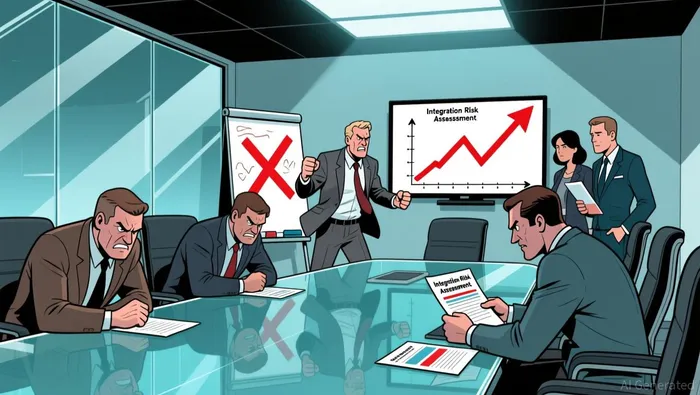
According to a Forbes analysis, 83% of failed mergers are attributed to poor integration practices. The problem isn't just about merging balance sheets-it's about merging cultures, retaining talent, and aligning leadership.
Consider Microsoft's $7.2 billion acquisition of Nokia in 2014. The deal was meant to bolster Microsoft's smartphone ambitions, but cultural clashes and misaligned strategies led to a collapse in market share, according to a Dealroom analysis. By 2016, Microsoft had written off $7.6 billion and sold the division for a fraction of its cost, as reported by a Dealroom analysis. Similarly, Google's $12.5 billion purchase of Motorola in 2012 ended in a 2014 fire sale to Lenovo for $2.9 billion, as reported by a Dealroom analysis.
McKinsey research underscores the financial toll: leadership and cultural incompatibility in M&A can lead to an average loss of $200 million in net income within three years, with some cases exceeding $600 million, according to a Forbes analysis.
Regulatory Hurdles and Shareholder Pain
Regulatory scrutiny has also intensified, with agencies like the U.S. Department of Justice and the UK Competition and Markets Authority cracking down on antitrust concerns. The failed Kroger-Albertsons merger ($25 billion) and JetBlue-Spirit Airlines deal ($3.8 billion) highlight how regulatory pushback can lead to massive financial losses, including $600 million and $69 million termination fees, respectively, according to a Medium analysis.
Even when deals go through, the aftermath can be brutal. Wood Group, an engineering and consulting firm, faced a 27.94% share price drop after revelations of "material weakness and failures" in its accounting practices, linked to its integration of legacy contracts, as reported by a Halifax Investment Research analysis.
Lessons for Investors
For investors, the message is clear: media consolidation isn't a guaranteed path to growth. While strategic acquisitions can unlock synergies, the risks of integration failures, regulatory pushback, and cultural clashes are real. The key is to scrutinize not just the financials but the human and operational elements of a merger.
Gray Media's Q3 2025 results offer a glimmer of hope. Despite a 21% revenue drop compared to 2024, the company's focus on cost-cutting and strategic acquisitions has improved its financial flexibility, according to a Financier Worldwide analysis. But such success stories are the exception, not the rule.
Conclusion
The media industry's consolidation frenzy has created both winners and losers. While some companies are leveraging megadeals to drive innovation, others are finding themselves trapped in costly integration nightmares. For shareholders, the takeaway is simple: don't be dazzled by the headline numbers. The real value lies in how well a company can navigate the messy, human side of M&A.





Comentarios
Aún no hay comentarios