
The Hidden Costs of Central Bank Bailouts: Navigating Long-Term Risks and Resilient Opportunities
Emergency central bank interventions have become a defining feature of modern financial crises, with undisclosed bailouts shaping market dynamics in ways that extend far beyond immediate stabilization. From the $700 billion Troubled Asset Relief Program (TARP) in 2008 to the Federal Reserve's direct corporate debt purchases during the 2020 pandemic, central banks have repeatedly stepped in to avert systemic collapse. Yet these interventions, while effective in short-term crisis management, carry hidden economic implications that investors must scrutinize. Behavioral economics and historical precedents reveal a complex interplay of moral hazard, policy opacity, and market distortions, creating both risks and opportunities for long-term investors.
The Historical Pattern of Bailouts and Their Economic Implications
Central bank bailouts, though often framed as necessary to prevent economic freefall, have consistently distorted market signals and eroded discipline. During the 2008 financial crisis, the Emergency Economic Stabilization Act of 2008 authorized TARP to purchase toxic assets and inject capital into banks, effectively shielding large financial institutions from the consequences of their risk-taking. Similarly, in 2020, the Fed's unprecedented corporate debt purchases allowed major corporations to access cheap financing while smaller businesses faced liquidity crunches. These actions, while stabilizing in the short term, created a feedback loop: institutions began to expect bailouts, incentivizing imprudent behavior and exacerbating wealth inequality.
Behavioral economics underscores this dynamic. When investors perceive bailouts as a safety net, they are more likely to engage in excessive risk-taking, assuming future government support. This moral hazard is compounded by policy opacity-central banks often obscure the terms of bailouts to avoid signaling guarantees, yet this ambiguity can lead to inefficient market decisions and herding behavior. For instance, during the 2008 crisis, the lack of transparency in TARP's implementation fueled uncertainty, causing market responses to weaken over time.
Resilient Asset Classes: Hedging Against Policy Uncertainty
Investors seeking to mitigate the risks of policy opacity and regulatory uncertainty must prioritize resilient asset classes. Historical data and behavioral economics provide clear guidance on which assets perform best during crises.
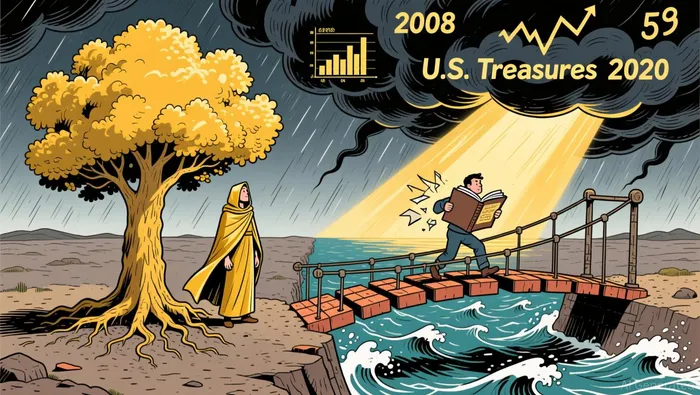
Gold: The Timeless Safe Haven Gold has consistently demonstrated its role as a hedge against inflation and policy uncertainty. During the 2008 crisis, gold prices surged over 50% in nine months, reaching $1,011 per ounce, while in 2020, prices exceeded $2,000 amid pandemic-driven uncertainty. Behavioral economics explains this resilience through the concept of risk aversion: investors shift capital to assets perceived as stable during crises, even if they offer no yield. Gold's low correlation with equities and its historical resilience during fiscal strain (e.g., the 1970s inflation era) make it a critical component of diversified portfolios. Analysts project gold to reach $3,700 or more by 2025, driven by U.S. debt refinancing challenges and inflationary pressures.
U.S. Treasuries: A Shifting Safe-Haven Dynamic U.S. Treasuries have traditionally served as a benchmark for safe assets, but their performance during recent crises reveals evolving dynamics. During the 2008 crisis, Treasuries appreciated as stock markets collapsed, reinforcing their safe-haven status. However, during the 2020 pandemic, long-term Treasury yields rose amid market turmoil, indicating a positive beta with stocks-a deviation from historical patterns. This shift reflects investor psychology: while Treasuries remain a store of value, their role as a liquidity buffer has been challenged by unconventional monetary policies, such as the Fed's $2 trillion in Treasury purchases.
REITs and Sectoral Resilience Real Estate Investment Trusts (REITs) exhibit sectoral differentiation during bailouts. For example, Industrial and Self-Storage REITs showed resilience during the 2020 pandemic, while Office REITs struggled due to remote work trends. Behavioral economics highlights how economic policy uncertainty shapes investor preferences, with sectors like Industrial REITs acting as net receivers of capital during crises.
Strategic Investment Frameworks for Policy Uncertainty
To navigate policy opacity, investors should adopt strategies that balance diversification with active risk management. Ethical assets, such as green bonds and clean energy indices, have emerged as safe havens during geopolitical and economic policy shocks. Additionally, low-volatility strategies and defensive equities are recommended to reduce correlation risk. Private markets and hedge funds further enhance resilience by offering uncorrelated returns (https://am.gs.com/en-us/advisors/insights/article/asset-management-mid-year-outlook).
Conclusion: Balancing Short-Term Stabilization and Long-Term Resilience
Central bank bailouts are a double-edged sword: they stabilize markets in the short term but risk entrenching systemic vulnerabilities. Investors must recognize that policy opacity and moral hazard are not transient issues but enduring features of the post-crisis landscape. By allocating capital to resilient asset classes like gold, U.S. Treasuries, and sector-specific REITs, investors can hedge against the hidden costs of bailouts while positioning for long-term growth. As behavioral economics reminds us, understanding the psychological and structural forces shaping market reactions is as critical as analyzing financial fundamentals.







Comentarios
Aún no hay comentarios