
The Hidden Costs of American Public Transit: Why Infrastructure Investments Are Riskier Than They Appear
The U.S. public transit sector has long been plagued by systemic inefficiencies that transform infrastructure investments into high-risk propositions. From ballooning rail project costs to inflated bus procurement prices, the sector's challenges are not merely technical but deeply rooted in procurement practices, regulatory frameworks, and market dynamics. For investors, these inefficiencies represent a critical risk factor that could erode returns and undermine the long-term viability of public transit projects.
Cost Overruns in Rail Transit: A National Crisis
According to a report by the Federal Transit Administration (FTA), U.S. rail transit projects have averaged a 40.2% cost overrun since 2003[1]. A 2020 statistical analysis of 81 projects over four decades confirmed that while early-stage cost estimates have improved, larger projects still face disproportionately higher overruns—often exceeding 100% of initial budgets[1]. The New York City Second Avenue Subway Extension, for instance, cost 8-12 times more per mile than comparable projects in Europe[1].
California's high-speed rail project epitomizes this trend, with costs soaring to $127.9 billion—a figure that dwards its original $33 billion estimate[1]. Researchers attribute these overruns to a combination of factors: inadequate megaproject management capacity, scope creep, and the labyrinthine National Environmental Policy Act (NEPA) approval process[3]. Even the FTA's 2003 risk assessment mandate, intended to curb underestimation, has failed to produce statistically significant improvements[1].
Procurement Inefficiencies: Buses as a Case Study
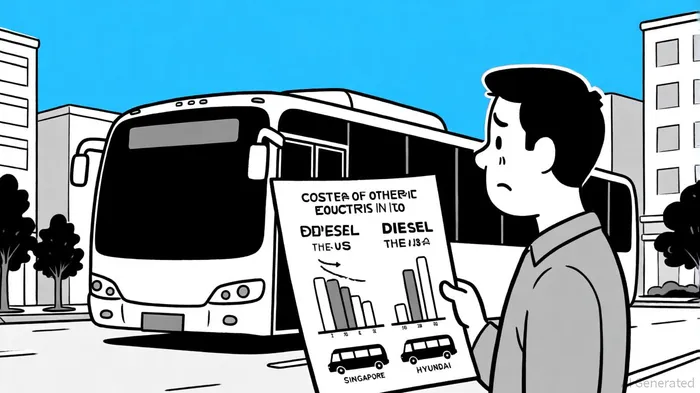
The procurement of buses reveals a parallel crisis. Despite technological advancements, U.S. bus prices remain stagnant or rising. The median cost for a diesel bus is $500,000, while electric buses now average $1.1 million—a stark contrast to global markets where electric buses can be procured for as little as $333,000 in Singapore or $350,000 from Hyundai[1].
This disparity stems from a duopoly in the U.S. market, dominated by Gillig and New Flyer, which limits competition and economies of scale[1]. Low-volume, highly customized procurements further exacerbate costs. A report by the American Enterprise Institute (AEI) notes that the U.S. market's lack of standardization and reliance on domestic production requirements—such as the Buy America Act—constrain cost reductions[1].
Systemic Challenges and Policy Implications
The root causes of these inefficiencies are systemic. First, the U.S. ranks sixth globally in rail construction costs, with 37% of lines requiring tunneling—a factor that drives up expenses[3]. Second, procurement processes often lack coordination between agencies, leading to fragmented decision-making and delayed timelines[3]. Third, the absence of a robust risk-mitigation culture—despite the FTA's 2003 reforms—means that cost underestimation remains entrenched[1].
For investors, these challenges translate into heightened risks. Projects with inflated budgets and delayed timelines strain public-private partnerships and increase the likelihood of cost overruns spilling into taxpayer-funded bailouts. A 2025 update from the Transit Costs Project underscores that U.S. rail projects are 3-4 times more expensive than those in China or India, even after accounting for complexity[2].
Recommendations for Mitigating Risk
Addressing these inefficiencies requires a multi-pronged approach. Researchers from the University of California, Berkeley, recommend forming regional collaboratives to maintain permanent expertise in megaproject management[3]. Alternative procurement methods, such as construction manager/general contractor (CMGC/CMAR) models, could also reduce delays by aligning incentives between agencies and contractors[3].
On the federal level, streamlining NEPA processes and adjusting Buy America requirements to allow for cost-effective imports—particularly for electric buses—could alleviate pressure on budgets[1]. Standardized joint purchases, as proposed by AEI, would further drive down costs by leveraging collective bargaining power[1].
Conclusion
The U.S. public transit sector's procurement inefficiencies are not just a fiscal issue but a structural one. For investors, the implications are clear: infrastructure projects in this space carry elevated risks due to systemic underestimation, regulatory bottlenecks, and market fragmentation. Without meaningful reforms, the sector will continue to underperform relative to global peers, deterring private capital and straining public resources. However, targeted policy interventions—rooted in data-driven procurement strategies and international best practices—could recalibrate the risk-reward balance, making U.S. transit investments more viable in the long term.







Comentarios
Aún no hay comentarios