
The Hidden Cost of Bank Fees and the Rise of Fintech Alternatives
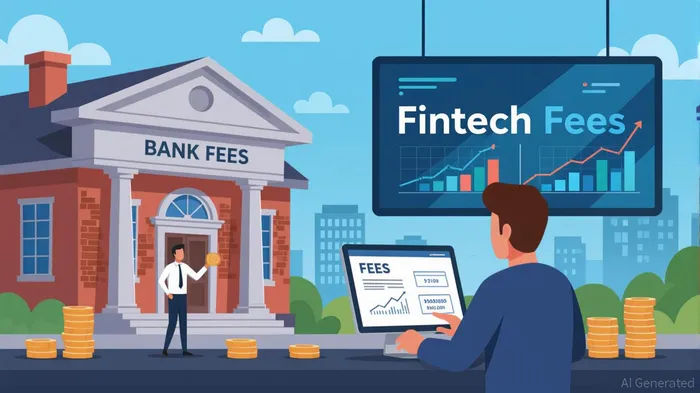
The financial services industry is at a crossroads. Traditional banks, long criticized for opaque fee structures, face mounting pressure to adapt as consumers increasingly turn to fintech solutions that prioritize transparency and cost efficiency. While precise 2025 data on average bank fees remains elusive, broader trends suggest that the cumulative impact of traditional banking costs—monthly maintenance fees, overdraft charges, and ATM fees—continues to erode consumer wealth over time. Meanwhile, fintech innovations are not only addressing these pain points but also creating compelling investment opportunities in AI, cybersecurity, and sustainability.
The Long-Term Financial Impact of Traditional Bank Fees
Traditional banks have historically relied on fee-based revenue models to offset declining interest margins. Monthly maintenance fees, often ranging from $10 to $30 per account, can accumulate to hundreds of dollars annually for households with multiple accounts or low balances[1]. Overdraft charges, which average $35 per transaction[2], further compound costs for consumers who lack access to real-time financial management tools. ATM fees, particularly for out-of-network withdrawals, add another layer of expense, with some institutions charging up to $5 per transaction[3].
While these figures are based on pre-2024 data, the Future of Jobs Report 2025 notes that banks are under pressure to streamline fee structures to retain customers in a digital-first era[4]. However, the long-term financial burden remains significant, especially for low-income households. A 2024 World Economic Forum analysis highlights that such fees disproportionately affect vulnerable populations, exacerbating wealth inequality[5].
Fintech Alternatives: Disrupting the Status Quo
Fintech platforms are redefining banking by leveraging technology to reduce operational costs and pass savings to consumers. Digital banks, for instance, often eliminate monthly maintenance fees by operating with lower overheads compared to traditional institutions[6]. AI-driven tools further enhance value by offering real-time budgeting insights, automated savings features, and predictive alerts to avoid overdrafts[7].
Blockchain-based payment systems and decentralized finance (DeFi) platforms are also gaining traction, offering fee transparency and reduced transaction costs. For example, cross-border payments that traditionally incurred 5–10% fees can now be executed at near-zero costs via blockchain networks[8]. These innovations align with global priorities for equity and sustainability, as emphasized by the World Economic Forum.
Investment Opportunities in Fintech
The fintech sector's growth is attracting capital from investors seeking high-impact opportunities. Key areas of focus include:
1. AI-Driven Financial Tools: Over 91% of financial firms are integrating AI to enhance efficiency and customer experiences. Platforms like MarketSenseAI, which uses generative AI for stock selection, have demonstrated outperformance against benchmarks.
2. Cybersecurity: As fintech systems adopt cloud infrastructure and AI, the demand for robust security solutions is surging. AI-powered fraud detection and zero-trust frameworks are critical for mitigating risks.
3. Sustainable Fintech: Green loans, carbon-tracking platforms, and eco-friendly cryptocurrencies are reshaping financial practices. Open banking initiatives and blockchain-based carbon offsetting are enhancing transparency in sustainability efforts.
Conclusion
While traditional bank fees remain a hidden drag on consumer wealth, fintech solutions are not only addressing these inefficiencies but also unlocking new investment horizons. As automation and AI reshape the financial landscape, investors who prioritize innovation and sustainability are well-positioned to capitalize on the sector's transformative potential. The future of finance lies in balancing technological advancement with equitable access—a vision that fintech is uniquely equipped to realize.







Comentarios
Aún no hay comentarios