
Hewlett Packard Enterprise’s Q3 Earnings: A Glimpse into Long-Term Momentum and Competitive Resilience
Hewlett Packard Enterprise (HPE) delivered a mixed performance in its fiscal third-quarter 2025 earnings report, showcasing strengths in revenue growth and segment-specific innovation while facing headwinds in guidance and margin pressures. For investors, the key question remains: Can HPEHPE-- sustain its long-term earnings momentum in a fiercely competitive AI/server market, particularly against rivals like DellDELL-- Technologies?
Q3 Earnings: Outperforming Estimates, But Guidance Casts Shadows
HPE reported Q3 earnings of $0.44 per share, surpassing both the Zacks Consensus Estimate of $0.43 and Wall Street’s $0.42 projection [1]. Revenue climbed to $9.1 billion, exceeding the $8.84 billion forecast [1]. These results highlight HPE’s ability to capitalize on demand for hybrid cloud solutions and edge computing, particularly in its Networking segment, which saw a 54% year-over-year revenue surge [5]. However, the stock fell 2.7% in after-hours trading after HPE issued revenue guidance of $9.7–$10.1 billion for the current quarter, falling short of the $10.1 billion Wall Street target [1]. This discrepancy underscores lingering concerns about margin pressures in its core server business and the challenges of scaling AI-related server revenue amid intensified competition.
Historical Momentum: A Decade of Steady Growth
Over the past five years, HPE has demonstrated consistent revenue growth, with annual revenue reaching $30.127 billion in 2024—a 3.4% increase from 2023 [1]. This follows a trajectory of 2.24% growth in 2023 and 2.56% in 2022, reflecting resilience in a volatile tech landscape. Earnings per share (EPS) have been more volatile, with a 25.32% jump to $1.93 in 2024 but a sharp 74.42% decline in 2022 [2]. Despite these fluctuations, HPE’s average annual EPS growth of 21% over five years outpaces the tech industry’s 14.8% [3], suggesting a strong underlying earnings model.
Competitive Positioning: Navigating the AI/Server Arms Race
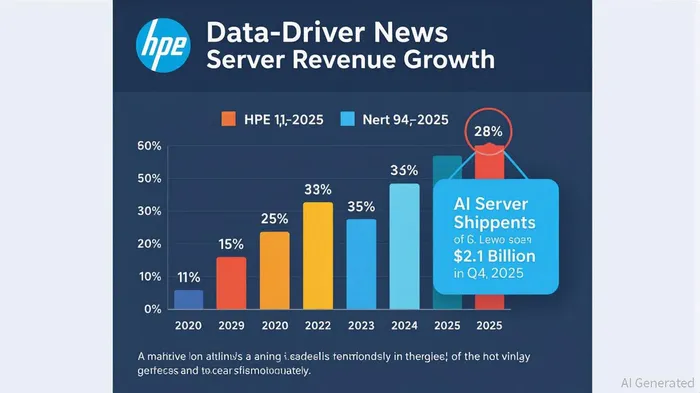
The AI/server market is a critical battleground for HPE. Dell TechnologiesDELL-- currently holds a 19.3% global server market share, driven by AI-optimized servers like the PowerEdge XE9680L and partnerships with NVIDIANVDA-- [1]. HPE, with a 13% share, has shown robust growth, reporting a 29% increase in server revenue in Q1 2025, fueled by hybrid cloud and high-performance computing [1]. HPE’s ProLiant server line and GreenLake cloud platform have driven $4.3 billion in server revenue for the quarter, a 30% year-over-year increase [2].
However, HPE faces margin pressures in its core server business, a challenge shared by Dell and other competitors. Both companies are investing in advanced cooling technologies—Dell’s Powercool eRDHx and HPE’s direct liquid cooling systems—to meet the thermal demands of AI workloads [2]. HPE’s recent $14 billion acquisition of Juniper Networks, completed on July 2, 2025, is expected to bolster its networking capabilities and long-term profitability [5], but integration risks and synergies will need to be closely monitored.
Long-Term Outlook: Can HPE Outperform Expectations?
HPE’s ability to outperform expectations hinges on three factors:
1. AI Server Adoption: The AI server market is projected to grow from $167.2 billion in 2025 to $1.56 trillion by 2034 at a 28.2% CAGR [3]. HPE’s focus on high-performance servers and edge computing positions it to capture a share of this growth, but Dell’s first-mover advantage in AI-optimized hardware remains a hurdle.
2. Margin Management: HPE must address margin pressures in its core server business while scaling higher-margin segments like Networking. The Juniper acquisition could provide a catalyst, but integration costs may weigh on short-term profitability.
3. Guidance Realism: The Q3 guidance shortfall highlights the need for more conservative forecasting. If HPE can align expectations with its execution capabilities, it may regain investor confidence.
Conclusion: A Cautious Bull Case
HPE’s Q3 results and historical growth trajectory suggest a company with durable earnings momentum and innovation in high-growth areas like Networking and AI. However, the stock’s post-earnings decline and guidance shortfall underscore the need for caution. Investors should monitor HPE’s ability to integrate Juniper, manage server margins, and capitalize on the AI server boom. While Dell’s market leadership remains formidable, HPE’s strategic investments and 21% average EPS growth over five years [3] position it as a compelling long-term play—if it can navigate near-term challenges.
Source:
[1] Hewlett PackardHPE-- Enterprise Revenue 2013-2025 | HPE, [https://www.macrotrends.net/stocks/charts/HPE/hewlett-packard-enterprise/revenue]
[2] Hewlett Packard Enterprise EPS - Earnings per Share ..., [https://www.macrotrends.net/stocks/charts/HPE/hewlett-packard-enterprise/eps-earnings-per-share-diluted]
[3] AI Server Market Size & Share, Statistics Report 2025-2034 [https://www.gminsights.com/industry-analysis/ai-server-market]





Comentarios
Aún no hay comentarios