
Hess Midstream LP's Updated Guidance: A Strategic Playbook for Midstream Resilience in 2025
The midstream energy sector is navigating a complex landscape in 2025, marked by high inflation, regulatory headwinds, and shifting capital priorities. Against this backdrop, Hess MidstreamHESM-- LP's updated guidance offers a compelling case study in strategic adaptability. By aligning its capital discipline, operational resilience, and shareholder return framework with broader industry trends, the company is positioning itself as a bellwether for midstream investors seeking stability in uncertain times.
Hess Midstream's 2025 Guidance: Balancing Growth and Prudence
Hess Midstream has revised its 2025 financial and operational targets to reflect evolving conditions. For the year, the company now expects full-year net income of $715 million to $765 million and Adjusted EBITDA of $1.235 billion to $1.285 billion, translating to a robust Gross Adjusted EBITDA Margin of approximately 75% [1]. These metrics underscore the company's ability to maintain profitability despite downward adjustments to gas gathering and processing volumes, which were revised to 455–465 million cubic feet per day and 440–450 million cubic feet per day, respectively, due to weather-related disruptions and maintenance [2].
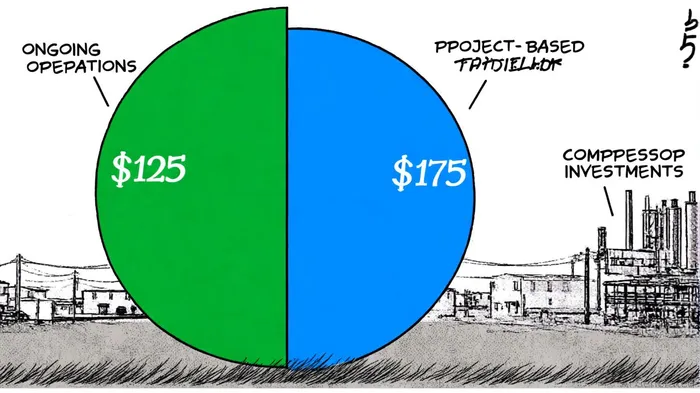
The revised guidance highlights Hess Midstream's capital allocation strategy. In 2025, the company plans to spend $300 million on capital projects, with $125 million directed toward ongoing operations (e.g., well connections and maintenance) and $175 million earmarked for greenfield initiatives, including high-pressure gathering pipelines, two new compressor stations, and a gas processing plant expected to come online in 2027 [1]. This phased approach balances near-term operational needs with long-term infrastructure development, a critical strategy in an era where aging midstream assets and permitting delays are top industry concerns [3].
Strategic Implications for Midstream Investors
Hess Midstream's updated guidance aligns with broader sector trends that favor fee-based business models and disciplined capital deployment. According to a report by Morgan StanleyMS--, midstream MLPs are increasingly seen as inflation hedges due to their exposure to U.S. natural gas production and exports, which are driven by global supply constraints and surging demand from AI data centers [4]. Hess's focus on gas infrastructure—particularly its 125 million cubic feet per day gas processing plant—positions it to capitalize on these structural tailwinds.
Moreover, the company's Return of Capital framework, extended through 2027, targets annual distribution growth of at least 5% per Class A share [1]. This commitment to shareholder returns is particularly attractive in a high-inflation environment, where investors seek income-generating assets with predictable cash flows. Hess's ability to maintain distribution growth despite revised volume projections reflects the strength of its fee-based contracts and operational flexibility—a contrast to peers reliant on commodity price swings.
Navigating Industry Challenges with Scenario Planning
The midstream sector faces headwinds, including regulatory uncertainty, permitting delays, and inflation-driven cost pressures. Hess Midstream's revised 2026 and 2027 guidance—lower capital spending due to the suspension of the Capa gas plant project and shifting rig activity [2]—demonstrates a proactive approach to scenario planning. By deferring non-essential projects and prioritizing high-impact infrastructure, the company mitigates exposure to stranded assets and aligns with industry best practices for long-term resilience [5].
This strategic flexibility is further reinforced by Hess's deleveraged balance sheet. With debt/EBITDA ratios for midstream operators declining from 5.6 in 2021 to 4.35 by early 2025 [4], the company has the financial capacity to navigate macroeconomic volatility while funding growth initiatives. For investors, this underscores the importance of selecting midstream assets with strong credit profiles and capital discipline.
Investment Takeaways
Hess Midstream's updated guidance offers three key lessons for midstream investors:
1. Prioritize Infrastructure-Linked Growth: Companies investing in greenfield projects (e.g., pipelines, processing plants) are better positioned to benefit from U.S. natural gas demand and global export trends.
2. Embrace Capital Prudence: Disciplined capital allocation—balancing maintenance spending with strategic projects—ensures resilience amid inflationary pressures and regulatory uncertainty.
3. Leverage Fee-Based Models: Assets with fixed-fee contracts and inflation escalators provide stable cash flows, reducing exposure to commodity price volatility.





Comentarios
Aún no hay comentarios