
Is Hesai Group (HSAI) Undervalued Amid Surging LiDAR Demand and Strategic Partnerships?
The question of whether Hesai GroupHSAI-- (HSAI) is undervalued hinges on a delicate balance between its explosive growth in the lidar market, strategic alliances with industry leaders, and the risks of margin compression and client concentration. As the lidar industry accelerates toward mainstream adoption in autonomous driving and robotics, Hesai's recent financial performance and partnerships suggest a compelling case for investors, though caution is warranted.
Valuation Analysis: A Premium with Justification
Hesai's stock has surged 81.57% over the past year, closing at $24.21 recently, and currently trades 11.3% below analysts' fair value estimate of $26.80. While its trailing price-to-earnings (P/E) ratio of 61.23 appears lofty, this premium is partially offset by a forward P/E of 41.12 and a projected 30.17% annual earnings growth rate. The company's profitability, which turned positive in 2025 with a net income of $60.35 million and a 15.64% profit margin, further supports its valuation. Analysts have assigned a "Strong Buy" consensus rating, with an average price target of $31.58-17.88% above the current price.
However, Hesai's enterprise value to EBITDA ratio of 68.53 raises questions about whether its valuation is fully justified by near-term cash flows. This multiple is high by traditional standards but aligns with the aggressive growth trajectories typical of disruptive tech firms. For investors willing to bet on lidar's role in the autonomous future, the premium may be warranted.
Growth Drivers: Strategic Partnerships and Market Expansion
Hesai's growth is underpinned by its dominance in the lidar supply chain and strategic partnerships. The company secured exclusive design wins for Li Auto's next-generation assisted driving platform, a critical step in cementing its position in the automotive sector. Additionally, a $40 million lidar supply deal with a robotaxi firm and collaborations with global players like Pony.ai, JD Logistics, and Motional highlight its expanding footprint in robotics and autonomous mobility.
The partnership with Nvidia is particularly transformative. Hesai's ETX lidar has been integrated into Nvidia's DRIVE Hyperion 10 platform, a reference architecture for Level 4 autonomous vehicles. This collaboration, which began in 2019, positions Hesai as a key enabler of AI-driven perception systems, aligning it with Nvidia's leadership in the AI chip ecosystem. While specific financial terms of the partnership remain undisclosed, the strategic value is clear: Hesai's lidars are now embedded in a platform that could redefine autonomous driving standards.
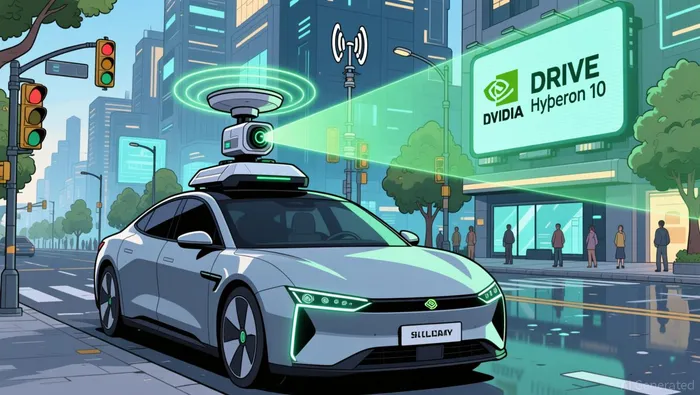 Morgan Stanley's inclusion of Hesai in its "Humanoid Tech 25" list further underscores its technological leadership, particularly in 3D perception for robotics and embodied AI. This recognition, coupled with Hesai's 46% market share in the ADAS lidar segment in August 2025, reinforces its competitive moat.
Financial Performance: Profitability and Scalability
Hesai's Q3 2025 results illustrate its scalability. The company reported quarterly net revenues of $111.7 million, a 47.5% year-over-year increase, driven by 441,398 lidar units shipped-a 228.9% surge. ADAS lidar shipments alone rose 193.1% to 380,759 units, while Robotics lidar shipments exploded by 1,311.9% to 60,639 units. These figures reflect not only strong demand but also Hesai's ability to scale production, with plans to double annual capacity to over four million units by 2026.
The company's financial health is robust, with $1.03 billion in cash and a debt-to-equity ratio of 0.09. Its gross margin of 41.34% suggests pricing power, though operating margins at 6.31% hint at pressures from aggressive capacity investments.
Risks: Margin Pressures and Client Concentration
Client concentration is another concern. Hesai's top two ADAS customers account for a substantial portion of its revenue, and its 100% lidar adoption across these customers' 2026 models raises dependency risks. A shift in order patterns or pricing demands from these clients could disrupt growth. Similarly, while Hesai's partnerships with robotaxi firms are promising, the sector's nascent stage means demand could be volatile.
Conclusion: A High-Conviction Bet with Caveats
Hesai Group appears undervalued relative to its growth potential and strategic positioning in the lidar industry. Its partnerships with Li Auto, Nvidia, and robotaxi firms, combined with a surge in shipments and profitability, justify a premium valuation. However, investors must weigh these positives against risks such as margin pressures and client concentration. For those comfortable with the company's long-term vision and its role in the autonomous driving revolution, HSAIHSAI-- offers a compelling opportunity-but one that demands close monitoring of execution and market dynamics.





Comentarios
Aún no hay comentarios