
Hemi's Token Generation Event: A Strategic Launchpad for Institutional Investors
In 2025, the cryptocurrency landscape is witnessing a pivotal shift as institutional investors increasingly seek exposure to blockchain projects with robust token economics and regulatory-ready infrastructure. Among the most promising candidates is Hemi, a modular BitcoinBTC-- Layer 2 network poised to redefine programmability on the Bitcoin blockchain. With its Token Generation Event (TGE) on the horizon, Hemi's tokenomics and market readiness strategies present a compelling case for institutional participation.
Tokenomics: Balancing Utility, Incentives, and Long-Term Value
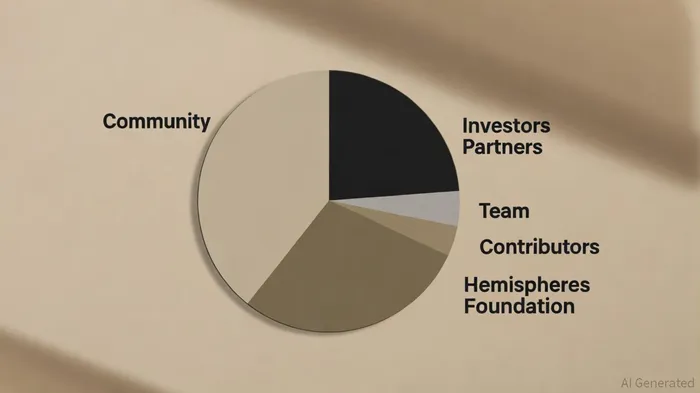
Hemi's native token, HEMI, is designed to serve as the backbone of its ecosystem, enabling governance, staking, and cross-chain liquidity. According to a report by CoinpulseHQ, the total supply of 10 billion HEMI tokens is allocated as follows: 32% to the community and ecosystem, 28% to investors and strategic partners, 25% to the team and core contributors, and 15% to the Hemispheres Foundation [1]. This distribution prioritizes community-driven growth, with incentives for developers, liquidity providers, and early adopters.
The token's utility extends beyond governance. HEMI is integral to the network's Proof-of-Proof (PoP) consensus mechanism, where validators stake tokens to submit state commitments to the Bitcoin mainnet, ensuring security and composability [2]. Additionally, the token facilitates transaction fees, cross-chain staking, and access to DeFi protocols like Lorenzo and Spectra, which offer yield generation on Bitcoin (BTC) and liquid staking tokens (LSTs) [2].
While explicit inflationary or deflationary mechanisms for HEMI are not detailed in available sources, the project's tokenomics align with hybrid models observed in successful tokens like EthereumETH-- (ETH) and Binance Coin (BNB). For instance, Hemi's structured vesting schedules—36 months with a 12-month cliff for team and investor allocations—mitigate short-term sell pressure, promoting long-term value retention [1]. Furthermore, the Hemispheres Foundation's 15% allocation may fund token buybacks or ecosystem grants, indirectly introducing deflationary pressures.
Market Readiness: Partnerships, Funding, and Regulatory Alignment
Hemi's market readiness is underscored by its $30.6 million in total funding, including a $15 million pre-TGE round led by YZi Labs (Binance Labs) and Republic DigitalRDAG-- [2]. These funds are earmarked for scaling Bitcoin Layer 2 infrastructure and developing over 90 protocols, including DeFi lending platforms and cross-chain bridges. The project's partnerships with HoudiniSwap, Orbiter Finance, and Gearbox further enhance its appeal, enabling seamless BTCFi access, trustless cross-chain transfers, and yield compounding strategies [3].
Regulatory compliance is another cornerstone of Hemi's institutional readiness. As noted in a Halborn blog post, the project is navigating evolving regulations like the EU's DORA and NIS2, which emphasize third-party risk management and cybersecurity [3]. By aligning with these frameworks, Hemi positions itself to attract institutional capital wary of regulatory uncertainties. Additionally, the project's integration with institutional-grade custody solutions and compliance tools—such as those developed by CircleCRCL-- and Paxos—addresses security and operational resilience concerns [4].
Strategic Implications for Institutional Investors
For institutional investors, Hemi's TGE represents a strategic entry point into a Bitcoin-centric ecosystem with strong utility and scalability. The token's community-driven allocation (32%) and vesting schedules ensure sustained demand, while its role in DeFi and LSTs taps into growing institutional interest in yield-generating BTCBTC-- strategies. Analysts project the token could debut at $0.05, with long-term potential reaching $1, driven by adoption in Bitcoin-native applications [2].
Moreover, Hemi's focus on Bitcoin programmability aligns with macro trends. As the U.S. formalizes its Strategic Bitcoin Reserve and ETFs drive institutional BTC adoption, Hemi's modular architecture offers a bridge between Bitcoin's security and Ethereum's programmability—a niche with limited competition. The project's airdrop campaigns, including a 200 million HEMI distribution via Binance's Wallet Booster Event, further incentivize early participation [2].
Conclusion
Hemi's Token Generation Event is more than a token launch—it is a calculated move to position Bitcoin at the center of a programmable, institutional-grade DeFi ecosystem. With a balanced tokenomics model, strategic partnerships, and regulatory foresight, the project addresses key pain points for institutional investors: liquidity, utility, and compliance. As the crypto market matures, Hemi's TGE offers a rare opportunity to invest in a project that bridges the gap between Bitcoin's dominance and the innovation of decentralized finance.






Comentarios
Aún no hay comentarios