
Helius Medical Technologies' $500M Private Placement and Strategic Growth Potential
Helius Medical Technologies' $500 million private placement in September 2025 represents a bold pivot into blockchain-based capital allocation, leveraging Solana's high-throughput ecosystem to generate yield. This move, led by Pantera Capital and Summer Capital, raises critical questions about capital efficiency and long-term value creation in a medtech sector still reeling from years of fundraising volatility.
Capital Allocation Efficiency: A Blockchain-Driven Experiment
Helius' decision to allocate proceeds toward a Solana-focused treasury is unconventional for a medtech firm. Solana's 7% staking yield—a stark contrast to Bitcoin's non-yield-bearing model—positions the company to generate passive income while aligning with blockchain's institutional adoption trends [1]. By acquiring SOL, HeliusHSDT-- taps into a network with over 1.5 million daily active wallets, suggesting scalability and utility beyond speculative trading [1].
However, the capital structure introduces dilution risks. The offering includes stapled warrants exercisable at $10.134 per share, exercisable for three years, which could dilute existing shareholders if exercised in full. Yet, the involvement of high-quality institutional investors—such as Animoca Brands and HashKey Capital—signals confidence in Helius' strategic pivot [1]. This contrasts with the MedTech sector's broader struggles: total industry financing hit an eight-year low of $27.5 billion in June 2024, driven by cautious VC activity and historically low M&A deals [2].
MedTech Industry Context: A Sector in Transition
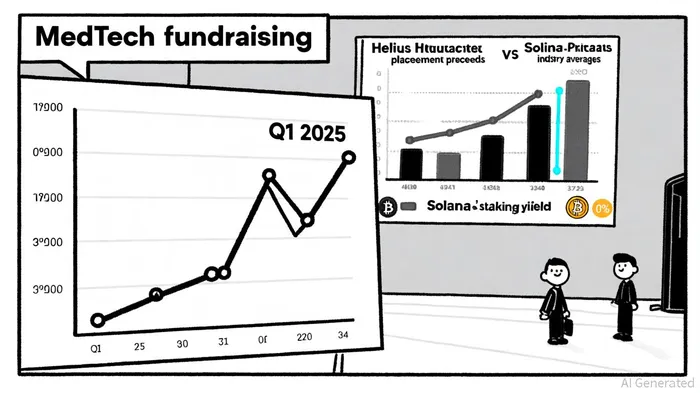
The MedTech sector's capital allocation benchmarks highlight both challenges and opportunities. From 2022 to mid-2024, fundraising plummeted as VCs prioritized profitability over growth-at-all-costs models. Yet, Q1 2025 saw a 47% year-over-year rebound, with $18 billion in funding, driven by 26 companies securing $100 million+ in rounds [2]. Helius' $500M raise, while smaller in scale, aligns with this recovery but diverges in execution by targeting blockchain rather than traditional medtech R&D or M&A.
This divergence is notable. Most MedTech firms allocate capital to product development, regulatory approvals, or acquisitions. Helius' SolanaSOL-- treasury strategy, overseen by former UBSUBS-- banker Joseph Chee, instead prioritizes yield generation through staking and DeFi. While this approach could diversify revenue streams, it also exposes the company to crypto market volatility—a risk not typically associated with medtech peers [1].
Financial Health and Shareholder Value: A Double-Edged Sword
Helius' financials underscore the urgency of this pivot. The company reported a $3.8 million net loss in Q3 2025, with revenue declining 53.8% year-over-year in 2024 [2]. Its reliance on existing cash reserves and PoNS device sales in the U.S. and Canada highlights operational fragility. The private placement aims to stabilize liquidity while creating a new revenue channel via Solana.
Yet, the success of this strategy hinges on Solana's performance. If the cryptocurrency's value appreciates alongside its staking yields, Helius could see outsized returns. Conversely, a market downturn or regulatory crackdown on crypto could erode value. This contrasts with MedTech industry leaders, which have historically balanced R&D investments with disciplined cost control, achieving 16.7% average total shareholder returns from 2020–2023 [5].
Strategic Implications and Long-Term Outlook
Helius' move reflects a broader trend: the convergence of blockchain and traditional finance. By positioning itself as a “treasury company,” Helius aims to capitalize on Solana's institutional momentum, potentially setting a precedent for medtech firms seeking alternative capital strategies. However, the lack of detailed financial metrics—such as Helius' debt levels or cash reserves—limits transparency, making it difficult to assess the placement's efficiency against industry benchmarks [5].
For long-term value creation, Helius must balance crypto exposure with core medtech operations. Its PoNS device, approved for treating gait disorders, remains a critical revenue driver. The private placement's success will depend on whether the Solana treasury generates returns exceeding traditional medtech investments, while avoiding overexposure to crypto's inherent volatility.
Conclusion
Helius' $500M private placement is a high-stakes bet on blockchain's potential to redefine capital allocation in medtech. While the Solana strategy offers attractive yield prospects and aligns with Q1 2025's fundraising rebound, it introduces risks that diverge from the sector's historical focus on operational efficiency. Investors must weigh the company's financial fragility against the transformative potential of blockchain-native treasuries—a gamble that could either catalyze innovation or expose Helius to crypto's turbulence.





Comentarios
Aún no hay comentarios