
Helius Medical's $500M Digital Asset Treasury Plan and Its Strategic Implications
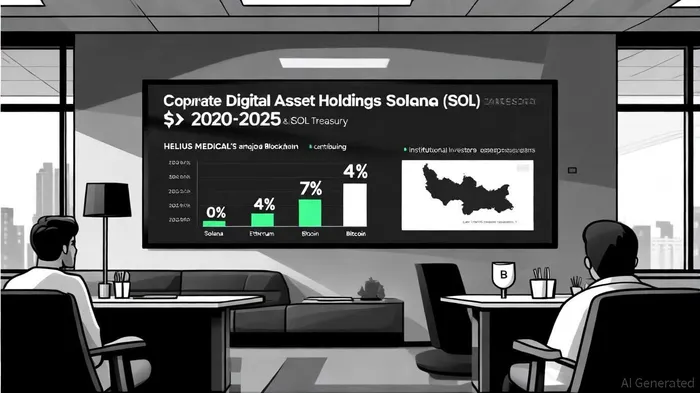
Helius Medical Technologies (NASDAQ: HSDT) has ignited a seismic shift in corporate capital allocation by committing $500 million to a SolanaSOL-- (SOL)-centric digital asset treasury, backed by a $1.25 billion capital raise through a private investment in public equity (PIPE) offering[1]. This move, which includes stapled warrants for an additional $750 million, positions Helius as a pioneer in leveraging blockchain infrastructure to redefine how corporations deploy idle cash. By prioritizing Solana—a high-performance blockchain with native yield-generating capabilities—Helius is notNOT-- merely diversifying its treasury but actively participating in the infrastructure of the next financial system[1].
A New Paradigm for Corporate Capital Allocation
For decades, corporate treasuries relied on low-yield assets like cash, bonds, and gold. Today, companies are increasingly allocating capital to digital assets that offer both diversification and active income generation. Helius's strategy mirrors the playbook of Digital Asset Treasury Companies (DATCOs) like MicroStrategy, which has turned $250 million in BitcoinBTC-- (BTC) investments into a $47.2 billion holding[3]. However, Helius's focus on Solana introduces a critical innovation: yield-bearing infrastructure alignment. By staking SOLSOL-- tokens—projected to generate ~7% annual returns[1]—Helius is transforming its balance sheet into a participant in Solana's network security and scalability, a stark contrast to Bitcoin's passive store-of-value model.
This approach reflects a broader trend. Companies like Forward Industries (FORD) and DeFi Development Corp. have allocated $1.65 billion and $199 million, respectively, to Solana treasuries, leveraging staking to earn income while supporting the blockchain's validator ecosystem[2]. Solana's ability to process 65,000 transactions per second—far outpacing Ethereum's 15 TPS—makes it an attractive partner for corporations seeking scalable, cost-efficient infrastructure[2].
Strategic Implications: From Passive Reserves to Active Ecosystem Participation
Helius's treasury strategy is not speculative; it is a calculated bet on Solana's role as the backbone of decentralized finance (DeFi) and real-world asset (RWA) tokenization. By acquiring 760,190 SOL tokens at an average cost of $231 each ($175.18 million)[1], Helius has already established a significant position. Over the next 12–24 months, the company plans to scale this holding via capital markets programs, including at-the-market (ATM) sales, while exploring lending and DeFi opportunities[1].
This strategy aligns with institutional confidence in Solana. Pantera Capital, Summer Capital, and other crypto-native investors have not only funded Helius but also embedded themselves in its governance, with figures like Dan Morehead (Pantera) and Joseph Chee (Summer Capital) serving as advisors[1]. Their involvement underscores Solana's appeal as a “category-defining blockchain”[1], a platform where corporations can generate returns while contributing to a decentralized financial ecosystem.
Broader Trends and Competitive Advantages
Helius's move is part of a $50 billion surge in corporate digital asset adoption. For example:
- MicroStrategy: Transformed from a software company to a BTC-focused DATCO, with a 2,700% stock price surge[3].
- SharpLink Gaming (SBET): Accumulated 280,706 ETH as its primary reserve asset[3].
- Interactive Strength (TRNR): Allocated $500 million to Fetch.ai (FET) tokens[3].
However, Solana's unique value proposition lies in its yield-generating architecture. Unlike Bitcoin or EthereumETH-- (which lacks native staking yields), Solana offers corporations a way to earn income on their holdings while supporting network operations. This dual benefit—capital appreciation plus active income—positions Solana as a superior alternative to traditional treasury instruments[1].
Risks and Regulatory Considerations
Despite its promise, Helius's strategy is not without risks. Concentrated holdings in a single blockchain (e.g., 5.9 million SOL across multiple firms)[2] could exacerbate price volatility during market downturns. Additionally, regulatory uncertainty—particularly delays in Solana ETF approvals—remains a hurdle[2]. Helius mitigates these risks through a conservative risk profile, emphasizing transparency and diversification while retaining $335 million in cash for neurotechnology projects[1].
Conclusion: A Blueprint for the Future
Helius Medical's $500 million Solana treasury is more than a financial maneuver—it is a blueprint for how corporations can integrate blockchain infrastructure into their capital strategies. By aligning with Solana's ecosystem, Helius is not only generating yield but also contributing to the development of a decentralized financial system. As institutional adoption accelerates, companies that embrace this model will redefine corporate finance, turning idle cash into active participants in the digital age.





Comentarios
Aún no hay comentarios