
Helen of Troy's Share Decline: Assessing Business Model Sustainability Amid Profit Pressures
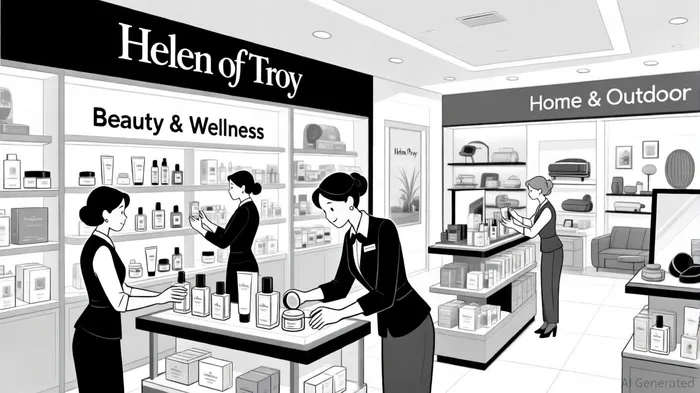
Helen of Troy Limited (HELE) has faced a sharp decline in its stock price following the release of its Q3 2025 earnings report, which revealed a 3.4% year-over-year drop in consolidated net sales to $530.7 million. The underperformance was driven by a 9.3% decline in its Beauty & Wellness segment, attributed to a weak global illness season and ongoing softness in the beauty category, according to the earnings release. While the Home & Outdoor segment grew by 4.3%, bolstered by international sales and distribution gains, the broader market has questioned the sustainability of the company's business model amid these profit pressures. This analysis evaluates Helen of Troy's strategic initiatives, operational adjustments, and long-term value proposition to determine whether the recent share decline reflects a temporary setback or a deeper structural challenge.
Profit Pressures and Segment Divergence
The Q3 2025 results underscore a stark divergence between Helen of Troy's segments. The Beauty & Wellness division, which includes brands like Revlon and Drybar, has been disproportionately affected by macroeconomic headwinds. According to the company's earnings report, weak consumer demand and increased competition have eroded sales, while the low illness season further dampened seasonal product demand. In contrast, the Home & Outdoor segment, which includes Hydro Flask and Osprey, demonstrated resilience, with international markets contributing a 7.5% growth rate, per the HELE Q3 2025 report.
Despite the sales decline, Helen of TroyHELE-- achieved margin improvements, with gross profit expanding by 90 basis points to 48.9% and adjusted operating margin rising to 16.6%, as noted in the Q3 release. These gains were driven by cost reductions under Project Pegasus, a global restructuring initiative aimed at boosting efficiency and reducing overhead, according to a BeyondSPX report. However, the company's revised fiscal 2025 guidance-narrowing consolidated sales to $1.888–$1.913 billion and lowering GAAP diluted EPS to $4.60–$5.02-has raised concerns about its ability to maintain profitability in a challenging retail environment.
Historical data from 2022 to 2025 reveals that HELE's stock has underperformed in the 30 trading days following earnings misses. On average, the stock declined by -7.0% post-event, compared to a -5.3% decline for its benchmark, according to the Q3 earnings release. Notably, the win rate (days the stock outperformed its pre-event close) dropped to 20% after day 20, and price pressure typically peaked between days 5–10 before stabilizing. These patterns suggest that market reactions to HELE's earnings misses have historically been muted but persistent, with limited recovery potential in the short term.
Strategic Initiatives and Long-Term Resilience
Helen of Troy's management has emphasized its commitment to long-term value creation through strategic acquisitions, operational efficiency, and diversification. The acquisition of Olive & June, a high-margin nail care brand, is a case in point. The company expects this acquisition to be immediately accretive, adding $33.4 million in sales during Q2 2026, per a Nasdaq article. CEO Noel M. Geoffroy highlighted that Olive & June's omnichannel capabilities align with the company's goal of strengthening its beauty portfolio and capturing growth in the wellness sector.
Project Pegasus remains central to Helen of Troy's sustainability strategy. The initiative, which includes restructuring charges of $60.9 million in Q4 2025, is detailed in the company's Q2 2026 results, and is projected to deliver $75 million to $85 million in annualized pre-tax operating profit improvements by fiscal 2027, according to BeyondSPX coverage. These cost-saving measures are critical for offsetting rising input costs and inflationary pressures, which have historically threatened gross margins, as noted in a SWOT analysis. Additionally, the company is diversifying production outside of China to mitigate U.S. tariff risks and has implemented price increases to counter margin compression, as outlined in its Q2 2026 results.
Challenges to Business Model Sustainability
While Helen of Troy's strategic moves are promising, structural challenges persist. The company's reliance on mass retailers-accounting for 75% of its revenue-exposes it to competitive threats from private-label brands, particularly on e-commerce platforms like Amazon, as discussed in the SWOT analysis. Its lagging direct-to-consumer (DTC) capabilities further limit its ability to capture premium pricing and build brand loyalty. Analysts have noted that Helen of Troy's ESG initiatives, including commitments to eco-friendly product development and climate action, are positive steps but may not be sufficient to offset these vulnerabilities, as described in the company's 2024 ESG report.
A significant risk lies in the company's asset valuation. In Q1 2026, Helen of Troy recorded a $414 million non-cash impairment charge, primarily affecting goodwill and intangible assets in its Beauty & Wellness and Home & Outdoor segments, as disclosed in the Q2 2026 release. This charge, coupled with a 17% organic sales decline and a $407 million operating loss reported in the same release, signals ongoing operational fragility. While management remains optimistic about repositioning the business for growth, the scale of these impairments raises questions about the long-term viability of its brand portfolio.
Analyst Perspectives and Market Outlook
Analyst reports present a mixed outlook for Helen of Troy. Some have lowered price targets due to recent challenges, while others maintain a neutral stance, citing the company's strategic investments and international growth potential, as shown in recent analyst projections. The Elevate for Growth plan, which outlines a vision for fiscal years 2025–2030, emphasizes brand innovation, retailer partnerships, and operational scale, but its success hinges on the effective execution of Project Pegasus and the integration of Olive & June.
Conclusion: A Path to Sustainable Growth?
Helen of Troy's recent share decline reflects investor skepticism about its ability to navigate macroeconomic headwinds and structural challenges. While the company has made strides in improving margins and diversifying its brand portfolio, its over-reliance on mass retailers and exposure to private-label competition remain significant risks. The success of initiatives like Project Pegasus and the Olive & June acquisition will be critical in determining whether Helen of Troy can restore profitability and sustain long-term value. For now, the market appears to be pricing in a high degree of uncertainty, but strategic execution and operational discipline could yet position the company for a rebound.





Comentarios
Aún no hay comentarios