
Heidelberg Materials' Strategic Resilience Amid Volume Risks
Capital Return Focus: Buybacks Over Dividends
Heidelberg Materials has not yet announced a 2025 dividend payout, but its aggressive share buyback program signals a clear commitment to returning capital to shareholders. As of October 2025, the company had spent €364 million repurchasing treasury shares under its second buyback program, which spans three tranches totaling up to €1.2 billion, according to a WorldCement report. This approach contrasts with traditional dividend-centric strategies, yet it aligns with broader industry trends where companies prioritize flexibility to reinvest in growth or navigate economic volatility.
The buyback program's scale is particularly noteworthy given the company's net debt-to-EBITDA ratio of 1.5×, a metric that reflects disciplined capital allocation, according to a Investing.com report. By reducing share counts, Heidelberg Materials enhances earnings per share (EPS) without compromising liquidity-a critical advantage in markets where cement demand remains uneven. For instance, while Europe and North America grapple with margin declines, Africa and the Mediterranean have shown stronger performance, illustrating the need for a dynamic capital return strategy, as discussed in a SimplyWall Street analysis.
Risk Mitigation Through Operational Efficiency
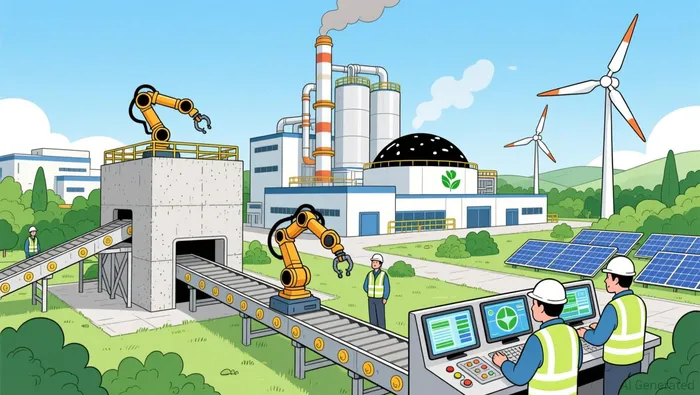
Central to Heidelberg Materials' resilience is its Transformation Accelerator initiative, which has already delivered cost savings and is on track to generate at least €500 million annually by 2026, according to a WorldCement report. This global efficiency drive-encompassing production network optimization and digitalization-has directly contributed to a 0.7 percentage point improvement in operating margins year-over-year, reaching 25.9% in Q3 2025, according to a WorldCement report. Such gains buffer the company against volume fluctuations, particularly in key markets like the U.S. and Europe, where infrastructure cycles remain unpredictable.
The initiative also complements the company's decarbonization goals. For example, the final investment decision for a CCS project at the Padeswood plant in the UK is set to capture 800,000 metric tons of CO2 annually, supporting the production of evoZero®, its near-zero carbon cement, according to a WorldCement report. These innovations not only future-proof operations but also open new revenue streams in markets prioritizing green building materials.
Long-Term Shareholder Value: Balancing Risks and Opportunities
While Heidelberg Materials' capital return strategy is robust, investors must weigh it against lingering volume risks. Mixed regional performance-such as declining cement margins in Europe-has already triggered short-term share price volatility, with the stock dropping over 3% following Q3 results, according to an Investing.com report. However, the company's focus on low-carbon products and infrastructure-linked demand mitigates these risks. For example, its four EU Innovation Fund grants for CCUS projects (Anthemis, AirvaultGOCO2, DREAM, and HuCCSar) reinforce its leadership in sustainable construction, a sector poised for growth as governments enforce stricter emissions targets, according to a WorldCement report.
The absence of a 2025 dividend announcement, while notable, is not a red flag. Instead, it reflects management's preference for retaining flexibility-a prudent stance in an industry where cash flow can fluctuate with construction cycles. The buyback program, combined with a 10% return on invested capital (ROIC), suggests that Heidelberg Materials is prioritizing value creation through share repurchases and reinvestment in high-impact projects, as noted in an Investing.com report.
Conclusion
Heidelberg Materials' strategic resilience lies in its ability to adapt capital allocation to both market dynamics and long-term sustainability goals. By leveraging share buybacks, operational efficiency, and decarbonization innovation, the company is positioning itself to weather volume risks while delivering competitive shareholder returns. For investors, the key takeaway is that Heidelberg Materials' approach-though unconventional in its dividend structure-aligns with the evolving priorities of a sector at the crossroads of industrial tradition and green transformation.







Comentarios
Aún no hay comentarios