
Hedera Hashgraph's Strategic Position in the Post-Proof-of-Work Era
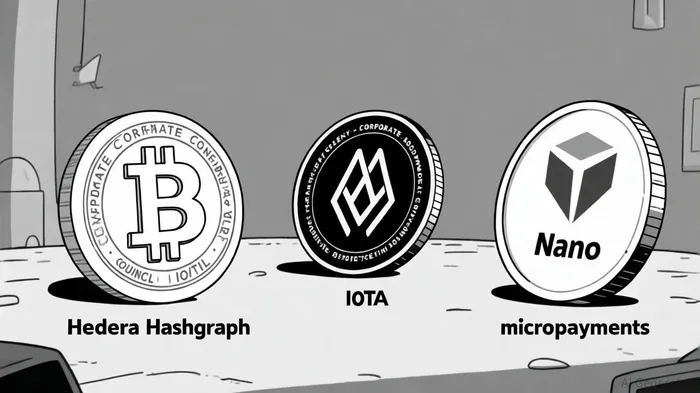
The post-Proof-of-Work era has ushered in a new wave of distributed ledger technologies (DLTs) prioritizing scalability, energy efficiency, and real-world utility. Among these, HederaHBAR-- Hashgraph stands out as a formidable contender, leveraging its unique governance model, hashgraph consensus algorithm, and corporate adoption to challenge traditional blockchains and emerging BlockDAG protocols like IOTAIOTA-- and Nano. This analysis evaluates Hedera's strategic position by dissecting its governance, scalability, and real-world adoption against these competitors.
Governance: Corporate Council vs. Decentralized Models
Hedera's governance is anchored by its Hedera Governing Council, a consortium of 39 global corporations—including GoogleGOOGL--, IBMIBM--, and Boeing—that oversee network upgrades and decision-making[1]. While this model ensures stability and enterprise-grade security, critics argue it centralizes power in the hands of a few entities. However, the roadmap includes a gradual shift toward decentralization, with HBARHBAR-- token holders gaining voting rights by 2025[1]. This hybrid approach balances corporate oversight with community-driven governance, a stark contrast to IOTA's Delegated Proof-of-Stake (DPoS) model.
IOTA Rebased, launched in 2025, transitioned to a DPoS framework where validators must stake 2 million IOTAs to participate[1]. While this fosters decentralization, it also introduces complexity and potential centralization risks if a small number of validators dominate the network. Nano, on the other hand, relies on a DAG-based architecture that eliminates traditional staking mechanisms, prioritizing speed and simplicity for micropayments[5]. However, its governance model lacks the formal structure seen in Hedera or IOTA, making it less appealing for enterprise adoption.
Scalability: Hashgraph vs. DAGs
Scalability remains a critical battleground. Hedera claims a throughput of 10,000 transactions per second (TPS) with finality in 3–5 seconds[1], outpacing IOTA's 1,000 TPS and Nano's focus on low-latency, feeless transactions[4]. This performance is underpinned by Hedera's hashgraph consensus, which eliminates the need for blocks and instead uses a gossip protocol to achieve asynchronous Byzantine fault tolerance. The result is a system that is not only faster but also 3,300× more energy-efficient than Ethereum[1], a key differentiator in an era where sustainability is paramount.
IOTA's DAG architecture, while theoretically scalable, has faced real-world limitations due to probabilistic finality and centralization in tip selection algorithms[2]. Nano's DAG excels in speed and cost efficiency but struggles with throughput under high transaction volumes[5]. For instance, Nano's feeless model works well for micropayments but may falter in enterprise environments requiring high transaction volumes. Hedera's deterministic finality and corporate-grade infrastructure position it as a more reliable solution for supply chain tracking, digital identity, and IoT applications[3].
Real-World Adoption: Enterprise vs. Niche Use Cases
Hedera's corporate adoption surge in 2025 is evident in partnerships with major players in logistics, healthcare, and IoT[4]. For example, its energy-efficient network is being integrated into supply chain systems to track goods in real time, reducing fraud and inefficiencies. IOTA, meanwhile, has carved a niche in machine-to-machine transactions, particularly in IoT ecosystems where low-cost, high-frequency data exchanges are critical[5]. Nano's focus on micropayments has made it a favorite for digital content monetization and peer-to-peer transactions, though its adoption remains fragmented compared to Hedera's enterprise-grade solutions[4].
The energy efficiency of Hedera's hashgraph—19× less than BNBBNB-- Chain—has also attracted attention from sustainability-focused investors[1]. As governments and corporations prioritize carbon-neutral technologies, Hedera's green credentials could drive further adoption in regulated industries. IOTA and Nano, while energy-efficient, lack the same level of corporate backing, limiting their scalability in enterprise contexts.
Conclusion: A Balanced Future for Hedera
Hedera Hashgraph's strategic position in the post-Proof-of-Work era is defined by its ability to merge corporate governance with decentralized aspirations, deliver enterprise-grade scalability, and align with global sustainability goals. While IOTA and Nano excel in niche use cases, Hedera's hybrid governance model, superior TPS, and real-world adoption make it a more versatile platform for the future. As the DLT landscape evolves, investors should monitor Hedera's transition to a fully decentralized model and its ability to maintain its edge against DAG-based competitors.





Comentarios
Aún no hay comentarios