
Hedera Hashgraph's Evolution and BullZilla's Roar Burn Mechanism: Tokenomics Innovation in the Post-2025 Crypto Market
In the post-2025 crypto landscape, tokenomics innovation has become a battleground for projects seeking to capture value through engineered scarcity, structured incentives, and enterprise-grade utility. Two standout examples—Hedera Hashgraph (HBAR) and BullZilla ($BZIL)—offer contrasting yet complementary approaches to redefining value capture in a market increasingly skeptical of unstructured hype. This analysis explores how their tokenomic designs reflect broader trends in the industry and why they matter for investors navigating the next phase of crypto's evolution.
Hedera Hashgraph: Balancing Inflation and Deflation in a Decentralized Framework
Hedera Hashgraph's tokenomics have undergone a strategic pivot toward a hybrid inflation-deflation model, blending Proof-of-Stake (PoS) governance with fee-burn mechanisms to create a self-sustaining ecosystem. By 2025, HBAR's annual inflation rate stood at 3.5%, with staking rewards offering 7% APY to secure the network while gradually decreasing over time as the platform matures [1]. This approach contrasts with rigid fixed-supply models, allowing flexibility to adapt to growth without triggering runaway inflation.
A critical innovation is the fee-burn mechanism, where a portion of transaction fees is permanently destroyed, reducing circulating supply. As enterprise adoption of HBARHBAR-- accelerates—driven by real-world asset tokenization, AI-driven governance, and carbon tracking—the burn rate is expected to offset inflationary pressures, creating a net neutral or deflationary supply trend by 2027 [2]. For instance, partnerships with NVIDIANVDA-- and Prove AI have already pushed HBAR into high-throughput use cases like AI transactions and supply chain tracking, generating consistent fee revenue [3].
However, challenges persist. A 34% supply unlock by 2025 poses short-term bearish risks, particularly if enterprise demand fails to materialize. Yet, the platform's governance model—transitioning to a more decentralized PoS framework—ensures token holders retain influence over network upgrades, aligning incentives between developers and users [4]. Analysts project HBAR could reach $0.35–$0.55 by 2027 under strong adoption scenarios, buoyed by potential regulatory milestones like an approved HBAR ETF [5].
BullZilla's Roar Burn Mechanism: Meme Coin Scarcity, Engineered for Growth
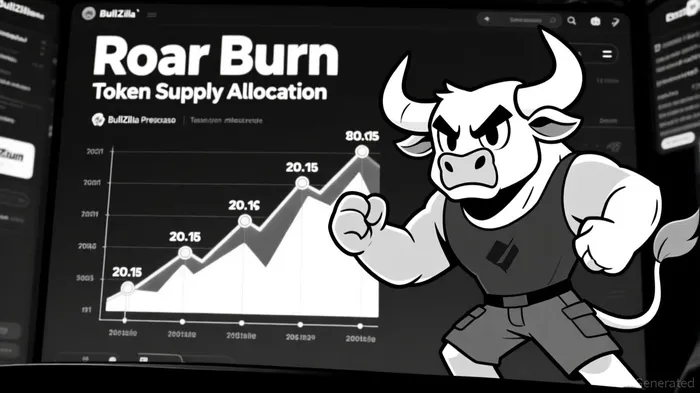
While HederaHBAR-- focuses on enterprise-grade utility, BullZilla ($BZIL) has redefined memeMEME-- coin tokenomics by embedding artificial scarcity into its narrative-driven design. The Roar Burn Mechanism, triggered at 24 presale milestones, permanently removes tokens from circulation, creating measurable supply shocks that drive psychological demand [6]. Each burn is tied to a “cinematic chapter” in the project's lore, blending community engagement with economic incentives.
The presale model itself is a masterclass in value capture. A Mutation Mechanism increases token prices every $100,000 raised or every 48 hours, rewarding early buyers with entry points as low as $0.00005908. By Stage 3, the presale had raised $430,000 with over 1,550 holders, projecting ROI of 16,164% for Stage 1D participants [7]. This is amplified by the HODL Furnace, a staking mechanism offering 70% APY to lock tokens and reduce circulating supply further [8].
BullZilla's tokenomics are structured to balance short-term incentives with long-term sustainability:
- 50% to presale (80 billion tokens)
- 20% to staking (32 billion)
- 20% to treasury/ecosystem (32 billion)
- 5% to burn pool (8 billion)
- 5% to team (8 billion, locked for two years)
The Scorch Reserve, a 5% burn pool, ensures consistent supply reduction, while a 10% referral bonus incentivizes community growth [9]. This structured approach differentiates BullZilla from traditional meme coins, which often rely on social media virality without economic safeguards.
Comparative Analysis: Tokenomics as a Value Capture Tool
Both projects leverage tokenomics to address market inefficiencies but target different audiences. Hedera's hybrid model appeals to institutional investors seeking scalable infrastructure, while BullZilla's narrative-driven burns cater to retail participants chasing speculative gains.
- Hedera's Strengths: Enterprise adoption, AI integration, and a deflationary fee-burn mechanism position it as a long-term store of value. However, its reliance on macroeconomic factors (e.g., ETF approvals) introduces volatility.
- BullZilla's Edge: The Roar Burn Mechanism creates immediate scarcity, amplified by a presale structure that rewards early participation. Yet, its high-risk profile—volatile ROI projections and a speculative meme coin narrative—makes it unsuitable for risk-averse investors.
The post-2025 market favors projects that combine innovation with adaptability. Hedera's controlled inflation-deflation balance and BullZilla's engineered scarcity both reflect this trend, albeit through divergent strategies.
Risks and Considerations
- Hedera: Supply inflation from vesting schedules and regulatory uncertainty could undermine growth.
- BullZilla: Presale participation carries no guarantees, and meme coins remain inherently volatile.
Investors must weigh these risks against the potential for tokenomic innovation to drive value. For Hedera, the key is enterprise adoption; for BullZilla, it's the execution of its burn-driven narrative.
Conclusion
In a post-2025 crypto market defined by tokenomic sophistication, both Hedera Hashgraph and BullZilla exemplify how structured scarcity and utility can capture value. Hedera's enterprise-grade infrastructure and balanced tokenomics appeal to long-term holders, while BullZilla's meme-driven burns and presale mechanics cater to speculative demand. Together, they highlight the industry's shift from unstructured hype to engineered value capture—a trend that will define the next decade of crypto innovation.






Comentarios
Aún no hay comentarios