
Hedera's 2025 Upgrades and Their Impact on DeFi Growth
The blockchain landscape in 2025 is defined by a critical inflection point in decentralized finance (DeFi) infrastructure. While EthereumETH-- remains a foundational platform, its scalability and cost limitations persist as barriers to mass adoption. HederaHBAR-- Hashgraph, however, has emerged as a formidable contender, leveraging 2025 upgrades to position itself as a superior infrastructure for DeFi growth. By combining enterprise-grade performance, institutional partnerships, and technical innovation, Hedera is notNOT-- merely competing with Ethereum-it is redefining the benchmarks for DeFi scalability and utility.
Hedera's 2025 Upgrades: A Strategic Edge in DeFi Infrastructure
Hedera's 2025 roadmap centers on three pillars: technical robustness, institutional integration, and ecosystem expansion. The platform's hashgraph consensus mechanism now supports over 10,000 transactions per second (TPS) with sub-second finality and fixed fees as low as $0.0001 per transaction, according to a Kanalcoin report. This dwarfs Ethereum's base-layer capacity of 15–20 TPS and even its Layer 2-optimized throughput of 25–35 TPS, as noted in a CoinLineup overview. For DeFi applications requiring real-time settlements-such as tokenized foreign exchange (FX) or carbon credit trading-Hedera's performance is not just competitive; it is transformative.
A key differentiator is Hedera's EVM compatibility enhancements, which allow developers to deploy Solidity and Vyper-based smart contracts without sacrificing speed or cost efficiency, as highlighted on Hedera's DeFi use cases. Projects like SaucerSwap and Bonzo Finance have already demonstrated this potential, with $56.4 million and $31.1 million in total value locked (TVL) respectively as of May 2025, as an AllInCrypto roundup shows. These figures underscore Hedera's ability to attract liquidity while maintaining low barriers to entry for users.
Institutional adoption further amplifies Hedera's strategic advantage. Partnerships with entities like Lloyds Bank and Archax have enabled tokenized FX settlements and collateral management, bridging traditional finance (TradFi) with blockchain innovation, according to a Genfinity update. The Reserve Bank of Australia's Project Acacia, which uses Hedera to pilot central bank digital currencies (CBDCs), highlights the platform's readiness for regulated financial ecosystems, as reported by a BSC News report. Such collaborations are rare for Ethereum, where institutional participation remains constrained by regulatory ambiguities and scalability bottlenecks.
Ethereum's 2025 Challenges: A Platform in Transition
Ethereum's 2025 upgrades, including the Dencun and Pectra hard forks, have reduced gas fees to an average of $0.41 per transaction, per CoinLaw statistics. Layer 2 solutions like ArbitrumARB-- and OptimismOP-- now handle 85% of Ethereum's transaction volume, mitigating congestion and lowering costs, as outlined in a Medium roadmap. However, these improvements are incremental rather than revolutionary. Ethereum's base-layer TPS remains capped at 15–20, and even with Layer 2s, it lags behind Hedera's 10,000 TPS.
Institutional adoption, while growing, is hampered by structural risks. Reports from Crypto.com research indicate over 64% of staked ETH is controlled by the top ten staking entities, raising centralization concerns. Additionally, Ethereum's variable supply dynamics-driven by treasury strategies of major ETH holders-introduce volatility that deters long-term institutional commitments, as discussed in a Financial Analyst article. While Ethereum's ERC-3643 standard and zero-knowledge proofs address compliance needs, its fragmented governance and ongoing scalability debates create uncertainty for enterprise adoption.
The DeFi Growth Equation: Hedera's Outperformance Thesis
Hedera's 2025 upgrades directly address the pain points that have limited Ethereum's DeFi potential. By offering predictable costs, enterprise-grade throughput, and institutional-grade security, Hedera creates an environment where DeFi applications can scale without compromising user experience. For instance, tokenized real-world assets (RWAs) like carbon credits and real estate-processed on Hedera via platforms like DOVU and StegX-benefit from transparent, low-cost settlements that Ethereum's current infrastructure cannot match, as an OKX overview explains.
Moreover, Hedera's governance model, governed by a council of 30+ global organizations, ensures decentralized decision-making while aligning with regulatory expectations, as an Awaken.tax profile notes. This contrasts with Ethereum's developer-centric governance, which often struggles to balance innovation with compliance. The Hedera To Earn (HTE) platform further drives adoption by incentivizing user participation through a unified reward token system, integrating with dApps that collectively serve 24 million users, as the BSC News update reported.
Conclusion: A New Paradigm for DeFi Infrastructure
Hedera's 2025 upgrades represent more than technical improvements-they signal a paradigm shift in DeFi infrastructure. By prioritizing scalability, institutional trust, and real-world applicability, Hedera is outpacing Ethereum in critical areas that define DeFi's next phase. While Ethereum's ecosystem remains robust, its limitations in throughput, cost predictability, and regulatory alignment create a vacuum that Hedera is uniquely positioned to fill. For investors, this is not merely a competition between blockchains but a reimagining of what DeFi infrastructure can achieve.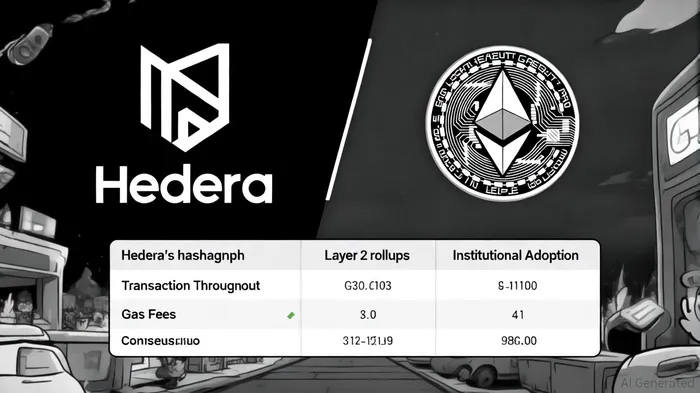






Comentarios
Aún no hay comentarios