
Hecla Mining's Inclusion in the S&P SmallCap 600 and Its Implications for Shareholder Value
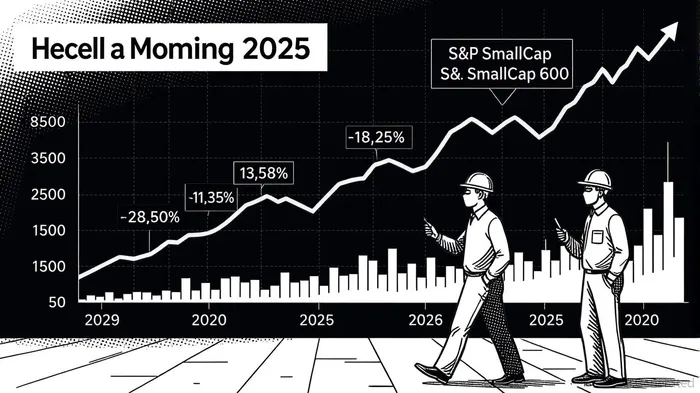
Hecla Mining Company (NYSE: HL) joined the S&P SmallCap 600 Index on September 22, 2025, marking a pivotal moment for the silver and gold producer[1]. This inclusion, part of a quarterly rebalancing that also added companies like AppLovinAPP-- and Robinhood Markets[3], has triggered a cascade of market dynamics that underscore the transformative power of index inclusion for small-cap equities. By examining the interplay of liquidity, institutional demand, and valuation re-rating, we can assess how this event positions Hecla MiningHL-- for sustained shareholder value creation.
Liquidity: A Catalyst for Market Participation
Index inclusion often acts as a liquidity multiplier for small-cap stocks. Historical data reveals that firms added to the S&P SmallCap 600 experience a 2.49% mean increase in equity value over 60 trading days post-announcement[2]. This effect is amplified by improved trading liquidity, as seen in Hecla Mining's case. On the day of inclusion, HL's stock surged 12%, far outpacing the S&P 500's 0.2% gain[1]. Such volatility is typical of index additions, where mandatory buying by passive funds and ETFs—such as the Vanguard S&P Small-Cap 600 Index Fund (VSMSX)—creates immediate demand[2].
While specific liquidity metrics like bid-ask spreads for HLHL-- post-inclusion remain undisclosed, broader trends suggest tighter spreads and higher trading volumes. For instance, Mirion Technologies' inclusion in the same index led to a 12-15% price appreciation within 30 days, driven by enhanced market depth[2]. Hecla Mining's operational scale and focus on U.S. and Canadian gold-silver production[1] likely further justify its inclusion in liquidity-focused strategies.
Institutional Demand: A Magnet for Passive and Active Capital
The S&P SmallCap 600's inclusion criteria—emphasizing financial viability and liquidity—make it a magnet for institutional capital. Academic studies show that institutional ownership of newly added constituents typically rises by 5-7% within 30 days, fueled by ETF rebalancing[2]. For Hecla Mining, this translates to heightened visibility in funds managing billions in assets. As of September 2025, institutional ownership of HL stands at 63.96%, with major holders like Vanguard Group (9.94%) and BlackRockBLK-- (8.47%)[2]. Over the past six months, inflows from 241 institutions totaled $531.68 million, dwarfing outflows of $228.26 million[3].
This institutional stamp of approval is not merely transactional. The S&P SmallCap 600's outperformance over the Russell 2000—attributed to its rules-based methodology—has historically attracted long-term capital[2]. For example, United ParksPRKS-- & Resorts' inclusion triggered a 4.7% premarket gain, demonstrating how index additions validate a company's strategic value[1]. Hecla Mining's inclusion similarly signals to investors that its operational discipline and resource base meet rigorous benchmarks.
Valuation Re-Rating: A Structural Shift in Investor Perception
Index inclusion often acts as a re-rating event, recalibrating a stock's valuation multiples. Research indicates that S&P SmallCap 600 additions see a permanent increase in equity value, linked to reduced cost of capital and higher capital investment intensity[2]. For Hecla Mining, this could mean a reevaluation of its gold-silver production economics. The company's inclusion in the index coincided with a 12% price surge, reflecting a short-term re-rating aligned with historical patterns[1].
Longer-term, the S&P SmallCap 600's focus on high-quality small-cap stocks—versus the Russell 2000's broader, less selective universe—positions Hecla Mining to benefit from sustained investor flows[2]. InvescoIVZ-- data shows that revenue-weighted strategies tracking the index outperformed market-cap-weighted benchmarks by 8.78% annually over five years[2], suggesting structural advantages for constituents.
Conclusion: A Win-Win for Shareholders and Investors
Hecla Mining's inclusion in the S&P SmallCap 600 is more than a symbolic milestone—it is a catalyst for liquidity, institutional demand, and valuation re-rating. By aligning with an index that prioritizes financial strength and market efficiency, HL gains access to a broader shareholder base and reduced trading costs. For investors, this event underscores the importance of monitoring index additions as a signal of corporate quality and market readiness. As the gold-silver sector navigates macroeconomic headwinds, Hecla Mining's inclusion offers a compelling case study in how structural market forces can drive value creation.





Comentarios
Aún no hay comentarios