
Heat Stress Is the New Catalyst for Climate Resilience Investing—Here’s Where to Put Your Money
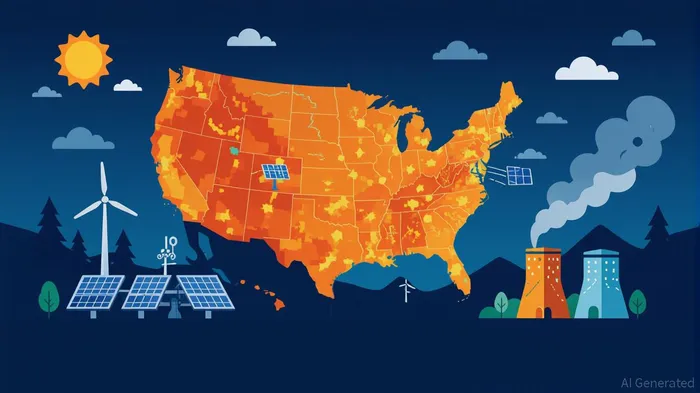
The scorching heat domes of 2025 have turned climate resilience from a buzzword into a business imperative. With economic costs from extreme heat in the U.S. alone hitting $162 billion in 2024 [1], sectors like agriculture, energy, and public health are undergoing a seismic revaluation. Investors who act now can capitalize on a $1.3 trillion Climate Adaptation and Resilience (Climate A&R) sector by 2030 [2], driven by heat stress as the ultimate catalyst.
Agriculture: A Boiling Pot of Opportunities
The Corn Belt is sweating under a 15% projected drop in crop yields by 2030 [1], but this crisis is spawning innovation. Agrivoltaics—combining solar panels with crop farming—are gaining traction, with companies like SunPower and First SolarFSLR-- leading the charge. Meanwhile, heat stress in dairy cattle is costing the U.S. $1.5–1.7 billion annually [3], but AI-driven climate intelligence tools are now helping farmers optimize irrigation and livestock management. Look for ag-tech firms integrating machine learning for heat stress prediction; their stock valuations are set to soar as demand for resilient food systems grows.
Energy: Grid Modernization Is the New Black
Duke Energy’s $75 billion grid modernization plan [1] isn’t just a response to heat—it’s a blueprint for the sector. The 2025 heat domes exposed vulnerabilities in aging infrastructure, with power grids struggling to meet surging cooling demands. Geothermal energy, which thrives in high-heat environments, is now a $200 billion annual investment target by 2030 [1]. Companies like Ormat TechnologiesORA-- and Fervo Energy are reaping the rewards of this shift. For investors, the message is clear: bet on grid resilience and geothermal innovation.
Public Health: A $1 Trillion Lifeline
The human cost of heat is staggering. U.S. healthcare systems spend $1 billion annually on heat-related illnesses [4], but the 2025 Heat Policy Agenda is pushing for a National Heat Coordinator and emergency-response funding [1]. This isn’t just about saving lives—it’s about creating a $1.3 trillion market for health tech and resilient infrastructure. Startups developing cooling wearable tech or AI-driven heatwave prediction systems are prime candidates for explosive growth.
The Bottom Line: Resilience Is the New Profitability
Every $1 invested in climate adaptation generates $10–$19 in benefits over a decade [2]. The Climate A&R sector’s trajectory—from $1 trillion today to $4 trillion by 2050 [1]—isn’t speculative; it’s math. Heat stress is forcing a revaluation of entire industries, and the winners will be those who adapt first.
Source:
[1] The Economic and Market Impacts of the 2025 U.S. Heat Domes [https://www.ainvest.com/news/economic-market-impacts-2025-heat-domes-opportunities-resilience-adaptation-sectors-2507/]
[2] Capitalizing on the coming boom in adaptation and resilience [https://www.cfainstitute.org/insights/articles/climate-adaptation-resilience-investment-boom]
[3] Global projections of heat stress at high temporal resolution using machine learning [https://essd.copernicus.org/articles/17/1153/2025/]
[4] The Health Care Costs of Extreme Heat [https://www.americanprogress.org/article/the-health-care-costs-of-extreme-heat/]







Comentarios
Aún no hay comentarios