
Healthcare Triangle's Warrant Inducement Offering: A Strategic Move in a Shifting Biotech Capital Landscape
Healthcare Triangle's Warrant Inducement Offering: A Strategic Move in a Shifting Biotech Capital Landscape
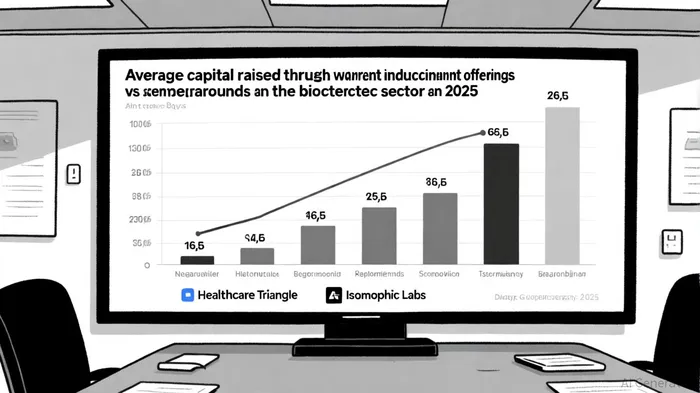
In 2025, the biotech sector continues to navigate a bifurcated capital-raising environment, where large-scale "megarounds" dominate private funding while public markets remain cautious. Against this backdrop, Healthcare Triangle, Inc. (Nasdaq: HCTI) has executed a warrant inducement offering that reflects a nuanced approach to liquidity and investor alignment. By raising approximately $755,000 through the exercise of 377,702 warrants and issuing new warrants at $3.00 per share, the company has leveraged a time-tested strategy to secure capital while mitigating dilution risks. This move, however, must be evaluated in the context of broader industry trends that increasingly favor megafunds and non-dilutive financing.
Strategic Rationale Behind Healthcare Triangle's Offering
Healthcare Triangle's October 2025 warrant inducement offering involved reducing the exercise price of existing warrants from $20.92 to $2.00 per share, incentivizing holders to exercise their rights and generate immediate liquidity. In exchange, investors received new warrants exercisable at $3.00 per share, expiring five years from issuance, according to a BioBuzz article. This structure not only provided the company with $755,000 in gross proceeds but also extended investor commitment through long-dated, in-the-money warrants. The offering aligns with the company's broader financing strategy, which includes a $15.2 million PIPE announced in February 2025, underscoring its focus on diversified capital sources, according to an SEC filing.
The decision to prioritize warrant inducements over traditional equity raises is strategic. By reducing the exercise price of existing warrants, Healthcare TriangleHCTI-- minimized dilution for existing shareholders while rewarding early investors for continued support. This approach is particularly relevant in a sector where maintaining share price stability is critical for attracting follow-on capital.
Industry Trends: Megarounds and Non-Dilutive Financing
While warrant inducements remain a viable tool, the biotech sector in 2025 has seen a pronounced shift toward megarounds-funding rounds exceeding $100 million. For instance, 75% of the $4.1 billion in private biotech investment in Q1 2025 fell into this category, with median rounds reaching $93 million, according to a Medicinetomarket analysis. High-profile examples include Isomorphic Labs ($600 million) and Verdiva Bio ($411 million), which reflect investor confidence in platforms with validated science and clear commercial pathways.
Simultaneously, non-dilutive financing options such as royalty and credit facilities are gaining traction. OrbiMed's Royalty & Credit Opportunities Fund V, with $1.86 billion in capital, exemplifies this trend, offering clinical-stage companies access to capital without equity dilution, as noted in the BioBuzz article. These alternatives are particularly attractive in a public market climate where IPOs remain scarce, with no biotech IPOs recorded in Q2 2025-the longest pause since the 2008 financial crisis, according to a LinkedIn post.
Comparative Analysis: Warrant Inducements vs. Megarounds
Healthcare Triangle's $755,000 raise, while modest compared to megarounds, highlights the flexibility of warrant inducements in specific scenarios. Unlike megarounds, which require significant investor appetite for high-risk, high-reward assets, warrant inducements can be executed with existing shareholders, reducing the need for broad market participation. This is particularly advantageous for mid-sized biotechs like Healthcare Triangle, which may lack the pipeline depth or therapeutic focus to attract megafund attention.
However, the sector's preference for megarounds underscores a broader investor shift toward de-risked assets and late-stage clinical programs. For example, Eli Lilly's $500 million partnership with Andreessen Horowitz to fund digital therapeutics illustrates how strategic alliances are increasingly used to validate and scale promising technologies, a trend highlighted in the BioBuzz article. In contrast, warrant inducements are less effective for companies without a clear path to commercialization or those operating in niche therapeutic areas.
Strategic Evaluation: Effectiveness and Implications
Healthcare Triangle's warrant inducement offering is a prudent short-term strategy that balances liquidity needs with shareholder interests. By reducing the exercise price of existing warrants, the company incentivized holders to convert their options into cash, providing immediate runway for R&D or operational expenses. The issuance of new, long-dated warrants also aligns investor incentives with long-term value creation, a critical factor in a sector where regulatory and clinical risks are high.
Yet, the offering's relatively small size raises questions about its long-term sufficiency. In a capital environment where megarounds and strategic partnerships dominate, Healthcare Triangle may need to pursue larger, milestone-driven financings to compete with peers. For instance, the $15.2 million PIPE announced earlier in 2025 suggests the company is aware of the need for diversified capital sources, as noted in the SEC filing. However, reliance on warrant inducements could limit its ability to attract institutional investors seeking exposure to high-growth, de-risked assets.
Conclusion: Navigating the New Normal
Healthcare Triangle's recent warrant inducement offering exemplifies a hybrid approach to capital raising in a sector defined by duality. While the biotech industry increasingly favors megarounds and non-dilutive financing, smaller, targeted strategies like warrant inducements remain relevant for companies with established shareholder bases and clear operational needs. The key for Healthcare Triangle-and other mid-sized biotechs-will be to balance these strategies with long-term goals, such as securing partnerships or accessing public markets.
As the sector evolves, companies that align their financing strategies with investor priorities-emphasizing scientific validation, milestone-driven development, and clear commercial pathways-will be best positioned to thrive. For Healthcare Triangle, the October 2025 offering is a step in the right direction, but sustained success will depend on its ability to scale and adapt to the sector's shifting dynamics.





Comentarios
Aún no hay comentarios