
Healthcare Policy Uncertainty and Insurance Sector Valuations: Navigating the ACA Subsidy Stalemate
The U.S. healthcare sector is at a crossroads, with the political stalemate over Affordable Care Act (ACA) subsidies creating a perfect storm of uncertainty for insurers, investors, and consumers. As 2025 draws to a close, the expiration of enhanced ACA subsidies-set to increase premiums by an average of 114% for enrollees-looms as a critical inflection point. This policy vacuum has triggered a cascade of financial and political risks, reshaping valuations in the insurance sector and testing the resilience of a market already burdened by regulatory complexity.
Political Stalemate and Market Volatility
The ACA subsidy debate has become a proxy for broader partisan divides. Democrats, who expanded subsidies during the pandemic, advocate for their continuation to protect middle-class and older Americans from unaffordable premiums. Republicans, meanwhile, push alternatives like health savings accounts (HSAs) and association health plans, arguing for market-driven solutions. This lack of consensus has left insurers in limbo, scrambling to model scenarios where enrollment could plummet by two-thirds if subsidies expire.
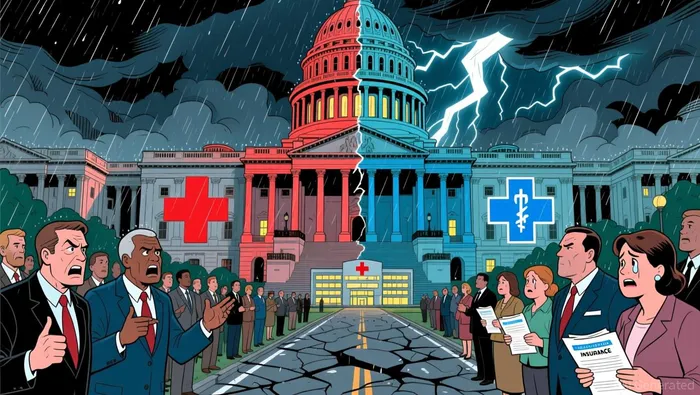 The Congressional Budget Office (CBO) has warned that without an extension, 3.8 million Americans could lose coverage, worsening risk pools and driving further premium hikes. States like California and Pennsylvania are already seeing a shift toward high-deductible bronze plans, signaling a growing affordability crisis. Meanwhile, political fallout is intensifying: a KFF poll shows 78% of Americans support subsidy extensions, and 39% would blame President Trump if costs spike. This sentiment could reverberate in the 2026 midterms, adding pressure for a last-minute legislative fix.
Financial Implications for Insurers and Investors
The uncertainty has sent ripples through financial markets. Hedge funds have ramped up short positions on healthcare stocks, betting on regulatory and enrollment volatility. Insurers like Elevance HealthELV-- have already filed for average 2026 rate hikes of over 20%, assuming subsidies expire. However, such strategies risk backfiring: UnitedHealthUNH-- predicts a two-thirds drop in ACA enrollment if premiums double, potentially destabilizing risk pools. Analysts from Morningstar caution that while insurers may absorb some costs, the loss of healthier enrollees could strain margins.
Investment firms are also factoring in macroeconomic risks. The Commonwealth Fund estimates that subsidy expiration could cost states $40.7 billion in GDP and 339,100 jobs, with Texas, Florida, and Georgia hit hardest due to their lack of Medicaid expansion. These ripple effects extend beyond insurers, threatening hospital systems and state budgets.
Opportunities Amid the Uncertainty
Despite the risks, the stalemate creates asymmetric opportunities. Insurers that pivot to alternative models-such as HSAs or narrow networks- could capture market share if Republicans gain traction with their proposals. Subsectors like dental and contract research organizations have shown resilience, outperforming broader healthcare indices in late 2025. Investors with a longer-term horizon may also benefit from a potential policy reset in 2026, as political pressure for a compromise grows.
For now, the ACA's 57% approval rating suggests bipartisan support for a solution, even if partisan gridlock persists. The key for investors lies in hedging against regulatory shifts while capitalizing on subsector strengths. As the clock ticks toward January 1, 2026, the healthcare sector's valuation will hinge not just on policy outcomes, but on the speed and scale of political action-or inaction.





Comentarios
Aún no hay comentarios