
Headwater Gold's Strategic Option Grant to OceanaGold in Nevada: A Catalyst for Value Unlocking in a High-Potential Gold Jurisdiction
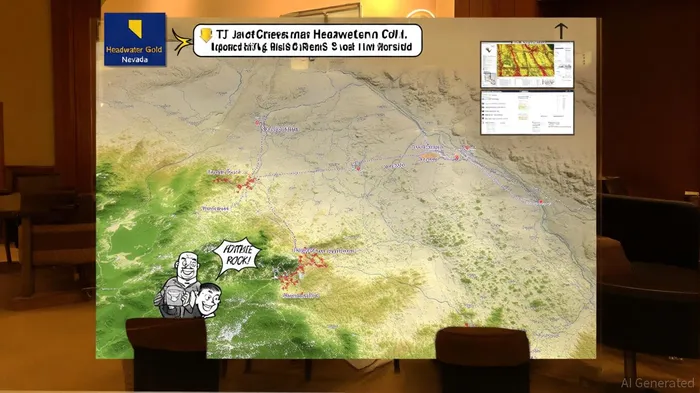
In a strategic move poised to capitalize on Nevada's robust mining environment, Headwater Gold has entered into a definitive agreement with OceanaGold to explore three high-potential gold projects-TJ, Jake Creek, and Hot Creek. This partnership, structured around a staged exploration expenditure of up to $65 million, underscores the growing confidence in Nevada as a premier jurisdiction for gold exploration and development. For investors, the deal represents a compelling convergence of geological promise, operational expertise, and regulatory clarity, all of which could catalyze significant value creation.
Nevada's Jurisdictional Advantages: A Magnet for Exploration Capital
Nevada's mining jurisdiction remains one of the most attractive globally, ranking third in mineral investment attractiveness in 2023, according to a Nevada exploration survey. The state accounts for 38% of U.S. exploration expenditures, with $648 million allocated in 2023 alone, according to the same survey. This dominance is driven by a combination of favorable geology, a supportive regulatory framework, and a history of high-grade gold discoveries. The TJ project, for instance, is situated on Bureau of Land Management (BLM) land and exhibits potential for deep-seated epithermal vein-style mineralization-a geological model that has historically yielded world-class gold deposits in the region, as noted in the definitive agreement.
The regulatory environment, while rigorous, is designed to balance environmental stewardship with operational efficiency. Mines must secure Water Pollution Control Permits (WPCP) and adhere to reclamation standards, but legislative efforts like the Mining Regulatory Clarity Act aim to streamline permitting for ancillary activities on public lands, according to that survey. Such reforms could reduce bureaucratic delays, enhancing the feasibility of large-scale exploration programs like OceanaGold's.
OceanaGold's Track Record: A Proven Operator in High-Grade Gold
OceanaGold's involvement adds another layer of credibility to the partnership. The company has demonstrated a strong ability to unlock value through exploration, particularly at its Haile Gold Mine in South Carolina. Recent drilling at Haile returned intercepts such as 28.9 meters at 18.33 g/t Au and 8.7 meters at 22.30 g/t Au, achieved through a $10 million exploration budget, according to a reclamation permit update. These results highlight OceanaGold's expertise in identifying and expanding high-grade gold systems-a skill set that could be replicated in Nevada's geologically analogous terrain.
The staged earn-in structure of the Headwater-OceanaGold agreement further aligns with OceanaGold's risk-mitigated approach. By committing to a minimum $2.5 million in exploration expenditures within the first two years, OceanaGold signals its confidence in the projects' potential while allowing for incremental capital deployment based on emerging data. This flexibility is critical in a sector where exploration success is inherently uncertain.
Value Creation Mechanisms: From Exploration to Royalty Streams
The partnership's value proposition extends beyond exploration. Headwater retains a 1% net smelter return (NSR) royalty and a 10% management fee, providing a recurring revenue stream if the projects progress to production. This structure mirrors successful models in the mining industry, where junior explorers leverage operator expertise while securing long-term upside through royalties.
Moreover, Nevada's geological continuity and historical drilling results-such as robust mineralization at Jake Creek and Hot Creek-suggest that the projects could host larger, more economically viable deposits than initially estimated. If OceanaGold's exploration confirms this potential, the projects could transition from high-grade satellite targets to core assets, attracting further investment and potentially triggering a re-rating of Headwater's valuation.
Regulatory and Market Considerations
While Nevada's regulatory environment is generally favorable, investors must remain cognizant of evolving policies. Assembly Bill 40, enacted in 2025, mandates stricter reclamation checklists for permit applicants, emphasizing long-term environmental accountability. While this could increase upfront costs, it also reduces the risk of future regulatory retroactivity, offering a degree of certainty for long-term projects. Conversely, the Mining Regulatory Clarity Act, if passed, could ease permitting for ancillary activities, accelerating timelines and reducing operational friction, according to the Nevada exploration survey.
From a market perspective, the gold sector is entering a phase of renewed interest in epithermal systems, driven by rising gold prices and a shift toward near-mine exploration. Nevada's historical production and geological similarity to other epithermal gold hubs (e.g., Indonesia, Mexico) position the state-and by extension, Headwater and OceanaGold-as beneficiaries of this trend, as highlighted in an OceanaGold Haile announcement.
Conclusion: A Strategic Alignment for Shareholder Value
Headwater Gold's partnership with OceanaGold is a masterclass in strategic alignment. By leveraging Nevada's jurisdictional strengths, OceanaGold's exploration prowess, and a structured earn-in framework, the deal creates multiple pathways for value creation. For investors, the combination of high-grade potential, regulatory clarity, and a proven operator offers a compelling case for upside in a sector poised for a renaissance. As exploration expenditures ramp up and drilling results emerge, the projects could evolve from speculative targets to blue-chip assets, delivering returns through both equity appreciation and royalty streams.







Comentarios
Aún no hay comentarios