
HDV vs. VIG: A Value Investor's Look at Margin of Safety and Durable Advantage
At its heart, this comparison is about the quality of the underlying businesses and the margin of safety each fund provides. For a value investor, the margin of safety isn't just about a stock's price; it's about the durability of the business model itself. Does it compound earnings through economic cycles, or is its profitability tied to a fleeting commodity price or a temporary regulatory advantage? This is the fundamental trade-off between HDVHDV-- and VIGVIG--.
HDV's portfolio is built on a foundation of cyclical sectors. Its concentration in energy (21%), healthcare (22%), and consumer staples (25%) means the fund's income stream is directly exposed to the economic cycle. The high yield it offers-nearly 3.2%-is often a reward for this sensitivity. Companies in these sectors can see profits and dividends swing dramatically with oil prices, healthcare policy changes, or consumer spending. This creates a narrower margin of safety; the business model's stability is less certain over the long haul.
VIG, by contrast, targets a different kind of durability. Its strategy is to own companies with a consistent record of growing dividends. This isn't just about paying a high current yield; it's a hallmark of stable, high-quality businesses that can reliably reinvest profits and grow their payout over decades. The fund's tilt toward technology (29%) and financial services (22%) reflects this focus on growth and compounding. While these sectors can be volatile, the companies VIG selects are those that have demonstrated an ability to navigate cycles and increase shareholder returns.
The trade-off is clear. HDV offers a higher current yield, but it comes with greater cyclical risk and less durable business models. VIG offers a lower yield, but it is built on a foundation of companies with a proven ability to compound earnings and grow dividends. For the patient investor, the margin of safety lies not in a higher coupon, but in a wider moat.
Assessing the Quality of Earnings and Dividend Sustainability
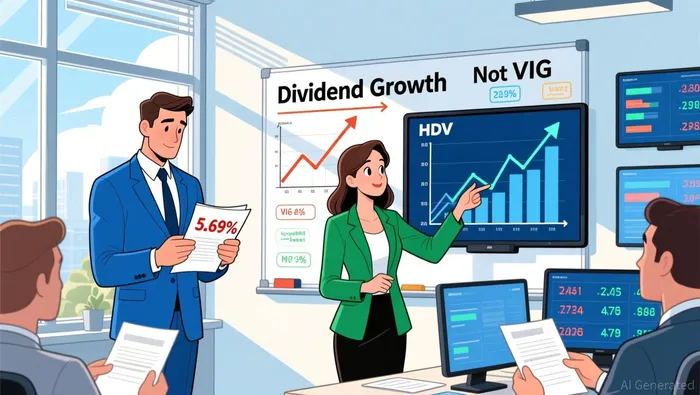
The headline yield is only the starting point. For a value investor, the true test is the quality and durability of the income stream. HDV's nearly 3.1% yield is supported by a portfolio of companies whose earnings and cash flows are often tied to the economic cycle. This volatility is baked into the dividend payments themselves. Over the past three years, the fund's average dividend growth rate has been 5.69%. But that average masks significant swings. The dividend history shows payments jumping as much as 35% one quarter, then dropping nearly 30% the next. This pattern signals less predictable earnings and a business model where profitability can contract sharply during downturns. The high yield, in this light, is a reward for accepting this cyclical uncertainty.
VIG takes a different approach. Its strategy is explicitly to own companies with a record of increasing dividends over time. This isn't about chasing the highest current payout; it's about selecting businesses with stable, high-quality earnings that can reliably grow their returns to shareholders. The fund's tilt toward technology and financial services reflects this focus on durable competitive advantages and consistent capital allocation. While the current yield is lower, the sustainability is higher. The income stream is backed by a compounding engine, not a cyclical one.
This distinction becomes particularly relevant in a strong market. The S&P 500 gained 16.39% in 2025, marking its third straight year of double-digit gains. In such an environment, growth-oriented portfolios like VIG are often better positioned to participate in broad market appreciation. The companies within its portfolio-those with a history of raising dividends-are typically the same high-quality, scalable businesses driving long-term market gains. HDV's cyclical holdings may benefit from the economic expansion, but their earnings and dividends remain more vulnerable to the next downturn. For an investor focused on the quality of earnings and the sustainability of income, VIG's approach offers a wider margin of safety.
Valuation, Risk, and the Long-Term Compounding Engine
The final test for any investment is its ability to compound wealth over time, adjusted for the risk taken. Here, the performance data reveals a clear winner for the long-term investor. Over the past year, VIG delivered a total return of 14.4%, outpacing HDV's 12.0%. More importantly, VIG's returns were achieved with superior risk-adjusted efficiency. Its Sharpe ratio of 0.72 significantly exceeds HDV's 0.44. This means VIG generated more return per unit of volatility, a critical metric for sustainable compounding. The fund's lower maximum drawdown over the past five years--20.39% versus HDV's -15.41%-further illustrates its resilience during market stress, a hallmark of a durable business model.
This risk profile is reflected in their portfolio betas. HDV's portfolio is less volatile than the broader market, with a beta of 0.64. VIG's beta of 0.85 indicates it moves more closely with the S&P 500, which is typical for a growth-oriented portfolio heavy in technology and financials. The lower expense ratio of HDV-0.08% versus VIG's 0.06%-is a minor cost advantage, but it is more than offset by HDV's higher portfolio volatility. For a value investor, the margin of safety isn't just about price; it's about the stability of the underlying earnings engine. VIG's higher beta is a function of its exposure to scalable, high-quality businesses, not a sign of poor management.
The fund's sheer size and liquidity also matter. With assets under management of $102 billion, VIG operates on a scale that provides a stable and less volatile capital base. This size allows for efficient execution and broad diversification across its 338 holdings, including giants like Microsoft and Apple. HDV's $12 billion AUM, while respectable, represents a smaller pool of capital. For the patient investor, the combination of stronger risk-adjusted returns, a portfolio built on compounding engines, and a massive, stable capital base makes VIG the superior vehicle for long-term wealth creation. It is the fund that best aligns with the principle of buying a wonderful business at a fair price, and letting it compound for decades.
Catalysts, Risks, and What to Watch
The investment thesis for both funds hinges on future economic conditions and market valuations. For HDV, the primary risk is an economic slowdown that hits its cyclical sector concentration. The fund's heavy weighting in energy, healthcare, and consumer staples means its income stream is directly exposed to the business cycle. A downturn could pressure earnings and cash flows at its large holdings, potentially forcing dividend cuts. This would challenge the fund's high yield and undermine the margin of safety that investors seek. The risk is not just lower income, but a potential re-rating of the entire portfolio as the durability of its business models comes into question.
For VIG, the main vulnerability is a valuation correction in technology and growth stocks. The fund's outperformance is driven by its tilt toward scalable, high-quality businesses, but these companies often trade at a premium. If the market reassesses the sustainability of their growth or if interest rates remain elevated, the premium paid for dividend growth could compress. This would pressure total returns, even if the underlying companies continue to raise dividends. The fund's technology and financial services exposure makes it more sensitive to this kind of market-wide repricing.
In both cases, investors should monitor the Federal Reserve's policy path and inflation trends. These factors will impact the cost of capital for all companies in both portfolios. Persistent inflation or a delay in rate cuts could pressure margins, particularly for the more leveraged or growth-heavy firms in VIG's portfolio. Conversely, a dovish pivot could support valuations. The broader market's trajectory, as seen in the S&P 500's 16.39% gain in 2025, sets the stage for these catalysts. In a strong market, VIG's growth engine can shine. In a more volatile or weakening environment, HDV's defensive sectors may offer a steadier, though less rewarding, path. The watchlist is clear: economic data, Fed signals, and the health of the tech sector will determine which fund's thesis holds.







Comentarios
Aún no hay comentarios