
HDFC Bank's Governance Crisis Creates Event-Driven Buy Setup—Watch Board Meeting for Clarity Catalyst
The catalyst was a surprise resignation. Atanu Chakraborty stepped down as non-executive chairman of HDFC BankHDB-- last Wednesday, citing "ethical concerns" over practices he said conflicted with his personal values. He stressed there was no wrongdoing and that his ideologies simply did not match the organization's. The bank disclosed the exit late in the trading day, but the damage was already done.
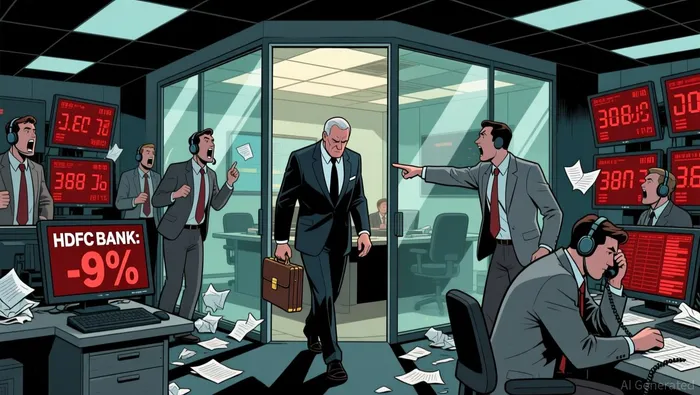
The market's reaction was swift and severe. Shares plunged nearly 9% on Thursday, wiping out over Rs 1 lakh crore in investor wealth in just a few hours. US-listed ADRs had already dropped over 7% overnight. This wasn't just a stock-specific sell-off; it was a full-blown governance shock that triggered a broader market rout. The drop coincided with a global risk-off wave sparked by an energy shock in the Middle East and a hawkish US Federal Reserve, amplifying the panic and dragging down the Nifty 50 and Sensex.
The mechanics are clear. A resignation at India's largest private bank, especially one framed as a values clash, raises a "governance risk premium." Investors demand a lower price to hold the stock until leadership offers credible fixes. The jitters spread quickly, with all major sectors falling and banks leading the decline. In practice, this created a perfect storm: a specific company event collided with a global sentiment shift, magnifying the impact on a stock that is a huge weight in the market indices.
The Setup: Interim Leadership and Key Catalysts
The immediate operational risk is now contained. The bank has a clear, stable hand: Keki Mistry was appointed interim chairman for three months with RBI approval. Mistry, a former HDFCHDB-- CEO, has publicly dismissed speculation of internal conflict and stated there was no material difference between Chakraborty and the board. This provides a crucial three-month buffer to maintain stability while the search for a permanent successor unfolds.
The next major catalyst is the board meeting scheduled in about a month. That gathering will discuss the reappointment of CEO Sashidhar Jagdishan, whose current term ends in seven months. This meeting is a key signal. A smooth reappointment would reinforce continuity and management confidence, potentially easing investor nerves. Any delay or controversy here could reignite the governance overhang that sparked the initial sell-off.
For now, the market's focus is on what comes next. The bank has stated there are no issues, but the unresolved "ethical concerns" remain a cloud. Investors must watch for any further disclosures from the bank or regulators about the nature of these concerns. The board's repeated attempts to get Chakraborty to elaborate were unsuccessful, leaving a gap in information that fuels uncertainty. Until that gap is filled, the stock will remain vulnerable to sentiment swings.
The Risk/Reward: Valuation and What to Watch
The price action tells a clear story. HDFC Bank shares are trading near their 52-week low of Rs 26.41, just a hair above that level. The stock is down over 27% year-to-date, a brutal decline that has erased a significant portion of its recent gains. This creates a classic event-driven setup: a sharp drop following a governance shock, leaving the stock at a discount to its own recent history.
The risk/reward hinges on the unresolved "ethical concerns." On one side, the RBI has provided a crucial anchor of stability. The central bank stated there are "no material concerns on record as regards its conduct or governance". This official stamp of approval is a key counterweight to the market panic. It suggests the bank's fundamentals and financial health are intact, even as its reputation faces a temporary cloud.
The near-term trigger is now in focus. The board meeting scheduled in about a month will discuss the reappointment of CEO Sashidhar Jagdishan. This gathering is the next major catalyst. A smooth, unanimous reappointment would send a powerful signal of internal unity and management confidence, directly addressing the governance overhang. It could provide the clarity needed to reverse the sell-off.
On the flip side, any ambiguity or delay in that process would keep the pressure on. The board's repeated inability to get Chakraborty to specify his concerns leaves a gap that fuels uncertainty. Until that gap is filled, the stock remains vulnerable to sentiment swings. The tactical play is to watch for a clear signal of stability at that board meeting. For now, the valuation offers a discount, but the risk is that the "trap" is a prolonged period of reputational drag and regulatory scrutiny, even if the RBI finds no formal wrongdoing.





Comentarios
Aún no hay comentarios