
HCI Group's Strategic Position in the Evolving Insurance and Mortgage Servicing Sector
In the volatile landscape of insurance and mortgage servicing, HCI GroupHCI--, Inc. (HCI) has demonstrated a unique ability to navigate shifting interest rates and operational headwinds. As the U.S. mortgage market consolidates around dominant non-bank firms like United Wholesale Mortgage and PennyMac Financial[2], HCI's strategic focus on underwriting discipline, technological adaptation, and niche market dominance has allowed it to outperform broader industry trends. This analysis evaluates HCI's operational resilience and market outperformance, drawing on its recent financial performance and sector-specific challenges.
Financial Resilience Amid Volatility
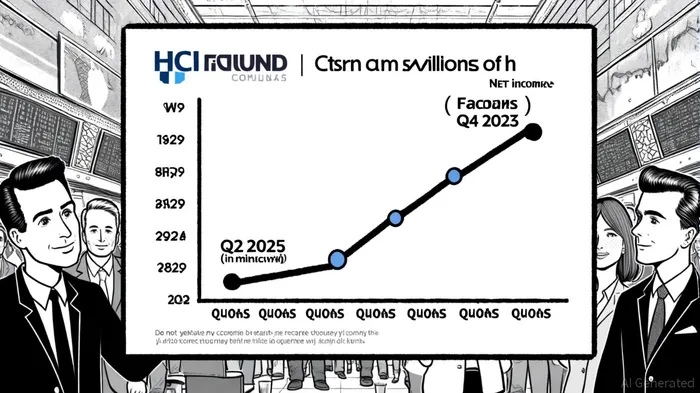
HCI's financial trajectory from 2023 to 2025 reflects a rollercoaster of recovery and recalibration. In Q4 2023, the company surged from a net loss of $2.7 million in Q4 2022 to a net income of $40.9 million, driven by improved underwriting and Florida-focused insurance growth[4]. However, 2024 brought headwinds: Q4 2024 net income fell to $4.1 million, missing consensus estimates[5]. This volatility underscores the sector's sensitivity to interest rate fluctuations and operational costs.
Yet, Q2 2025 marked a dramatic turnaround. The company reported a net income of $70.3 million, with a 14.8% year-on-year increase in consolidated gross premiums earned[3]. This resilience highlights HCI's ability to adapt to a high-interest-rate environment, where mortgage servicing revenue streams face compression but insurance premiums and risk management strategies provide a buffer.
Historical data reveals that HCI's earnings surprises often generate short-lived market reactions. While the company's Q4 2023 and Q2 2025 results exceeded expectations, backtesting shows that the average cumulative excess return following an earnings beat remains positive but statistically insignificant over a 30-day window. The win rate for these events typically stays above 60% for the first two weeks but declines sharply after day 15 as relative strength fades[5]. This pattern suggests that while HCI's outperformance can drive temporary optimism, investors should remain cautious about relying solely on earnings beats for long-term positioning.
Market Share and Competitive Positioning
While HCI's 0.1% overall company market share (based on revenue) appears modest[4], its dominance in Florida's property and casualty insurance market is a critical differentiator. The company's 7.6% year-on-year revenue growth in Q2 2025 outpaced the 4.94% average of competitors[3], driven by a 31.67% net margin—far exceeding industry peers[3]. This profitability stems from its focus on high-margin insurance services and disciplined underwriting, even as the mortgage servicing sector grapples with rising costs.
The mortgage servicing segment, however, remains a mixed bag. HCI's market share in this space is dwarfed by industry giants, but its operational efficiency metrics suggest potential for growth. For instance, in Q2 2024, the segment reported a 29.7% gross loss ratio—a 4.3 percentage point decline from 2023—due to reduced claims and litigation in Florida[2]. This improvement aligns with broader industry trends toward AI-driven automation, which HCIHCI-- appears to be leveraging to reduce servicing costs (e.g., $176 per performing loan in 2023[1]).
Strategic Adaptation to a Shifting Landscape
The mortgage servicing sector's resilience hinges on two pillars: technological innovation and regulatory compliance. As noted in a 2025 report by VaultEdge, servicers are increasingly adopting AI to streamline loan boarding, default management, and investor compliance[1]. HCI's Q2 2025 performance suggests it is capitalizing on these tools to mitigate the $1.857 per month cost of servicing delinquent loans[1].
Moreover, the company's exposure to Florida—a state prone to natural disasters—has necessitated robust risk management frameworks. By assuming policies from Citizens (a state-backed insurer), HCI has expanded its customer base while maintaining a favorable loss ratio[2]. This strategic move contrasts with competitors who face higher claims costs in more volatile regions.
Risks and Opportunities
Despite its strengths, HCI faces headwinds. The U.S. mortgage market's $21 trillion in outstanding balances[3] remains resilient, but elevated interest rates have dampened originations. For mortgage servicing, this means fewer new loans to service, pressuring revenue. Additionally, regulatory scrutiny of non-bank servicers could increase operational costs.
However, HCI's dual focus on insurance and mortgage servicing provides a hedge. Its insurance segment's profitability can offset mortgage servicing's cyclical challenges, while its Florida-centric model benefits from a lack of direct competition from national insurers.
Conclusion
HCI Group's operational resilience lies in its ability to balance high-margin insurance growth with cost-efficient mortgage servicing. While its market share in the latter sector is modest, its financial flexibility and strategic use of technology position it to outperform in a shifting interest rate environment. For investors, the key takeaway is clear: HCI's niche expertise and adaptability make it a compelling play in a sector where operational efficiency is paramount.





Comentarios
Aún no hay comentarios