
HC Surgical Specialists (Catalist:1B1): Decelerating Returns and Long-Term Viability in a Dynamic Surgical Sector
The surgical services sector in 2025 is undergoing a transformation driven by technological innovation and shifting care models. Against this backdrop, HC Surgical Specialists (Catalist:1B1) has delivered a mixed performance, marked by impressive annual results but muted quarterly growth. This duality raises critical questions about the company's long-term viability and its ability to sustain returns in a competitive landscape.
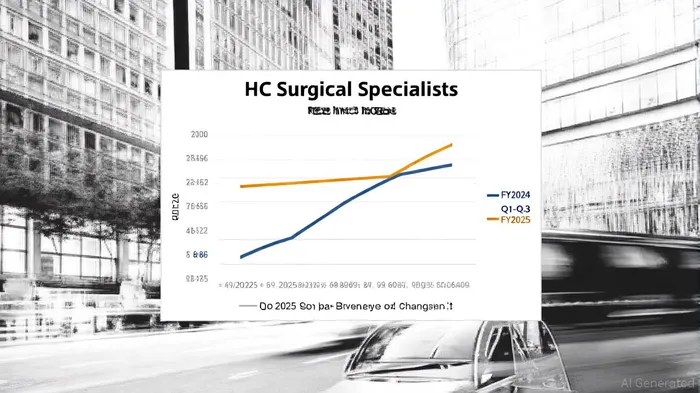
Annual Triumphs, Quarterly Stagnation
HC Surgical Specialists reported a 119% year-over-year surge in net income to S$8.44 million for FY2025, alongside an 18% revenue increase to S$22.4 million[1]. These figures reflect a dramatic improvement in profit margins, which rose from 20% in FY2024 to 38% in FY2025[2]. Such performance is largely attributed to strategic expansion into orthopedics, including the addition of three orthopedic centers and specialized surgeons[3]. However, these gains mask a concerning trend: quarterly data for Q1-Q3 2025 reveals flat revenue and EBIT margins[4]. This stagnation suggests that the company's growth is concentrated in annual reporting periods rather than being sustained throughout the year, a red flag for investors seeking consistent returns.
Sector Tailwinds vs. Operational Headwinds
The global surgical industry is projected to grow at a 8.5% CAGR through 2033, fueled by aging populations and the rise of ambulatory surgery centers (ASCs)[5]. Orthopedic procedures, in particular, are driving revenue per case, with net margins reaching $6,419 in 2024[6]. HC Surgical's foray into orthopedics aligns with these trends, yet its market share remains undefined. Competitors like Fullerton Health and Parkway Pantai dominate Singapore's surgical services sector[7], while the company's small market cap (S$54.45 million) raises questions about its scalability[8].
A critical challenge lies in the company's capital allocation. Despite a robust ROCE of 24%, HC Surgical's capital employed has remained flat over five years[9], indicating limited reinvestment in growth initiatives. This contrasts with sector peers leveraging AI-driven preoperative planning and robotic-assisted surgeries to enhance margins[10]. Without reinvestment, the company risks falling behind in a sector where technological adoption is non-negotiable.
Early Warning Signs and Strategic Gaps
While FY2025 results are laudable, several red flags emerge. First, the absence of quarterly growth data for Q1-Q3 2025 suggests operational inefficiencies or unmet demand during these periods[11]. Second, the company faces governance concerns, including insufficient new directors and earnings quality issues[12]. These factors could undermine investor confidence, particularly as the sector becomes increasingly competitive.
Moreover, HC Surgical's reliance on a narrow range of services-endoscopic procedures and orthopedics-leaves it vulnerable to market shifts. For instance, the rise of GLP-1 drugs, which reduce obesity-related joint deterioration, could dampen long-term demand for orthopedic surgeries[13]. While the company has diversified into orthopedics, it has yet to demonstrate resilience against such macroeconomic headwinds.
Long-Term Viability: A Calculated Outlook
To assess long-term viability, investors must weigh HC Surgical's strengths against its structural limitations. The company's 38% profit margin and strategic expansion into orthopedics position it to capitalize on sector growth[14]. However, its flat capital employed and governance concerns suggest a lack of ambition to scale operations[15].
A key differentiator will be its ability to integrate emerging technologies. For example, AI-driven surgical planning and 3D-printed implants are becoming standard in advanced markets[16]. HC Surgical's current focus on operational efficiency-such as clinic consolidation-may not suffice to compete with tech-forward rivals.
Conclusion
HC Surgical Specialists' FY2025 results underscore its potential as a sector player, but the decelerating quarterly returns and lack of reinvestment signal early-stage vulnerabilities. While the surgical services sector offers tailwinds, the company's long-term viability hinges on addressing governance gaps, embracing technological innovation, and demonstrating consistent quarterly performance. For now, investors may view HC Surgical as a high-risk, high-reward proposition-capable of outperforming in annual reports but requiring closer scrutiny for sustained growth.







Comentarios
Aún no hay comentarios