
HBAR's Stability Amid a Volatile Crypto Market and Its Implications for Long-Term Investors
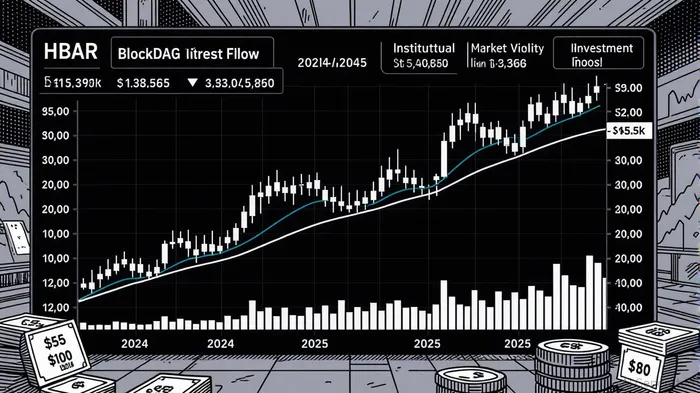
The cryptocurrency market in 2024–2025 has been defined by extreme volatility, regulatory uncertainty, and a shift in institutional investment priorities. Amid this turbulence, HBARHBAR--, the token of the HederaHBAR-- Hashgraph network, has emerged as a unique case study in stability. While presale projects like BlockDAG and PENGU have captured headlines with explosive growth and speculative fervor, HBAR’s institutional-grade infrastructure and real-world adoption metrics position it as a counterpoint to the hype-driven narratives dominating the sector.
Institutional Support: HBAR’s Foundation for Resilience
HBAR’s institutional credibility is anchored in strategic partnerships and enterprise-grade use cases. The Hashgraph Association’s collaboration with Taurus to enhance global HBAR custody and tokenization has directly addressed institutional concerns about security and compliance [4]. Similarly, Wyoming’s adoption of the FRNT stablecoin on Hedera’s network underscores the platform’s appeal to governments seeking transparent, scalable solutions for digital currency [4]. These developments are not mere PR milestones; they reflect a deliberate effort to integrate HBAR into the backbone of global finance.
In contrast, BlockDAG and PENGU rely on speculative momentum. BlockDAG’s $101.5 million presale and 3 million mining community highlight its grassroots appeal, but institutional validation remains limited [5]. PENGU, a Solana-based memecoin, thrives on viral branding and community-driven price action, yet lacks the enterprise partnerships that anchor HBAR’s value proposition [1]. While these projects may benefit from short-term retail enthusiasm, their long-term viability hinges on attracting institutional-grade infrastructure—a gap HBAR has already filled.
Market Resilience: HBAR vs. the Volatility of Presale Projects
HBAR’s price performance in 2024–2025 has been marked by drawdowns, particularly in August 2025, where selling pressure pushed the token to $0.218—a 9% monthly decline [1]. However, its institutional adoption and real-world utility (e.g., IBM’s World Wire integration) have mitigated the severity of these swings compared to altcoins like SolanaSOL-- (SOL) and SuiSUI--, which fell 68% year-to-date [2]. This resilience stems from HBAR’s role as a liquidity bridge in cross-border payments, a use case insulated from the speculative cycles affecting meme coins and DAG-based networks.
BlockDAG and PENGU, meanwhile, exhibit textbook volatility. PENGU’s 12–13% price spikes alongside Dogwifhat (WIF) reflect its exposure to meme coin dynamics, where sentiment-driven trading dominates [2]. BlockDAG’s presale success—raising $101.5 million—has translated into retail hype but lacks the macroeconomic safeguards of HBAR’s enterprise-grade DLT (Distributed Ledger Technology) adoption [5]. For long-term investors, this distinction is critical: HBAR’s stability is rooted in infrastructure, while BlockDAG and PENGU’s growth depends on market sentiment.
Institutional Investment Flows: A Tale of Two Paradigms
HBAR’s institutional traction is further evidenced by its alignment with ISO 20022 standards, which streamline cross-border payments and reduce forex risks [3]. This technical integration has attracted corporate treasuries and financial institutionsFISI-- seeking compliance-ready solutions, a stark contrast to the unregulated presale frenzy surrounding BlockDAG and PENGU. For instance, BlockDAG’s recent VC investment signals institutional interest, but its DAG-based architecture remains untested in enterprise environments [1]. PENGU, meanwhile, lacks any institutional-grade infrastructure, relying instead on social media virality to sustain its price.
HBAR’s institutional inflows, though not quantified in the provided data, are implied by its role in Wyoming’s stablecoin initiative and TokenySolutions’ tokenization efforts [4]. These partnerships suggest a steady, if less visible, flow of capital from entities prioritizing long-term utility over speculative gains. In contrast, PENGU’s “600% price surge” and BlockDAG’s $388 million valuation are driven by retail FOMO, a model prone to rapid reversals during market corrections [1].
Implications for Long-Term Investors
For investors seeking stability in a volatile market, HBAR’s institutional-grade infrastructure and real-world adoption metrics offer a compelling case. While BlockDAG and PENGU may deliver short-term returns, their reliance on speculative demand makes them inherently riskier. HBAR’s partnerships with Taurus, Wyoming, and IBMIBM--, combined with its role in cross-border payments, position it as a “crypto infrastructure stock” with defensiveness akin to traditional financial assets.
However, HBAR is not without challenges. Its September 2025 price decline and historical 10% monthly drawdowns highlight the need for caution [1]. Investors must weigh these risks against the token’s institutional adoption and macroeconomic tailwinds, such as ISO 20022 integration. For those prioritizing long-term value over speculative gains, HBAR’s stability—rooted in enterprise-grade DLT—may prove more durable than the fleeting hype of presale projects.
Source:
[1] HBAR price volatility and institutional inflows, [https://www.mitrade.com/insights/news/live-news/article-3-1086365-20250902]
[2] VanEck Crypto Monthly Recap for April 2025, [https://www.vaneck.com/us/en/blogs/digital-assets/matthew-sigel-vaneck-crypto-monthly-recap-for-april-2025/]
[3] ISO 20022 Standards and Crypto Liquidity Dynamics, [https://www.clometrix.com/news/macroeconomics-crypto/iso-20022-standards-and-crypto-liquidity-dynamics-volatility-in-cross-border-payments]
[4] Hedera Hashgraph Price, [https://messari.io/project/hedera-hashgraph]
[5] BlockDAG’s X1 Miner Pulls In 300K+ Users, [https://www.mitrade.com/insights/news/live-news/article-3-544587-20241227]






Comentarios
Aún no hay comentarios