
HBAR's Quiet Resilience: A Deep Dive into Undervaluation and Entry Points in 2025
The Case for HBAR: Stability Amidst Market Noise
Hedera (HBAR) has carved a niche in Q3 2025 as a stable yet undervalued blockchain asset, trading within a narrow range despite being overshadowed by retail-driven hype cycles. According to a report by DeepBrief21, on-chain activity has surged, with the HederaHBAR-- Token Service (HTS) seeing a 30% increase in active accounts and consistent developer contributions[2]. This quiet growth is underpinned by enterprise adoption, including SK Telecom's CBDC pilot in South Korea—a testament to institutional trust in Hedera's consensus infrastructure[2].
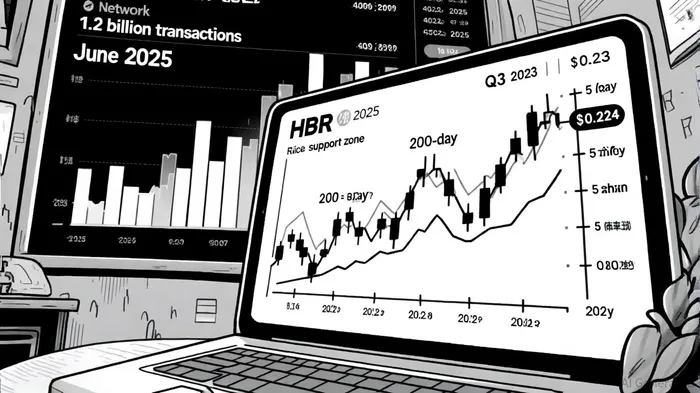
Fundamentally, the network processed 1.2 billion transactions in June 2025, maintaining 90 TPS with low latency[2]. However, its market valuation lags behind this utility, creating a compelling asymmetry. The HBARHBAR-- Foundation's $45 million allocation to DePIN, tokenization, and climate tech further cements its real-world application focus[2].
Technical Indicators: A Balancing Act
HBAR's technical profile reflects a tug-of-war between bearish and bullish forces. The RSI at 52 and MACD hovering near the signal line suggest a neutral market, while the 5-day moving average's upward trend hints at short-term optimism[1]. Conversely, the 200-day MA remains in a descending channel, signaling long-term bearishness[1].
Price action has already priced in skepticism, with a 16% monthly drop leaving the $0.23–$0.24 support zone as a critical psychological barrier[1]. If this level holds, it could trigger a rebound toward $0.29–$0.30, aligning with the logarithmic regression channel's lower bound[4]. Whale accumulation patterns, where large holders have increased stakes by 12% in Q3 2025, further reinforce long-term confidence[3].
NVT Ratio and Peer Comparison: A Tale of Two Valuations
The Network Value-to-Transactions (NVT) ratio is pivotal in assessing HBAR's undervaluation. As of August 2025, HBAR's NVT stands at 83.16, significantly higher than Solana's 10.22[4]. This suggests HBAR's market cap is disproportionately inflated relative to its transaction volume, a classic sign of undervaluation. In contrast, Cardano's NVT ratio has hit a 22-month high, indicating potential overvaluation despite growing staking participation[5].
HBAR's aBFT consensus mechanism, offering 10,000 TPS with 3–5 second finality, provides a reliability edge over Solana's PoH/PoS hybrid, which has faced network outages[4]. While Solana's ecosystem thrives on retail adoption and DeFi TVL, HBAR's enterprise-grade security and partnerships with Google and IBM position it as a long-term infrastructure play[4].
Entry Points and Risk Mitigation
For investors, HBAR's current price action presents a strategic entry opportunity. The $0.23–$0.24 support zone, if validated, could serve as a low-risk entry point, especially if the SEC approves spot HBAR ETFs by Q4 2025 (estimated 35%–90% probability)[1]. Additionally, the network's burn rate via AI ledger transactions and carbon tracking partnerships may offset supply-side pressures from token unlocks (250M–300M HBAR to pre-2018 executives)[1].
However, risks persist. A delay in ETF approval or a surge in selling pressure from unlocks could test the $0.20–$0.21 secondary support. Investors should also monitor Cardano's NVT dynamics, as a correction in ADA's overvalued state could indirectly impact HBAR's relative appeal[5].
Conclusion: A Calculated Bet on Enterprise Utility
HBAR's combination of enterprise adoption, reliable performance, and undervaluation metrics makes it a compelling case for 2025. While macro risks like regulatory delays and token unlocks linger, the asset's fundamentals and technical setup suggest a high reward-to-risk ratio. For those with a medium-term horizon, the $0.23–$0.24 support zone offers a disciplined entry point, backed by growing on-chain utility and institutional validation.






Comentarios
Aún no hay comentarios