
Hawkish Rate Cuts: A Delicate Balance Between Inflation Control and Economic Stability
The Federal Reserve's December 2025 rate cut-a 25-basis-point reduction to a target range of 3.50-3.75%-has sparked intense debate among investors and economists. While the move signals a cautious easing of monetary policy, the Fed's "hawkish" tone underscores its reluctance to commit to further cuts amid persistent inflation and a fragile labor market. This divergence in signals-lower rates paired with a guarded stance-creates a complex environment for investors navigating macroeconomic uncertainty.
The Fed's Policy Dilemma: Inflation, Employment, and Internal Divisions
The Fed's decision to cut rates in December 2025 followed a labor market showing signs of strain. Job gains slowed, and the unemployment rate rose to 4.4%, up from a 53-year low of 3.4% earlier in the year. Despite these pressures, the central bank emphasized its commitment to bringing inflation back to 2% while avoiding a full-scale easing cycle. Core PCE inflation, at 2.8%, remains above target, and the Fed's Summary of Economic Projections now forecasts only one additional rate cut in 2026, far below market expectations.
This "hawkish cut" reflects a broader policy dilemma. The Fed must balance the risk of a labor market downturn with the threat of inflation persisting longer than anticipated. Internal disagreements within the FOMC highlight this tension: three members dissented, with some advocating for a larger 50-basis-point cut and others opposing any reduction. The central bank's cautious approach is further complicated by external factors, such as the potential inflationary impact of Trump's proposed trade and fiscal policies according to BBVA research.
Market Reactions: Mixed Signals and Modest Gains
The December rate cut elicited a muted but positive response from financial markets. The S&P 500 rose 0.67%, while the Russell 2000 surged 1.3%, reflecting optimism about lower borrowing costs. Bond markets also reacted favorably, with the 10-year Treasury yield dropping to 4.15% as investors priced in reduced inflation expectations according to U.S. Bank analysis. However, these gains were tempered by the fact that the rate cut had largely been anticipated, leaving room for volatility if future data diverges from the Fed's projections as reported by Investors.com.
The Fed's announcement to purchase short-term Treasury securities to maintain liquidity according to Federal Reserve press release further bolstered market confidence, signaling a commitment to supporting financial stability. Yet, the central bank's data-dependent approach-emphasized by Chair Jerome Powell-leaves investors in a state of uncertainty. With the Fed now projecting only one more rate cut, versus market expectations of two, the risk of policy misalignment remains elevated.
Strategic Investment Implications: Navigating Divergent Signals
For investors, the Fed's mixed signals necessitate a nuanced approach to asset allocation. The following strategies emerge as critical in this environment:
Equities: Sector Rotation and Quality Focus
Historically, equities perform best when the Fed cuts rates in non-recessionary conditions according to UBS research. In the current climate, sectors poised to benefit from lower interest rates-such as technology, consumer discretionary, and real estate-appear well-positioned. The technology sector, in particular, is gaining momentum due to AI-driven innovation and strategic reinvestment, making it a key area for exposure according to advisory insights.Quality Bonds: Yield and Diversification
Medium-duration government and investment-grade corporate bonds offer a compelling balance of yield and risk mitigation. With the Fed's easing path likely to continue in 2026, these bonds are expected to deliver mid-single-digit returns while providing diversification against equity volatility as UBS analysts note.Gold: A Safe Haven Amid Uncertainty
Gold's role as a hedge against inflation and geopolitical risks has gained renewed relevance. Analysts project gold prices could reach $4,500/oz by mid-2026, driven by lower real yields and persistent macroeconomic uncertainties.Currency Allocations: Favoring the Euro and Australian Dollar
The U.S. dollar's relative weakness, coupled with divergent policy paths in Europe and Japan, makes the euro and Australian dollar attractive. European equities in sectors like financials and utilities also offer re-rating potential as valuations remain attractive compared to U.S. peers according to market analysis.
Navigating the K-Shaped Economy
The Fed's dual mandate faces additional challenges in a K-shaped economy, where high-income households and large corporations thrive while lower-income segments struggle. This divergence complicates policy decisions, as rate cuts may disproportionately benefit asset-rich individuals while offering limited relief to cash-constrained consumers. Investors must remain agile, adjusting allocations to reflect sector-specific resilience and risk tolerance.
Conclusion: A Data-Driven Path Forward
The Fed's December 2025 rate cut exemplifies the delicate balancing act between inflation control and economic stability. While the move provides temporary relief to a cooling labor market, the central bank's hawkish stance underscores its commitment to price stability. For investors, the key lies in maintaining a diversified portfolio that adapts to evolving policy signals and macroeconomic trends. As the Fed navigates its path in 2026, agility and a focus on quality assets will be paramount.
The Fed's announcement to purchase short-term Treasury securities to maintain liquidity according to Federal Reserve press release further bolstered market confidence, signaling a commitment to supporting financial stability. 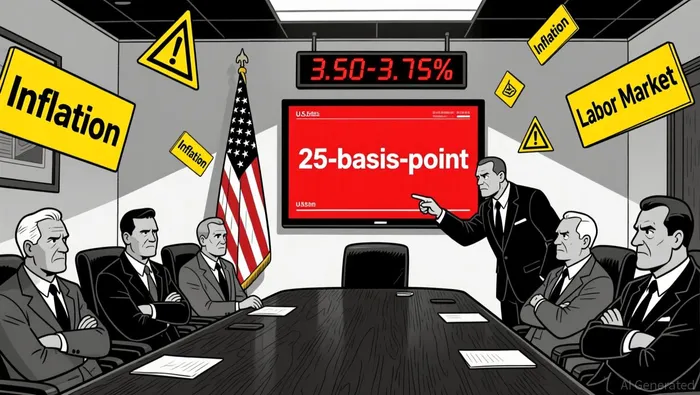 Yet, the central bank's data-dependent approach-emphasized by Chair Jerome Powell-leaves investors in a state of uncertainty. With the Fed now projecting only one more rate cut, versus market expectations of two, the risk of policy misalignment remains elevated.
The December rate cut elicited a muted but positive response from financial markets. The S&P 500 rose 0.67%, while the Russell 2000 surged 1.3%, reflecting optimism about lower borrowing costs. Bond markets also reacted favorably, with the 10-year Treasury yield dropping to 4.15% as investors priced in reduced inflation expectations according to U.S. Bank analysis. However, these gains were tempered by the fact that the rate cut had largely been anticipated, leaving room for volatility if future data diverges from the Fed's projections as reported by Investors.com.







Comentarios
Aún no hay comentarios