
Hawaiian Electric's Strategic Debt Issuance: A Smart Move for Capital Deployment and Shareholder Value?
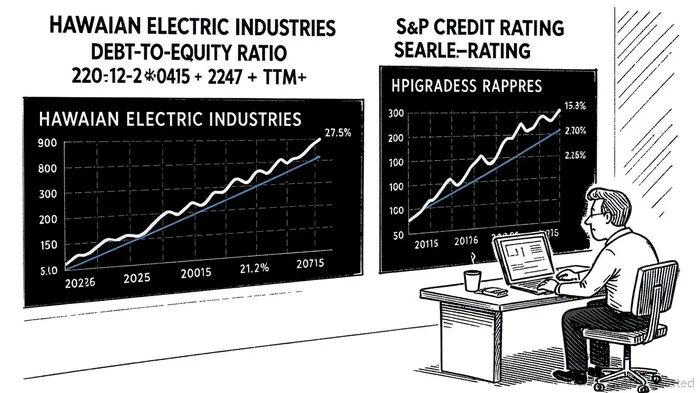
Hawaiian Electric Industries (HEI) has recently completed a $400 million senior note offering, a move that has sparked debate among investors about its implications for capital structure optimization and risk-adjusted returns. This analysis evaluates whether the issuance aligns with HEI’s strategic goals, particularly in light of its heavily leveraged balance sheet and evolving credit profile.
Capital Structure: A High-Stakes Balancing Act
HEI’s debt-to-equity ratio of 220.12 as of Q2 2025 underscores a capital structure that is exceptionally reliant on debt financing [2]. While leverage can amplify returns in stable environments, it also heightens vulnerability during periods of financial stress. The company’s interest coverage ratio of 2.08 for the same period—calculated by dividing operating income ($54 million) by interest expense ($26 million)—suggests it can cover its interest obligations, but with limited margin for error [2]. For context, a ratio above 3 is typically considered a safer threshold for sustainable debt servicing.
The $400 million senior note, which matures in 2025 and carries a 5% annual interest rate, appears to be part of a broader strategy to refinance existing liabilities and fund operational needs [2]. HEI has previously used similar instruments, including HEI 2.48%-6.10% senior notes due between 2025 and 2052, to manage its capital structure [2]. However, with $1.92 billion in settlement obligations to be paid over four years—including $479 million annual payments starting in Q4 2025—the company faces significant liquidity pressures [1].
Credit Rating Dynamics: A Mixed Signal
Standard & Poor’s recent upgrade of HEI’s long-term issuer credit rating to 'B+' from 'B-' signals improved confidence in its financial resilience [1]. This follows a 2023 downgrade to 'BB-' linked to wildfire-related liabilities, which had raised concerns about the company’s risk profile [2]. The positive outlook adjustment suggests that HEI’s efforts to strengthen liquidity—such as selling American Savings Bank for $380 million and retiring $384 million in debt—are paying off [3].
Yet, the 5% interest rate on the new senior notes appears relatively high given the upgraded credit rating. For comparison, HEI’s existing notes carry rates as low as 2.48%, reflecting earlier periods of higher market volatility and lower creditworthiness [2]. The discrepancy raises questions about whether the company could secure more favorable terms, particularly as energy sector capital markets have stabilized in 2025 [3].
Use of Proceeds: Strategic or Reactive?
The proceeds from the $400 million offering are slated for “general corporate purposes,” including potential expansion and debt refinancing [3]. While this flexibility allows HEI to address immediate needs, it lacks the specificity of targeted investments—such as renewable energy infrastructure or grid modernization—that could enhance long-term value. By contrast, peers like Sunnova have used similar green senior note offerings to fund sustainability initiatives, which often attract lower borrowing costs and align with ESG-driven investor preferences [3].
HEI’s liquidity measures, including a $250 million at-the-market equity program and a $239 million utility accounts receivable-backed credit facility, demonstrate a proactive approach to managing cash flow [1]. However, the company’s reliance on short-term solutions—such as quarterly dividends reinstated at $10 million—may not address structural challenges tied to its debt-heavy capital structure [3].
Risk-Adjusted Returns: A Calculated Gamble
From a risk-adjusted returns perspective, HEI’s debt issuance presents a nuanced trade-off. On one hand, the upgraded credit rating and improved liquidity position reduce the likelihood of default, potentially lowering future borrowing costs. On the other, the high debt-to-equity ratio and modest interest coverage ratios leave little room for operational setbacks, such as rising wildfire liabilities or regulatory penalties.
Investors must also consider the broader context: HEI’s capital structure optimization hinges on resolving its $1.92 billion settlement obligation, a process that could strain cash reserves even with current liquidity measures [1]. The success of the $400 million offering will ultimately depend on whether the proceeds enable HEI to delever its balance sheet or merely extend the timeline for addressing deeper structural issues.
Conclusion: A Step Forward, But Not a Silver Bullet
HEI’s $400 million senior note offering reflects a strategic attempt to navigate near-term liquidity challenges and capitalize on improved credit conditions. While the upgraded S&P rating and debt retirement efforts are positive developments, the company’s heavily leveraged capital structure and opaque use of proceeds for “general corporate purposes” suggest caution. For risk-adjusted returns to justify this move, HEI must demonstrate that the proceeds will be deployed to reduce long-term liabilities, invest in growth opportunities, or insulate itself from wildfire-related shocks. Until then, the offering remains a calculated gamble rather than a definitive path to shareholder value creation.
Source:
[1] Horizon Kinetics: Hawaiian ElectricHE-- ($HE) Investment Case [https://www.bbae.com/blog/horizon-kinetics-hawaiian-electric-he-investment-case/]
[2] HE | Hawaiian Electric IndustriesHE-- Inc. Financial Statements [https://www.wsj.com/market-data/quotes/HE/financials?gaa_at=eafs&gaa_n=ASWzDAiMaID_rFu-Q6jsTbgywwsdagze3fKNr_TQFEkaeNgkBFXJAy09gSzV&gaa_sig=8JmXSSwKFVuoYAv16ZUeltgFK2nkEkMsZQ2X-SXtGndTKapKULUXBINFW8ifbdhsx2yDIRaBatmRGoZbelzbOQ%3D%3D&gaa_ts=68bf0534]
[3] HawaiianHE-- Electric Industries, Inc. (HE) Q1 2025 Earnings Call Transcript [https://seekingalpha.com/article/4784718-hawaiian-electric-industries-inc-he-q1-2025-earnings-call-transcript]





Comentarios
Aún no hay comentarios