
The Hartford Insurance Group's 2025 Credit Refinancing: A Strategic Move for Capital Structure Optimization and Credit Resilience
The Hartford Insurance Group's recent refinancing of its credit facility represents a calculated step toward fortifying its capital structure and enhancing credit resilience in a sector grappling with macroeconomic headwinds and evolving regulatory demands. By securing a $750 million revolving credit facility with a $500 million accordion option, the insurer has positioned itself to navigate liquidity needs while maintaining flexibility in a volatile market, as disclosed in the The Hartford filing. This move, coupled with upgraded credit ratings and alignment with industry trends, underscores a strategic approach to balancing growth ambitions with financial prudence.
Capital Structure Optimization: Flexibility and Prudent Leverage
The refinanced credit agreement, which matures on September 24, 2030, offers The Hartford a critical tool for managing short- and long-term liquidity. The $750 million base facility, expandable to $1.25 billion, provides a buffer against unforeseen capital demands, such as claims volatility or investment opportunities in private credit markets-a sector where insurers are increasingly allocating capital to diversify returns, according to the IAIS mid-year update. The inclusion of a $100 million sublimit for letters of credit further enhances operational flexibility, enabling the company to support underwriting activities without overleveraging its balance sheet, per a Marketscreener notice.
Crucially, the covenants embedded in the credit agreement reflect a disciplined approach to capital management. The Hartford is required to maintain a minimum consolidated net worth of $12.7 billion and limit its debt-to-capitalization ratio to 35%. These thresholds are tighter than industry averages (typically 38–42% for peers), signaling a conservative stance that aligns with its upgraded credit ratings. By adhering to these covenants, the company reduces the risk of downgrades while preserving capacity to invest in high-margin ventures, such as its new CyberChoice First Response product, as noted in the Yahoo filing.
Credit Resilience: Ratings Upgrades and Risk Mitigation
The refinancing coincides with significant credit rating upgrades, reinforcing The Hartford's resilience. S&P elevated its issuer credit rating to 'A-' from 'BBB+', while AM Best upgraded its Long-Term Issuer Credit Rating to "aa" (Superior) from "aa-" (Superior), citing "strong balance sheet strength" and "favorable operating performance," according to an S&P upgrade. These upgrades are not merely symbolic; they reduce borrowing costs and enhance access to capital markets, which is critical as insurers face rising debt burdens and inflation-driven claim costs, as discussed in an Onwish analysis.
The company's refinancing strategy also aligns with broader industry trends. For instance, the insurance sector's shift toward private credit investments-growing at 20% annually in North America-requires robust liquidity to capitalize on opportunities, as highlighted in a McKinsey report. The Hartford's expanded credit facility ensures it can participate in this trend without compromising its risk-adjusted capital ratios. Additionally, the agreement's provisions for alternative currency/interest-rate calculations and prepayment flexibility allow the company to hedge against currency fluctuations and refinance debt at favorable terms if market conditions improve, according to the Marketscreener filing.
Industry Context: Navigating Macroeconomic and Regulatory Shifts
The Hartford's refinancing must be viewed through the lens of systemic challenges facing insurers in 2025. Rising interest rates have bolstered investment income for life insurers but also increased refinancing costs for maturing debt. Meanwhile, inflation has eroded underwriting margins, particularly in property-casualty lines, where claim severity has surged, a dynamic highlighted in the Deloitte outlook. The company's ability to maintain a 35% debt-to-capitalization ratio-well below the 40–45% range seen among peers-positions it to withstand these pressures while peers with looser covenants face greater refinancing risks, an issue examined in II Reporter analysis.
Regulatory tailwinds further amplify the significance of The Hartford's refinancing. The NAIC's ongoing overhaul of Risk-Based Capital (RBC) standards is pushing insurers to adopt more dynamic capital planning frameworks, as noted in an II Reporter analysis. By proactively optimizing its capital structure, The Hartford is ahead of the curve in meeting these evolving requirements, which emphasize principles-based risk assessment over rigid formulas. This proactive stance is likely to enhance its competitive positioning as regulators prioritize firms with agile capital management practices, a point underscored in an AM Best release and a WNS framework.
Conclusion: A Model for Strategic Resilience
The Hartford Insurance Group's 2025 refinancing exemplifies how insurers can balance growth and stability in an era of uncertainty. By securing a flexible, covenant-driven credit facility and leveraging its strengthened credit profile, the company has created a foundation for long-term resilience. Its approach mirrors broader industry shifts toward liquidity preservation, private capital allocation, and regulatory preparedness-key themes highlighted in Deloitte's 2025 global insurance outlook. For investors, The Hartford's refinancing is not just a financial maneuver but a strategic signal of its commitment to navigating macroeconomic turbulence while capitalizing on innovation in risk management and capital deployment.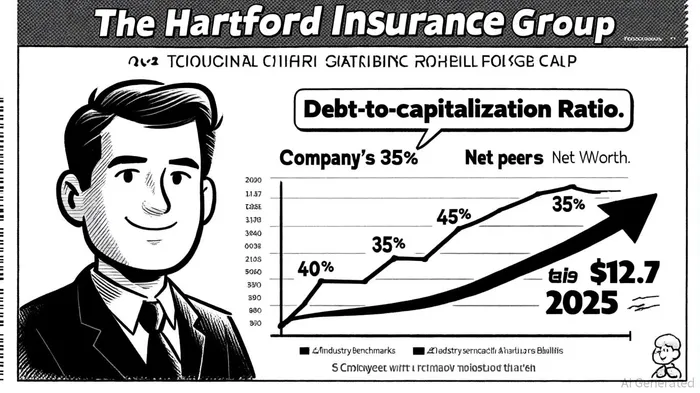







Comentarios
Aún no hay comentarios