
Harnessing Holiday Cycles: Strategic Market Timing Around U.S. Holidays
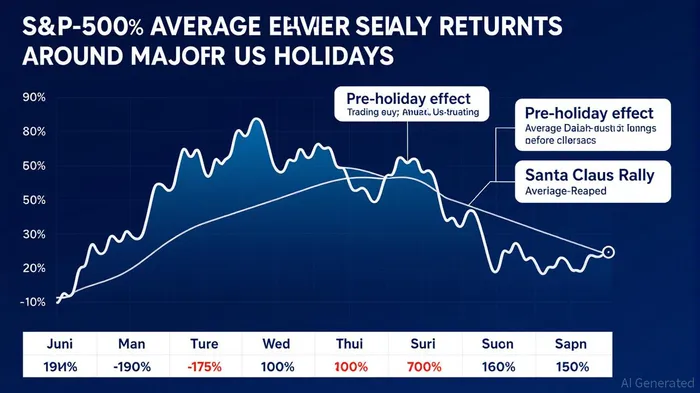
The U.S. stock market’s behavior around holidays is a blend of behavioral quirks and liquidity shifts. While critics dismiss calendar effects as noise, historical data reveals patterns that savvy investors can exploit. By analyzing market closures and early closures around major U.S. holidays—such as Labor Day, Thanksgiving, and Christmas—strategic timing and sector rotation can enhance returns.
The Labor Day Paradox: A Weak Signal in a Noisy Season
The week of Labor Day presents a paradox. The S&P 500 has historically delivered its strongest returns on the Friday before the holiday, averaging a 0.11% gain, while the day after reopening is marked by high volatility [1]. A backtested strategy of buying before Labor Day and selling after the holiday yields a 57% win ratio but a modest profit factor of 1.14 [2]. This suggests that while the signal exists, it is fragile. Investors might consider hedging with options or short-term positions during this period to capitalize on the pre-holiday optimism while mitigating post-holiday uncertainty.
Thanksgiving and the Retail Rally: Sector Rotation Opportunities
The “Thanksgiving Rally” is more robust. The S&P 500 has historically gained 0.3% on the day after Thanksgiving, with a 70% success rate [3]. This aligns with the broader “pre-holiday effect,” where markets tend to rise before long weekends due to reduced liquidity and investor optimism [4]. The week of Thanksgiving also sets the stage for the “Santa Claus Rally,” with December’s final five trading days averaging 1.3% gains [3]. Retail and consumer discretionary sectors, such as WalmartWMT-- and AmazonAMZN--, often outperform during this period, driven by holiday sales forecasts [3]. Investors might overweight these sectors in late November, while underweighting defensive plays like utilities.
Fourth of July and New Year’s: Mixed Signals and Strategic Patience
The Fourth of July holiday shows a modest positive bias, with the S&P 500 averaging 0.087% returns during the ten trading days centered on the holiday [3]. However, New Year’s presents a different challenge. The “January effect”—driven by tax-loss harvesting and portfolio rebalancing—has historically delivered gains, but its consistency has waned in recent decades [1]. For example, January has only topped the year’s best month in four of the past 20 years. Investors might treat New Year’s as a cautionary case: while the pre-holiday effect persists, relying on it requires patience and a diversified approach.
Early Closures and Liquidity Vacuums
Early closures, such as the day before Independence Day or the day after Thanksgiving, create liquidity vacuums. These days often see reduced trading volumes, amplifying volatility for smaller stocks and sectors like technology [3]. For instance, Black Friday’s early closure in 2025 (November 28) could trigger a “sell-off vacuum,” where reduced participation leads to sharp price corrections [2]. Options traders might exploit this by using straddles or iron condors to profit from expected volatility.
A Holiday-Driven Strategy: Balancing Risk and Reward
A holiday-driven portfolio strategy should combine timing, sector rotation, and risk management. For example:
1. Pre-Holiday Buys: Allocate to equities on the Friday before major holidays, leveraging the “pre-holiday effect” [4].
2. Sector Rotation: Shift into consumer discretionary and retail stocks in late November, while exiting energy or industrial plays [3].
3. Options Hedging: Use volatility-based options strategies during early closures to capitalize on liquidity gaps [2].
4. Santa Claus Rally: Rebalance into growth stocks in late December, anticipating year-end optimism [3].
However, these strategies must be tempered with caution. Calendar effects are not foolproof; for instance, the Labor Day signal’s profit factor of 1.14 indicates limited edge [2]. Investors should treat holiday-driven tactics as complementary to fundamental analysis, not replacements.
Conclusion
Holiday-driven market timing is a nuanced art. While historical patterns offer insights, they are shaped by behavioral biases and liquidity shifts that can reverse in different economic cycles. By integrating these effects into a disciplined, diversified strategy—while remaining mindful of their limitations—investors can navigate the U.S. market’s seasonal rhythms with greater confidence.
**Source:[1] Stock Market Returns Around Labor Day [https://www.cxoadvisory.com/calendar-effects/stock-returns-around-labor-day/][2] The Labor Day Holiday Effect in Trading – Backtesting and ... [https://www.quantifiedstrategies.com/labor-day-effect-in-trading/][3] How Thanksgiving Impacts the Financial Markets [https://contentworks.medium.com/how-thanksgiving-impacts-the-financial-markets-fd36497b7622][4] Pre-Holiday Effect [https://quantpedia.com/strategies/pre-holiday-effect]







Comentarios
Aún no hay comentarios