
Harleysville Savings Financial's Earnings Resilience: Assessing the Sustainability of $2.61 GAAP EPS
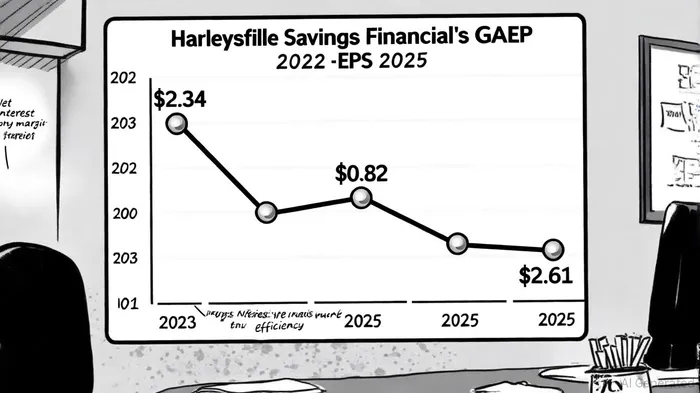
Harleysville Savings Financial (HARL) has demonstrated a remarkable rebound in earnings performance, culminating in a GAAP EPS of $2.61 for fiscal 2025, as reported in the 2025 earnings release, a significant improvement from the $0.82 reported in 2023 in the 2023 earnings release. This recovery raises critical questions about the sustainability of its earnings and the drivers behind its resurgence. By analyzing key metrics such as net interest margin (NIM), efficiency ratio, and management guidance, this article evaluates whether the $2.61 GAAP EPS is a durable achievement or a temporary rebound amid shifting economic conditions.
Operational Efficiency and Cost Management: A Key Catalyst
One of the most compelling indicators of Harleysville's improved performance is its efficiency ratio, which fell to 57.72% in fiscal 2025 from 59.01% in 2024, as outlined in the 2025 earnings release. This trend reflects disciplined cost management, particularly after the company's efficiency ratio stood at 50.48% in 2023, according to the 2023 earnings release, suggesting a consistent focus on reducing operating expenses relative to revenue. A lower efficiency ratio (i.e., less than 60%) is generally a positive sign for financial institutions, as it indicates stronger profitability and operational effectiveness. Harleysville's ability to maintain this trajectory bodes well for its long-term earnings sustainability, provided macroeconomic headwinds do not force a reversal in cost-cutting efforts.
Net Interest Margin: Navigating Interest Rate Dynamics
The company's net interest margin (NIM) also provides insight into its earnings resilience. For fiscal 2025, Harleysville reported a NIM of 2.68%, up from 2.47% in Q4 2024, as the company noted in its fiscal disclosures. This improvement aligns with broader industry trends of tightening spreads as banks adjust to higher interest rates. However, the NIM's exact trajectory will depend on the Federal Reserve's monetary policy. If rates stabilize or decline, Harleysville's disciplined pricing of loans and deposits—highlighted by management in its 2025 report—could help preserve margins. Conversely, aggressive rate cuts could compress spreads, testing the company's ability to maintain its current NIM.
Forward-Looking Considerations: Economic Uncertainty and Conservative Guidance
Despite the 2025 earnings rebound, Harleysville's leadership has adopted a cautious outlook for fiscal 2026. CEO Brendan J. McGill noted that customers are likely to maintain a conservative approach to borrowing and spending due to ongoing economic uncertainty, as described in the 2025 earnings release. This sentiment is echoed in the company's decision to increase its quarterly dividend by 6.5% to $0.33 per share, as detailed in the dividend announcement, prioritizing shareholder returns over aggressive reinvestment. While this strategy reduces near-term growth risks, it also limits upside potential in a low-interest-rate environment.
Dividend Yield and Investment Appeal
Harleysville's 5.52% dividend yield, according to the MarketBeat profile, positions it as an attractive option for income-focused investors, particularly in a market where high-yield assets remain scarce. However, the sustainability of this yield hinges on the company's ability to maintain its current EPS trajectory. With a trailing P/E ratio of 10.20 reported in the 2025 filings, the stock appears undervalued relative to its earnings, but this valuation assumes continued operational efficiency and stable interest rates—a scenario that remains uncertain.
Conclusion: A Prudent Bet Amid Macroeconomic Volatility
Harleysville Savings Financial's $2.61 GAAP EPS for fiscal 2025 is underpinned by strong operational efficiency and a modestly improved NIM. However, the company's conservative guidance for 2026 and exposure to interest rate volatility suggest that investors should approach its earnings growth with tempered optimism. For those prioritizing dividend stability and moderate earnings resilience, HARL offers a compelling case—but its long-term potential will depend on how effectively it navigates the next phase of the economic cycle.







Comentarios
Aún no hay comentarios