
The Hardware-Software Holy Grail: OpenAI's $6.5B Bet on Jony Ive's io Products to Redefine AI Interaction
The tech industry is witnessing a paradigm shift as OpenAI, the leader in AI software, makes its boldest move yet into hardware with the acquisition of Jony Ive's io Products for $6.5 billion. This deal isn't merely about buying a design firm—it's a strategic vertical integration play to fuse AI prowess with iconic design, creating a new class of “ambient intelligence” devices that could disrupt Apple's ecosystem dominance and redefine consumer technology. Let's dissect why this merger represents a transformative market differentiator and what it means for investors.
The Strategic Rationale: Vertical Integration as a Moat
OpenAI's entry into hardware is a direct response to the industry's “embodied intelligence” race, where AI is no longer confined to screens but exists as a tangible, omnipresent companion. By acquiring io Products—a firm founded by Jony Ive, the architect of Apple's most iconic devices—the company gains:
1. Design Leadership: LoveFrom's ability to create emotionally resonant, minimalist hardware (e.g., the iPhone, iPad) is now aligned with OpenAI's cutting-edge models like ChatGPT.
2. Control Over the User Experience: Instead of relying on third-party platforms (iOS, Android), OpenAI can now own the hardware-software stack, ensuring seamless integration of its AI capabilities.
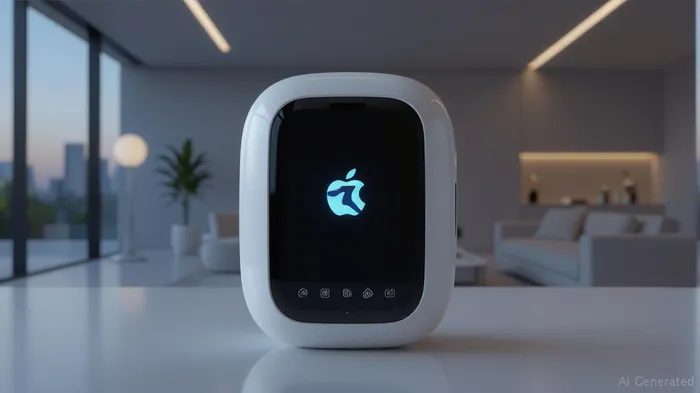
3. First-Mover Advantage: The planned 2026 launch of a screen-free, context-aware device (think a desk-based or pocket-sized companion) aims to capture users before competitors like AppleAAPL-- or GoogleGOOGL-- can solidify their own AI hardware offerings.
Valuation Rationale: A Drop in the Bucket for Long-Term Gains
At $6.5 billion, this acquisition represents just 2% of OpenAI's $300 billion post-March 2025 valuation (backed by SoftBank's infusion). This underscores the strategic priority OpenAI places on hardware:
- Apple's Market Cap: $2.8 trillion (as of Q2 2025) highlights the scale OpenAI aims to rival.
- Google's Hardware Stumbles: Despite Alphabet's $20 billion+ in hardware investments (Pixel, Nest), it has yet to crack the premium consumer tech market—a gap OpenAI aims to fill.
The deal is a calculated bet on hardware-software convergence, where AI-driven devices could command premium pricing and recurring revenue (e.g., subscriptions for advanced AI features).
Competitive Advantages: Redefining the AI-Hardware Ecosystem
OpenAI's vertical integration strategy poses a dual threat to incumbents:
1. Design as a Differentiator: Jony Ive's team brings a legacy of “emotional design”—devices that feel indispensable, not just functional. This contrasts with Apple's current focus on incremental upgrades and Google's utilitarian hardware.
2. AI-First Hardware: Unlike competitors, OpenAI's devices will embed its large language models (LLMs) directly into hardware, enabling real-time contextual awareness (e.g., recognizing user emotions, room settings) without relying on cloud latency.
3. Ecosystem Lock-In: By controlling both the AI model and the hardware interface, OpenAI can create “sticky” user experiences that reduce switching costs—similar to Apple's ecosystem but powered by AI.
Risks and Hurdles: Legal Battles and Market Skepticism
The acquisition isn't without obstacles:
- Trademark Lawsuit with Iyo: A Google-linked startup has temporarily blocked OpenAI from using the “io” brand until October 2025. While the lawsuit could force rebranding costs, the core hardware development remains unaffected.
- Consumer Adoption: Screen-free AI devices (like the rumored 2026 launch) require users to trust ambient interaction—a leap from current smartphone dependency.
However, OpenAI's $300 billion valuation and access to capital provide a cushion to navigate these challenges. The bigger risk? Missing the hardware boat entirely—a misstep that could cede the AI-hardware frontier to rivals.
Investment Implications: Where to Play the Vertical Integration Theme
- OpenAI Itself: While direct investment in OpenAI is limited to accredited investors, its valuation trajectory (now at 10x its 2023 value) suggests continued growth. Monitor its stock performance post-IPO (expected by 2026).
- Hardware Suppliers: Semiconductor firms like NVIDIA (NVDA) and Qualcomm (QCOM), which power edge-AI chips for low-latency devices, stand to benefit.
- Design and Manufacturing Partners: Companies like Luxottica (LUX) (for wearables) or Foxconn (HKG: 2317) could gain contracts if OpenAI scales production.
- AI-Driven Software Plays: Adobe (ADBE) and Salesforce (CRM), which embed AI into their tools, may see competitive pressure to integrate hardware partnerships.
Avoid: Overvalued “AI hype” stocks without clear hardware-software synergies (e.g., Meta (META)'s underperforming hardware division).
Conclusion: The Holy Grail of Tech Integration
OpenAI's $6.5 billion bet on Jony Ive's io Products is a masterstroke in vertical integration—a move that could finally separate software and hardware into a single, user-centric ecosystem. While risks like the Iyo lawsuit linger, the strategic vision is clear: dominate the next frontier of AI interaction before competitors can mimic it.
For investors, this isn't just about buying into a product—it's about backing a new paradigm in technology where AI isn't just a tool but a living, breathing companion. The first-mover advantage here is immense, and the rewards could redefine the tech landscape for decades.
Stay tuned for the October 2025 trademark ruling—a potential inflection pointIPCX-- for OpenAI's branding and market momentum.







Comentarios
Aún no hay comentarios