
Happy Belly's Franchise-Driven Coffee Expansion in Canada: Assessing Scalability and Unit Economics of Smile Tiger Coffee Roasters
The Canadian quick-service restaurant (QSR) coffee market is undergoing a transformative phase, driven by shifting consumer preferences, technological innovation, and a surge in demand for convenience. Against this backdrop, Happy Belly Food Group's acquisition and franchise expansion of Smile Tiger Coffee Roasters position the brand as a strategic player in a sector poised for robust growth. This analysis evaluates the scalability and unit economics of Smile Tiger Coffee Roasters, contextualized within the broader QSR coffee market dynamics in Canada.
Market Tailwinds: A Booming Sector for QSR Coffee
The Canadian food service market, valued at USD 135.63 billion in 2025, is projected to grow at a CAGR of 17.6%, reaching USD 583.47 billion by 2034. Within this, the QSR segment dominates 41% of the market, fueled by demand for speed and convenience. The QSR coffee subsector is particularly dynamic, with cold coffee consumption surging-21% of past-day cups in December 2024 were cold, up from 10% in 2023. Espresso-based beverages and plant-based milk options are also gaining traction, with 30% of Canadians reporting daily espresso consumption.
Automation and self-serve technologies are further reshaping the landscape. Super-automatic coffee machines, which enhance consistency and operational efficiency, are increasingly adopted in drive-thru lanes and office locations. These trends align with Smile Tiger's value proposition: ethically sourced, in-house roasted coffee tailored for QSR environments.
Smile Tiger's Franchise Model: Strategic Positioning and Growth Trajectory
Happy Belly Food Group acquired Smile Tiger Coffee Roasters in January 2025 for $173,000, paying 3.3x EBITDA based on 2024 sales of over $1,000,000. The acquisition marks Happy Belly's entry into the coffee sector, leveraging Smile Tiger's in-house roasting capabilities and existing corporate-owned retail location in Kitchener, Ontario. A 25-unit area development agreement in British Columbia, signed in February 2025, underscores the brand's expansion ambitions.
The franchise model emphasizes asset-light growth, with Happy Belly aiming to double EBITDA within 24 months. Franchisees receive support in site selection, store design, training, and marketing, reducing barriers to entry for entrepreneurs with food industry experience. While specific initial investment costs and royalty fees remain undisclosed, the brand's acquisition at a premium to EBITDA suggests confidence in its unit economics.
Unit Economics and Scalability: Challenges and Opportunities
The coffee roasting industry typically sees profit margins of 54% (excluding labor costs for roasting and bagging), but Smile Tiger's QSR-focused model likely faces thinner margins due to operational overheads like wages and rent. However, the brand's integration into Happy Belly's portfolio enables cross-selling and supply chain efficiencies. For instance, Smile Tiger's roasted coffee could be distributed as consumer-packaged goods (CPG) or white-label products to Happy Belly's other brands, diversifying revenue streams.
The QSR coffee market's projected revenue of US$6,211.0 million by 2030 (CAGR of 5.8%) provides a strong foundation for scalability. 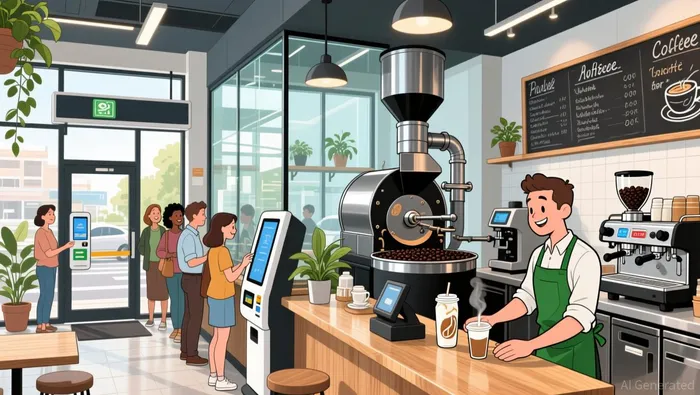 Smile Tiger's focus on automation-such as super-automatic machines-aligns with industry trends to mitigate labor costs and improve throughput. However, rising operational expenses in high-rent areas could pressure smaller franchisees. Tim Hortons' recent emphasis on drive-thru optimization and espresso innovation highlights the competitive intensity, necessitating continuous menu and technology upgrades.
Risks and Mitigation Strategies
Key risks include market saturation in the QSR coffee segment and the high costs of technology adoption. To mitigate these, Smile Tiger must prioritize differentiation through product quality and customer experience. Its emphasis on ethically sourced beans and plant-based milk options aligns with consumer demand for sustainability and health-conscious offerings. Additionally, Happy Belly's disciplined acquisition strategy-prioritizing cash-flow-positive brands-reduces financial risk.
Conclusion: A Promising but Cautious Outlook
Smile Tiger Coffee Roasters is well-positioned to capitalize on the QSR coffee market's growth, supported by Happy Belly's operational expertise and a franchise model designed for scalability. While specific unit economics data remains opaque, the brand's acquisition at a premium to EBITDA and its alignment with industry trends (cold coffee, automation, plant-based options) suggest strong potential. Investors should monitor the 25-unit expansion in British Columbia as a litmus test for the model's viability, with a focus on how effectively the brand balances innovation, cost control, and customer retention in a competitive landscape.







Comentarios
Aún no hay comentarios