
Hapag-Lloyd's Gemini Gambit: Can Strategic Synergies Unlock Hidden Value?
The shipping industry is no stranger to turbulence, but Hapag-Lloyd and Maersk's Gemini Cooperation—launched in February 2025—aims to redefine efficiency and profitability in an era of cost pressure and decarbonization demands. This partnership, combining Hapag-Lloyd's agility with Maersk's scale, could prove transformative for free cash flow (FCF) generation and valuation multiples. For investors, the question is clear: Does this strategic bet justify Hapag-Lloyd's current undervaluation?
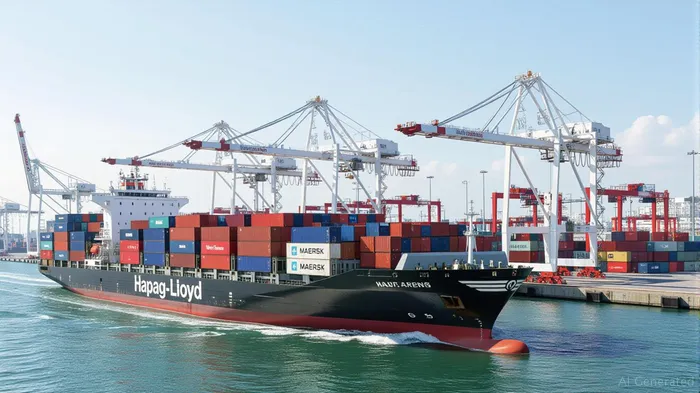
The FCF Case for Gemini: Synergies in Motion
The Gemini Cooperation's core promise revolves around cutting costs while boosting reliability. By consolidating their networks into a streamlined hub-and-spoke model, the partners aim to achieve >90% schedule reliability—a dramatic improvement over the industry's 60-70% average. This shift has three critical FCF implications:
Fleet and Route Optimization:
The combined fleet of 290–340 vessels (3.4–3.7 million TEU) will prioritize larger, fuel-efficient ships, reducing per-TEU operating costs. Fewer port stops and centralized hubs (e.g., Jade Wessel Port) cut handling expenses and idle time. Maersk has already flagged $500 million in annual savings, with Hapag-Lloyd likely to see proportional gains.Reduced Contingency Costs:
Higher reliability means fewer expedited services or last-minute re-routings—a major cost sink for shipping firms. Hapag-Lloyd's FCF margin, currently 8%, could expand as these savings materialize.Sustainability Levers:
The partnership's decarbonization goals (net-zero by 2045) will accelerate adoption of low-emission fuels. While upfront investments exist, long-term fuel savings and regulatory compliance (e.g., EU ETS) could bolster FCF by avoiding penalties.
Valuation: A Discounted Opportunity?
Hapag-Lloyd's valuation metrics scream undervalued. As of July 2025, its EV/EBITDA of 4.29 is 50% below the Transportation sector median of 8.74. Even its P/E ratio of 14.3x—in line with peers—fails to reflect the upside from Gemini's cost savings.
- Peer Comparison:
Competitors like AP Moller-Maersk (EV/EBITDA: 1.70) trade at a premium, yet Hapag-Lloyd's operational improvements could narrow this gap. - Growth Catalysts:
The $1.66 billion FCF generated in 2024 (despite macro headwinds) hints at untapped potential. Gemini's savings could push annual FCF toward $2.5–3 billion by 2026, assuming a 10% margin expansion.
Risks on the Horizon
No deal is without pitfalls. Geopolitical risks (e.g., Red Sea blockades) and softening demand could delay FCF gains. Execution is also critical: integrating 340 vessels and 26+ services requires flawless coordination.
However, the partnership's governance structure—backed by contractual commitments—mitigates operational risks. Meanwhile, Hapag-Lloyd's $36.4 billion net cash position (as of 2025) provides a safety buffer.
Investment Thesis: Buy the Dip
Hapag-Lloyd's stock has faced strong bearish pressure (MACD at -6.1, RSI at 33.89), driven by near-term earnings uncertainty. Yet this presents an entry point:
- Target Price: At a conservative 7x EV/EBITDA (vs. 4.29x now), Hapag-Lloyd's valuation could rise to EUR 30+ per share (up from EUR 22 currently).
- Catalysts to Watch:
- Q2 2025 Earnings: Confirm cost savings from Gemini's early implementation.
- Freight Rate Stability: A rebound in East-West trade volumes could lift margins.
Final Verdict
The Gemini Cooperation is a high-stakes bet, but the math favors investors. With a 23% undervaluation relative to peers, strong FCF foundations, and a partnership engineered for scale, Hapag-Lloyd offers a compelling risk-reward profile. For income seekers, its dividend yield of 3.2% (as of 2025) adds further allure.
Actionable Idea: Accumulate Hapag-Lloyd stock on dips below EUR 20, with a 12–18-month horizon. Monitor execution of Gemini's cost targets and freight rate trends closely.
In an industry where reliability and cost discipline reign, Hapag-Lloyd's alliance with Maersk is not just a partnership—it's a blueprint for survival.







Comentarios
Aún no hay comentarios