
Hanwha Ocean’s $1 Billion Stake Divestment: Strategic Capital Reallocation and Green Energy Momentum
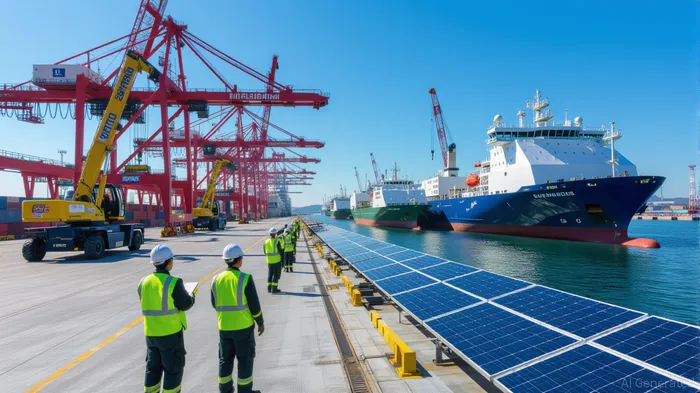
In September 2025, Hanwha Ocean’s strategic divestment of a $1 billion stake marked a pivotal moment in its capital reallocation strategy, aligning with global shifts toward green energy and maritime decarbonization. This move, executed through its affiliate Hanwha Impact Partners Inc., reflects a calculated effort to fund high-impact projects while navigating geopolitical and regulatory complexities in key markets like the U.S. and South Korea [1].
Capital Allocation: From Debt Reduction to Strategic Expansion
The proceeds from the stake sale are being directed toward three primary objectives. First, they will support Korea’s shipbuilding collaborations with the U.S., including the Make American Shipbuilding Great Again (MASGA) initiative, which aims to revitalize domestic shipbuilding capabilities [1]. Second, the funds will bolster U.S. liquefied natural gas (LNG) investments, a sector poised for growth amid rising energy security demands [1]. Third, the divestment will help Hanwha Group reduce its debt burden, a critical step in maintaining financial flexibility for future ventures [1].
This reallocation underscores Hanwha’s broader strategy to consolidate its defense and shipbuilding operations. For instance, Hanwha Aerospace’s recent $900 million block deal to increase its stake in Hanwha Ocean highlights the group’s commitment to cross-sector synergies, particularly in defense and maritime infrastructure [2].
Green Energy Synergies: A $5 Billion Bet on Decarbonization
The divestment’s alignment with green energy momentum is evident in Hanwha’s U.S. shipbuilding investments. The $5 billion expansion of Philly Shipyard, a 40%-owned subsidiary, is a cornerstone of this strategy. The project includes advanced automation, smart yard technology, and the development of dual-fuel X-DF engines with variable compression ratio (VCR) technology for LNG carriers—innovations that directly address decarbonization goals [3]. By 2027, Philly Shipyard aims to increase its annual production capacity from two to 20 vessels, positioning it as a leader in next-generation maritime solutions [3].
South Korea’s national green energy agenda further amplifies this momentum. The government’s target of 14.3 GW of offshore wind capacity by 2030 and 40.7 GW by 2038 [4] creates a fertile ground for Hanwha’s expertise in shipbuilding and energy infrastructure. While the stake sale proceeds are not explicitly earmarked for offshore wind, the company’s broader sustainability initiatives—such as Q.HOME SMART solar-plus-storage systems and utility-scale energy storage projects in Europe—demonstrate a coherent green energy portfolio [5].
Market Momentum: Leveraging Geopolitical and Regulatory Tailwinds
The U.S. market, in particular, offers strategic advantages. Hanwha’s $5 billion Philly Shipyard investment is part of South Korea’s $150 billion commitment to U.S. shipbuilding growth, a move designed to counter Chinese competition and align with U.S. “America First” policies [3]. The Jones Act-compliant MR tanker orders from Philly Shipyard further solidify Hanwha’s role in strengthening the U.S. maritime industrial base [3].
Meanwhile, Hanwha’s cautious approach to foreign ownership regulations—such as its gradual acquisition of Austal shares in Australia—reflects an awareness of geopolitical risks. This measured expansion strategy ensures compliance while maximizing long-term gains in markets with high regulatory scrutiny [6].
Conclusion: A Strategic Pivot with Long-Term Payoffs
Hanwha Ocean’s $1 billion stake divestment is not merely a liquidity play but a strategic pivot toward capitalizing on green energy and maritime decarbonization trends. By channeling funds into U.S. LNG infrastructure, next-gen shipbuilding, and debt reduction, the company is positioning itself to benefit from both immediate market opportunities and long-term sustainability goals. As global energy transitions accelerate, Hanwha’s ability to integrate technological innovation with geopolitical agility will likely determine its success in this high-stakes arena.
Source:
[1] Hanwha Ocean Affiliate Sells $1 Billion Stake After Stock ... [https://www.bloomberg.com/news/articles/2025-09-05/hanwha-ocean-affiliate-sells-1-billion-stake-after-stock-triples]
[2] Why Hanwha Aerospace's historic share sale has investors up in arms [https://koreajoongangdaily.joins.com/news/2025-03-30/business/industry/Why-Hanwha-Aerospaces-historic-share-sale-has-investors-up-in-arms/2273507]
[3] Hanwha announces $5 billion Philly Shipyard investment [https://www.hanwha.com/newsroom/news/press-releases/hanwha-announces-5-billion-philly-shipyard-investment-as-part-of-south-koreas-commitment-to-us-shipbuilding-growth.do]
[4] Global offshore wind: South Korea [https://www.nortonrosefulbright.com/en/knowledge/publications/faee407b/global-offshore-wind-south-korea]
[5] IEA World Energy Investment Report 2025: Where is global capital flowing? [https://www.hanwha.com/newsroom/news/feature-stories/iea-world-energy-investment-report-2025-where-is-global-capital-flowing.do]
[6] Shipbuilder Raid Gingerly Tests Geopolitics Shift - Megaproject [https://www.megaproject.com/news/portandship/shipbuilder-raid-gingerly-tests-geopolitics-shift]







Comentarios
Aún no hay comentarios