
Hanon Systems' R744 Electric Compressors: A Green Industrial Revolution at Scale
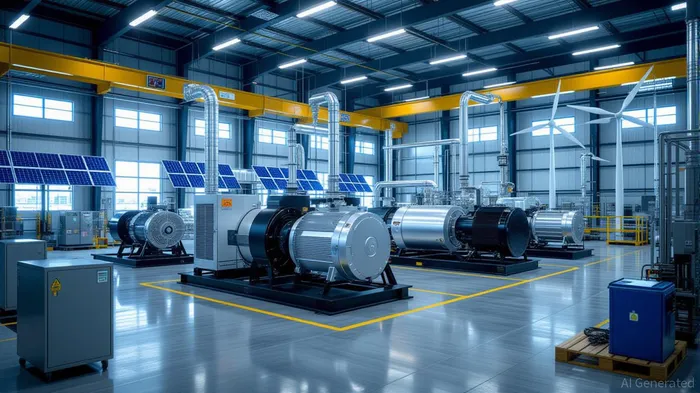
The manufacturing sector is undergoing a seismic shift, driven by the urgent need to decarbonize and align with global ESG (Environmental, Social, and Governance) standards. At the heart of this transformation lies Hanon Systems' R744 Electric Compressors, a technology poised to redefine industrial efficiency and sustainability. While direct data on Hanon's R744 compressors remains elusive, the broader industry trends and strategic imperatives for decarbonization paint a compelling picture of their potential.
Decarbonization and the Electrification Imperative
The push to reduce carbon emissions in manufacturing has accelerated dramatically. According to a report by IBMIBM--, electrification of industrial processes is a cornerstone of this effort, with companies replacing fossil fuel-dependent systems with electric alternatives to cut emissions[3]. Hanon's R744 compressors, which utilize (R744) as a refrigerant, align perfectly with this trend. Unlike traditional hydrofluorocarbon (HFC) refrigerants, which have high global warming potential, R744 is a natural refrigerant with zero ozone depletion potential and minimal climate impact[3]. By leveraging this technology, Hanon is positioning itself at the intersection of energy efficiency and environmental responsibility.
Scalability and ESG-Driven Growth
Manufacturing scalability is another critical factor. The industry's shift toward renewable energy and smart systems has created a demand for technologies that can be rapidly deployed across diverse sectors[2]. Hanon's R744 compressors, if scalable, could serve as a universal solution for industries ranging from automotive to food processing. This scalability is not just a technical challenge but a strategic one. As governments and investors prioritize net-zero targets, companies that can demonstrate rapid, cost-effective decarbonization will dominate the market.
The ESG landscape further amplifies this opportunity. According to , regulatory pressures and consumer expectations are forcing companies to adopt transparent, verifiable sustainability practices[4]. Hanon's focus on R744 technology—assuming it meets rigorous third-party validation—could position it as a leader in ESG-driven innovation. While specific partnerships or certifications for Hanon's R744 compressors are not yet public, the broader industry's embrace of ESG metrics suggests that such validation is likely a priority for the company.
Strategic Positioning in a Green Economy
Hanon's R744 compressors also benefit from the rise of (CCUS) technologies. As McKinsey notes, residual emissions are increasingly being addressed through CCUS, which pairs well with electrified systems like R744 compressors[1]. By integrating these technologies, Hanon could create a closed-loop system where emissions are minimized at the source and residual CO2 is captured or repurposed. This dual approach not only enhances environmental impact but also reduces long-term operational costs—a win for both investors and stakeholders.
Risks and Considerations
While the strategic alignment is clear, investors must remain cautious. The absence of detailed data on Hanon's R744 compressors—such as efficiency metrics, manufacturing timelines, or third-party certifications—introduces uncertainty. Additionally, the success of R744 technology depends on regulatory support and industry-wide adoption. If competitors develop alternative solutions or if policy shifts favor other decarbonization pathways, Hanon's market position could be challenged.
Conclusion: A High-Stakes Bet on the Future
Hanon Systems' R744 Electric Compressors represent a bold bet on the future of industrial decarbonization. By leveraging the broader industry's shift toward electrification, energy efficiency, and ESG compliance, the company is well-positioned to capitalize on a multitrillion-dollar green transition. However, the lack of granular data means investors must weigh the potential against the unknowns. For those willing to take a long-term view, Hanon's technology could be a cornerstone of the green industrial revolution—provided it scales as promised.







Comentarios
Aún no hay comentarios