
Hancock Whitney's Q3 2025 Earnings: A Case Study in Regional Banking Resilience and Strategic Growth
Hancock Whitney Corporation (HWC) delivered a standout performance in Q3 2025, reporting net income of $127.5 million, or $1.49 per diluted share, a 12% increase from Q2 2025[1]. This growth was driven by a 5% rise in adjusted pre-provision net revenue (PPNR) to $175.6 million and an 8% surge in noninterest income to $106.0 million, fueled by higher investment fees, annuity charges, and syndication activity[4]. The bank's efficiency ratio improved to 54.10%, down 81 basis points from the prior quarter, reflecting disciplined cost management and the absence of one-time acquisition-related expenses[1].
Strategic Resilience in a Shifting Landscape
Hancock Whitney's results align with broader regional banking trends marked by resilience. The 2025 Federal Reserve stress tests confirmed that regional banks, including HWCHWC--, demonstrated robust capital strength, with the bank's Common Equity Tier 1 (CET1) ratio rising to 14.08%[4]. This positions HWC to withstand economic volatility while maintaining a strong balance sheet. Meanwhile, the industry's focus on fee-based revenue diversification is paying off: HWC's noninterest income growth outpaced the projected regional bank average of 1.5% of average assets[5].
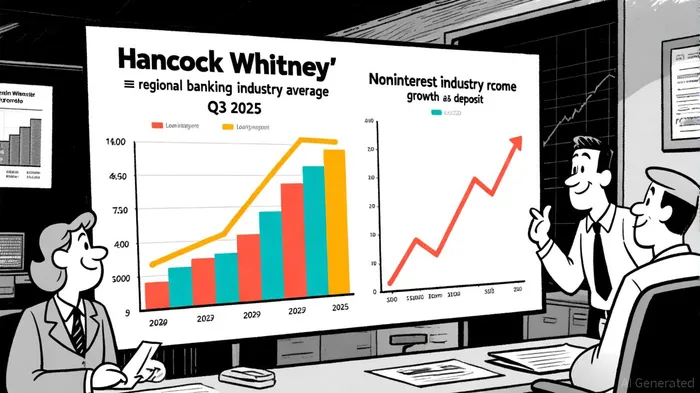
The bank's net interest margin (NIM) remained stable at 3.49%, a critical achievement in a falling interest rate environment[1]. While large banks like JPMorgan Chase and Citigroup reported record-breaking Q3 2025 earnings, HWC's performance underscores the competitive edge of regional players in niche markets such as commercial real estate and equipment finance[2]. Total loans grew by $134.8 million to $23.6 billion, though deposits fell by $386.9 million due to seasonal outflows and reduced public fund balances[4]. This deposit decline, while notable, appears temporary and aligns with broader industry challenges in retaining low-cost deposits[5].
Peer Comparisons and Operational Excellence
Hancock Whitney's efficiency ratio of 54.10% stands out in an industry where the average hovers near 60%[5]. This improvement was driven by a 1% reduction in noninterest expenses to $212.8 million, excluding one-time costs from the Sabal Trust acquisition in Q2[1]. While direct peer comparisons for noninterest income growth are limited in the available data, HWC's 8% increase suggests a stronger pivot to fee-based revenue than the industry's projected 1.5% average[5].
Capital returns also highlight HWC's shareholder-friendly approach: the bank repurchased 662,500 shares during the quarter[4]. This contrasts with larger peers like Wells Fargo, which are focusing on improving return on tangible common equity (ROTCE) rather than immediate buybacks[2].
Challenges and Forward-Looking Outlook
Despite its strengths, HWC faces headwinds. Nonaccrual loans rose to 0.48% of total loans, signaling potential credit risks in the commercial real estate sector-a concern echoed in Deloitte's 2025 banking outlook[3]. Additionally, the bank's deposit base remains vulnerable to rate adjustments and competition from larger institutions with stronger liquidity advantages[5].
Management expects modest loan growth and a slight recovery in deposits for the remainder of 2025[4]. These projections align with industry caution, as regional banks navigate a landscape where net interest margin compression and credit risk management are key challenges[3].
Conclusion: A Model for Regional Banking Adaptability
Hancock Whitney's Q3 2025 results exemplify the resilience and strategic agility of regional banks in a dynamic economic environment. By leveraging fee-based revenue growth, improving operational efficiency, and maintaining strong capital ratios, HWC has positioned itself as a leader in its peer group. While challenges in deposit stability and credit risk persist, the bank's proactive approach to cost management and capital returns offers a compelling case for investors seeking exposure to the regional banking sector.
Historical backtesting of HWC's earnings release performance from 2022 to 2025 reveals mixed short-term outcomes. While the 10-day post-earnings window showed an average return of +1.37% versus the benchmark, the 30-day horizon ended with a -3.27% cumulative excess return. This suggests that while HWC's earnings events occasionally generate positive momentum, long-term investors should focus on the bank's structural strengths rather than timing market reactions.





Comentarios
Aún no hay comentarios