
Hancock Whitney Corporation's Q3 2025 Performance: Strategic Resilience in a Shifting Regional Banking Landscape
Hancock Whitney Corporation (HWC) has emerged as a standout performer in the regional banking sector during Q3 2025, delivering robust earnings and demonstrating strategic agility amid evolving interest rate dynamics. With a net income of $127.5 million (EPS of $1.49), the bank exceeded analyst expectations by 4.9% and reported a 12% year-over-year profit increase[4]. This performance underscores HWC's ability to navigate a challenging macroeconomic environment while maintaining disciplined capital allocation and asset quality.
Financial Highlights: Profitability and Efficiency Gains
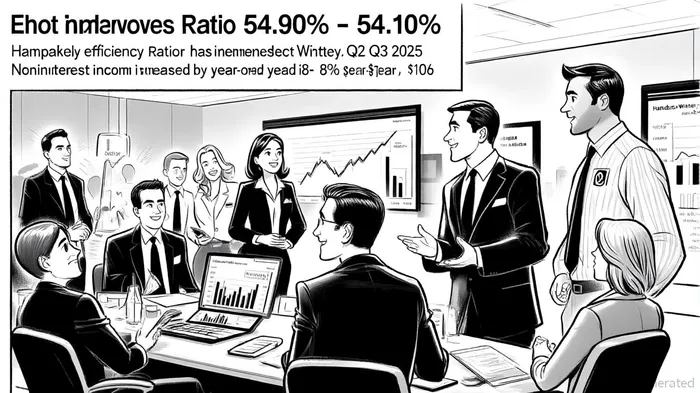
HWC's Q3 results were driven by a 5% rise in adjusted pre-provision net revenue (PPNR) to $175.6 million and a record 8% surge in noninterest income to $106 million[1]. The latter was fueled by strong contributions from investment, insurance, and annuity services, reflecting the bank's strategic pivot toward fee-based income streams. Operational efficiency also improved significantly, with the efficiency ratio dropping 81 basis points to 54.10% year-over-year[1]. This improvement was achieved despite a 1% decline in noninterest expenses to $212.8 million, highlighting HWC's cost management capabilities[1].
However, the bank faced headwinds in deposit growth, with total deposits declining $386.9 million to $28.7 billion due to seasonal outflows and reduced public fund balances[2]. This contrasted with a 2% annualized loan growth to $23.6 billion, driven by commercial real estate (CRE) and equipment finance lending[2]. While asset quality remained stable-with a 1.45% allowance for credit losses-nonaccrual loans rose to 0.48% of total loans, signaling cautious optimism about credit risk management[1].
Strategic Positioning: Organic Growth and Capital Discipline
HWC's strategic focus on organic expansion and disciplined capital allocation has positioned it to capitalize on sector-wide tailwinds. The bank opened new branches in Dallas and targeted Southeast markets, aiming to bolster balance sheet growth and market share[1]. Concurrently, it maintained a Common Equity Tier 1 (CET1) ratio of 14.08%, well above its 11% threshold, while repurchasing 662,500 shares for $40 million[1]. This dual emphasis on growth and shareholder returns aligns with broader trends in the regional banking sector, where firms are prioritizing fee income and capital preservation[1].
The regional banking landscape in Q3 2025 was marked by declining interest rates, which compressed net interest margins (NIMs) across the industry[3]. As rates settled near 3%, banks faced pressure to offset margin compression through noninterest income. HWC's 10.5% year-over-year increase in noninterest income[2] positioned it ahead of peers, including JPMorgan Chase and Goldman Sachs, which also reported elevated investment banking fees but with less operational efficiency[3].
Interest Rate Dynamics and Sector Risks
While falling rates created opportunities for regional banks, they also exposed vulnerabilities. PNC and others benefited from improved net interest income as rates normalized[4], but HWC's exposure to CRE-particularly office sector loans-remains a risk. The bank's 0.48% nonaccrual loan ratio[1] suggests cautious credit management, yet analysts warn that a CRE downturn could strain asset quality[3]. Additionally, elevated deposit costs, which remain above historical averages[3], could pressure NIMs further if rate cuts outpace cost reductions.
Conclusion: A Model of Resilience
Hancock Whitney's Q3 2025 performance exemplifies strategic resilience in a sector undergoing transformation. By leveraging fee-based income, expanding organically, and maintaining strong capital ratios, HWCHWC-- has positioned itself to weather macroeconomic uncertainties. However, investors must remain vigilant about CRE risks and the sustainability of its efficiency gains. As the regional banking sector navigates a delicate balance between growth and prudence, HWC's disciplined approach offers a compelling case study for investors seeking value in a dynamic market.
Historical data from 2022 to 2025 reveals that HWC's earnings beats have yielded mixed outcomes for investors. A simple buy-and-hold strategy following these events showed a median 1-day reaction of -0.95%, improving to +2.73% by day 30, though without consistent alpha generation. Win rates hovered around 45-55%, suggesting no clear edge for investors relying solely on these signals.





Comentarios
Aún no hay comentarios