
Hancock Whitney's Contrarian Opportunity: NIM Strength and Strategic Resilience in a Volatile Market
As macroeconomic uncertainty clouds the banking sector, contrarian investors are seeking resilient institutions with durable fundamentals. Hancock Whitney CorporationHWC-- (NYSE:HWC) emerges as a compelling candidate, with its Q2 2025 earnings report underscoring strategic discipline and structural growth drivers that are underappreciated by the market. While near-term headwinds such as loan paydowns and rising nonperforming loans (NPLs) have sparked skepticism, the bank's ability to expand its net interest margin (NIM), deploy capital prudently, and execute geographic/wealth management expansions positions it as a contrarian buy.
Net Interest Margin: A Contrarian's Silver Lining
The most overlooked positive in Hancock Whitney's story is its NIM resilience. Despite loan yield compression, the bank's Q1 NIM expanded by 2 bps to 3.43%, driven by a 15-basis-point decline in deposit costs to 1.70% and higher bond portfolio yields from reinvested cash flows. Management's proactive cost management—coupled with $236 million in bond principal repayments slated for reinvestment at higher rates—supports its Q2 outlook of 3–4% net interest income (NII) growth.
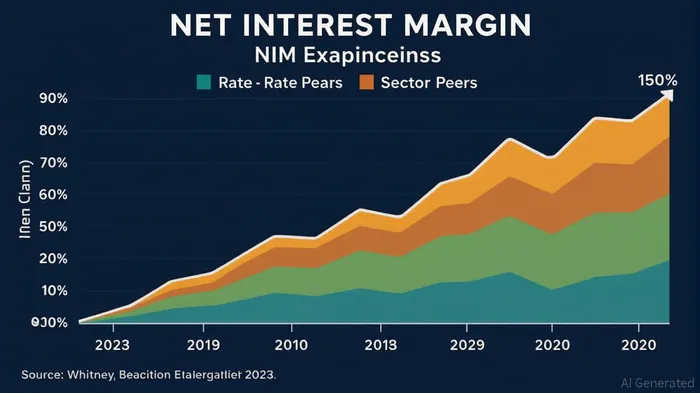
Critically, three projected Fed rate cuts (June, July, October 2025) could further depress deposit costs, a tailwind often underappreciated in a market fixated on margin contraction fears. Contrarians should note that HWC's deposit cost discipline has outpaced peers, and its bond portfolio's reinvestment strategy creates a “rising rate hedge” even in a slowing economy.
Loan Portfolio: Softness Now, Growth Later
While Q1 loans declined by $201 million due to healthcare and commercial paydowns, the bank's strategic moves aim to reverse this trend. The planned hiring of 24–30 revenue-producing bankers and the opening of five new Texas financial centers signal a focus on high-growth markets. Equipment finance loans—a bright spot in Q1—reflect demand for technology and manufacturing upgrades, a sector less prone to cyclical slowdowns.
The risks here are clear: NPLs rose 23% year-over-year, and economic uncertainty could stall loan demand. However, the $18 million in Q1 charge-offs were comfortably covered by a 1.49% allowance for credit losses. The key contrarian argument is that loan softness is sector-specific and temporary, while geographic and product diversification (e.g., wealth management via the Sabal Trust acquisition) mitigates overexposure to any single segment.
Capital Deployment: Dividends, Buybacks, and M&A
Hancock Whitney's capital strength—reflected in its 14.51% CET1 ratio—provides flexibility to reward shareholders. A 50% dividend hike to $0.45/share and $350K in Q1 buybacks signal confidence in NII stability. The Sabal Trust acquisition, boosting fee income to 9–10% YoY growth, reduces reliance on net interest income and aligns with a long-term structural shift toward recurring revenue streams.
In a sector where capital returns are under pressure, Hancock's disciplined approach stands out. The stock's current 11.2x forward P/E—below its five-year average—suggests the market is pricing in worst-case scenarios, creating a contrarian entry point for investors willing to bet on its execution.
Valuation and Investment Thesis
With consensus estimates pointing to $5.52 EPS for 2025, HWCHWC-- trades at $59.58 (vs. a $65.25 average target). The “Hold” rating hinges on near-term loan growth and NIM volatility, but contrarians should focus on two catalysts:
1. July 15 Earnings Call: Management's commentary on loan pipelines, credit quality, and Texas expansion execution could reset sentiment.
2. Structural Growth: Fee income diversification and deposit cost discipline position HWC to outperform in a low-rate environment.
Conclusion: Buy the Dip, but Watch the Watchlist
Hancock Whitney's Q2 report is a mosaic of resilience and opportunity. While loan paydowns and NPLs warrant caution, its NIM trajectory, capital strength, and strategic M&A suggest the bank is navigating macro headwinds better than peers. For contrarians, the sub-$60 price—a 9.5% discount to its target—offers a compelling entry. Recommendation: Accumulate positions below $60, with a focus on buying the post-earnings dip if NIM and loan growth guidance exceed expectations. The $65.25 price target implies 9.5% upside, but the true reward lies in HWC's potential to outperform in a sector primed for consolidation and recovery.
Final caveat: Monitor geopolitical risks and recession indicators closely. Hancock's Texas and Florida expansions may shine if growth persists, but a severe downturn could test its credit reserves.





Comentarios
Aún no hay comentarios