
Hancock Whitney's 2025 Q3 Financial Performance and Strategic Positioning: Assessing Profitability, Loan Growth, and Regional Banking Resilience in a Shifting Interest Rate Environment
Profitability: Margin Stability and Cost Efficiency
Hancock Whitney's Q3 2025 results highlight its disciplined cost management and margin resilience. The bank's net interest margin (NIM) held steady at 3.49%, a critical achievement given the Fed's September 2025 rate cut of 25 basis points [3]. This stability was underpinned by proactive asset liability management (ALM) strategies, which prioritized higher-yielding loans while mitigating deposit cost pressures. Simultaneously, the efficiency ratio improved to 54.10%, reflecting operational cost reductions and revenue diversification [1].
Adjusted pre-provision net revenue (PPNR) rose 5% to $175.6 million compared to Q2 2025, driven by a 2% increase in net interest income and a 4% rise in fee income [1]. These figures underscore HWC's ability to generate consistent cash flow even as deposit balances dipped by 1% to $28.7 billion, primarily due to seasonal outflows and reduced public fund balances [1].
Loan Growth and Balance Sheet Strength
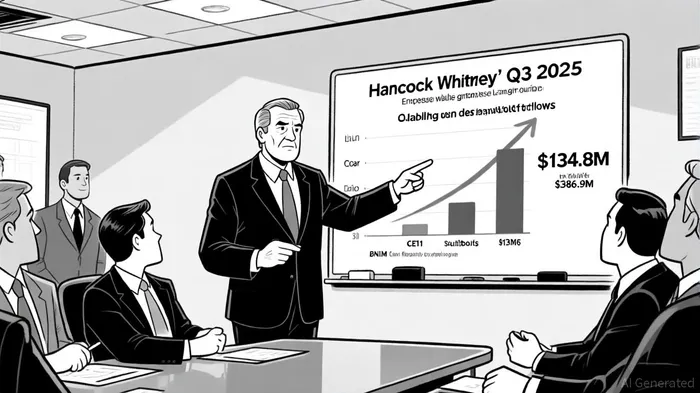
The bank's loan portfolio expanded by $134.8 million in Q3 2025, reaching $23.6 billion-a testament to its focus on organic growth and credit discipline [2]. This growth was concentrated in commercial and industrial (C&I) lending, where higher-yielding assets align with HWC's strategy to optimize its interest income in a low-rate environment. Notably, the bank's capital ratios remain robust, with a Common Equity Tier 1 (CET1) ratio of 14.08% and a total risk-based capital ratio of 15.91% [3]. These metrics position HWCHWC-- to withstand potential economic shocks while supporting future capital returns to shareholders.
Strategic Positioning: Navigating Rate Cuts and Digital Transformation
Hancock Whitney's strategic initiatives are closely aligned with the Federal Reserve's 2025 rate-cutting cycle. The bank anticipates mid-single-digit loan growth in H2 2025 and modest NIM expansion, leveraging its ALM framework to balance interest rate risk [2]. For instance, its shift toward longer-duration, higher-yielding loans is designed to offset margin compression from declining deposit costs. Additionally, HWC has accelerated digital transformation efforts, automating back-office processes and enhancing customer-facing platforms to reduce operational costs and improve service efficiency [3].
The bank's resilience is further reinforced by its strong capital base and proactive risk management. As noted in its 2025-Q4 strategic plan, HWC is prioritizing "prudent risk management" to navigate macroeconomic uncertainties, including potential volatility from nonbank financial institutions (NBFIs) and housing market fluctuations [3]. This approach mirrors broader industry trends, as the 2025 bank stress tests revealed that all 22 regional banks passed under simulated economic stress scenarios [4].
Regional Banking Resilience in a Shifting Rate Environment
The Federal Reserve's 2025 rate cuts-bringing the federal funds rate to 4.00%-4.25% by September-have created a dual-edged sword for regional banks. While lower rates stimulate loan demand in sectors like mortgages and construction, they also threaten NIMs as deposit costs lag behind lending rate declines [5]. Hancock Whitney's stable NIM and improved efficiency ratio, however, suggest it is better positioned than many peers to mitigate these risks.
Moreover, the bank's strategic emphasis on capital returns-via share buybacks and dividend growth-aligns with industry trends highlighted in the 2025 stress test results. Regional banks with strong capital positions, like HWC, are increasingly focusing on shareholder value creation while maintaining liquidity buffers [4]. This balance of growth and prudence is critical as the Fed signals further rate cuts in 2026, with median projections pointing to a terminal rate of 3.50%-3.75% by year-end 2025 [5].
Conclusion: A Model of Resilience and Adaptability
Hancock Whitney's Q3 2025 performance exemplifies the strategic agility required to thrive in a shifting interest rate environment. By stabilizing its NIM, expanding its loan portfolio, and enhancing operational efficiency, the bank has fortified its profitability and capital strength. Its proactive ALM strategies and digital transformation initiatives further underscore its commitment to long-term resilience. As the Fed continues its rate-cutting cycle, HWC's disciplined approach positions it as a compelling investment within the regional banking sector-a sector that, despite challenges, has demonstrated remarkable resilience in 2025's stress tests and evolving economic conditions.





Comentarios
Aún no hay comentarios