
HALT's Volatility Gap Exposes Market's Underestimated Risk Profile
The recent trading pause for ticker HALT was a textbook volatility trigger, not a news event. The halt was implemented because the stock's price moved more than 10% from a recent print within a five-minute window, a condition that automatically activates a pause. The specific thresholdT-- price that triggered this was $5.974300. This mechanism is designed to cool down extreme short-term swings and ensure orderly trading.
The key takeaway is that the halt was a reaction to price action, not fundamental news. The system flagged a rapid, significant move, and trading was paused to allow the market to digest. This type of event often creates an expectation gap. The market had been pricing in a certain level of stability or a specific narrative. The sudden 10% deviation suggests that either new, unpriced information emerged or that the stock's underlying volatility was higher than previously accounted for. For investors, the halt itself is a data point: it signals that the stock's recent trajectory was not smooth, and the subsequent resumption of trading will reveal whether the market's prior expectations were too optimistic or too pessimistic.
HALT trades on the NYSE American (AMEX), a venue that typically hosts smaller, less liquid companies. Stocks here often have wider bid-ask spreads and are more susceptible to sharp price moves on lower volume. The volatility pause, therefore, is a common feature of this market environment. It underscores the importance of monitoring price thresholds and understanding that a halt here is a technical reset, not necessarily a fundamental warning. The real story will unfold when trading resumes and the stock finds its new equilibrium price.
Expectations vs. Reality: The Volatility Gap
The halt itself is a stark signal of an expectation gap. The market's prior consensus, reflected in the pre-halt price, likely underestimated the stock's inherent volatility. This setup is classic "buy the rumor" behavior: investors were positioning for a positive catalyst or simply assuming stability, and the stock's risk was not fully priced in. When the price moved more than 10% in five minutes, it exposed that miscalculation.
The 10% volatility threshold is the market's own benchmark for acceptable price swings. The fact that this level was breached suggests the market's whisper number for volatility was higher than the actual printed price. In other words, the system's tolerance for rapid moves was exceeded, forcing a pause. This isn't a failure of the mechanism; it's evidence that the stock's risk profile had shifted beyond what the recent trading pattern had anticipated.
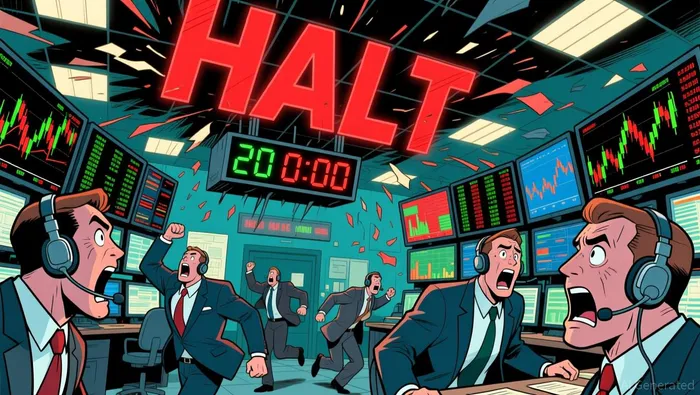
A prolonged halt or delayed resumption would signal a deeper expectation gap. It would indicate the market needed more time to digest the volatility risk, implying that the initial price move contained information that fundamentally challenged the prevailing narrative. For a stock on a smaller exchange like the NYSE American, where liquidity is thinner, such a gap can be more pronounced. The halt acts as a forced reset, giving participants a chance to reassess the risk-reward equation before trading resumes. The key question now is whether the post-halt price finds a new equilibrium closer to the stock's true volatility or if the market's initial underestimation persists.
Post-Halt Reality Check: Pricing the New Volatility
The critical path for HALT's recovery now begins. The stock's performance immediately after resuming trading will reveal whether the halt caused a 'sell the news' reaction or a 'buy the rumor' bounce. If the price gaps down sharply on the open, it suggests the market is pricing in the volatility risk as a negative, a classic 'sell the news' dynamic. Conversely, a strong bounce could signal that the halt was a temporary overreaction, and the underlying narrative remains intact. The key is to watch the first few minutes of trading for the direction and magnitude of the move.
Investors must then assess if the halt's cause-excessive volatility-has been fully disclosed and priced in. The volatility pause itself is a mechanical event, but the market's whisper number for risk has clearly been reset. The system's 10% threshold was breached, meaning the stock's recent price action contained information that challenged prior stability assumptions. The next step is to determine if this is a one-time event or a sign of deeper operational sandbagging. Did the volatility stem from a single news event that has now been digested? Or does it reflect persistent underlying instability that the company will need to address with clearer guidance? The market will be watching for any subsequent operational metrics or earnings reports to see if they align with this new, post-halt consensus on risk.
The bottom line is that the halt has forced a new expectation gap. The market's prior view of HALT as a stable, low-volatility play is now in question. The stock's new equilibrium price will depend on whether the company can demonstrate that the volatility was an anomaly and that its fundamentals support a return to a lower-risk profile. Until then, the post-halt trading pattern will be the primary indicator of whether the market's new pricing of risk is justified.







Comentarios
Aún no hay comentarios