
Halliburton's Valuation and Growth Potential in the Era of Digital Oilfields
In the evolving landscape of the oil and gas industry, Halliburton's strategic pivot toward digital oilfield technologies has positioned it as a key player in redefining operational efficiency and competitive advantage. Central to this transformation is its acquisition of WellSense's FiberLine Intervention (FLI) technology, a breakthrough in subsurface diagnostics that leverages fiber-optic sensing and disposable probes to deliver high-resolution data in real time. This innovation not only mitigates operational risks but also aligns with broader industry trends toward automation, sustainability, and capital efficiency.
FiberLine: A Catalyst for Operational Excellence
FLI technology represents a paradigm shift in well stimulation monitoring. By deploying bare fiber despooling and disposable probes, HalliburtonHAL-- enables operators to collect subsurface data with unprecedented precision, reducing the need for costly and time-intensive manual interventions. According to a report by Oil & Gas 360, this approach minimizes exposure to harsh downhole environments, cuts deployment time, and enhances diagnostic accuracy, directly translating to cost savings and improved well performance. For instance, FLI's ability to streamline well intervention processes-such as identifying underperforming zones or optimizing fracturing operations-has been lauded as a game-changer in reducing non-productive time (NPT) during drilling and completion phases, as reported by Nasdaq.
The technology's integration into Halliburton's digital ecosystem further amplifies its value. As stated by the company's CEO, Jeff Miller, the deployment of FLI is part of a broader strategy to embed artificial intelligence (AI) and automation into upstream operations, enabling predictive maintenance and data-driven decision-making in an interview with Oil & Gas Leads. This aligns with the industry's push toward "smart wells," where real-time analytics optimize production while reducing environmental footprints.
Financial Performance and Capital Efficiency
Despite macroeconomic headwinds, Halliburton's Q1 2025 results underscore its resilience. Total revenue reached $5.4 billion, with an adjusted operating margin of 14.5%, reflecting disciplined cost management and strategic focus on high-margin digital solutions, according to Hart Energy. While North American revenue declined by 12% year-over-year due to reduced stimulation activity, international markets-particularly in Latin America, Europe, and the Middle East-offset some of these losses. The company's capital efficiency is evident in its 6% revenue allocation to capital expenditures and its commitment to returning $1.6 billion to shareholders in 2025 through buybacks and dividends, per StockInvest.
The Zeus electric fracturing platform and Octiv auto frac system, which are central to Halliburton's digital portfolio, have already demonstrated market traction. Zeus, for example, is projected to comprise 50% of the company's fleet by year-end 2025, with Octiv deployed on over 50% of Zeus spreads, Hart Energy reports. These systems reduce fuel consumption and emissions while enhancing operational speed, directly contributing to cost savings. Analysts at Monexa estimate that such technologies could improve Halliburton's operating margins by 2–3 percentage points over the next two years, bolstering its competitive positioning.
Competitive Advantages and Long-Term Growth
Halliburton's competitive edge lies in its global footprint, technological depth, and strategic partnerships. With operations in 80 countries and over 3,247 active patents, the company has established itself as a leader in energy services. The acquisition of FLI technology further strengthens its IP portfolio, enabling it to offer integrated solutions for emerging applications like carbon capture, utilization, and storage (CCUS), according to Oil Review Middle East. This aligns with global sustainability goals and opens new revenue streams in the transition to low-carbon energy.
Moreover, Halliburton's focus on international expansion mitigates regional market volatility. A $3.2 billion international revenue segment in Q1 2025-driven by contracts with Shell in Brazil and West Africa-highlights its ability to capitalize on growth opportunities outside North America, as reported by Hart Energy. The company's recent launch of the Zeus IQ closed-loop autonomous fracturing system exemplifies its commitment to innovation, with potential to reduce labor costs and enhance safety in high-pressure environments, as shown in Halliburton's Q1 2025 results.
Challenges and Mitigation Strategies
Not all is smooth sailing. Halliburton faces margin pressures from factors like tariff uncertainties and SAP S4/HANA upgrade costs, which could reduce Q2 2025 margins by $0.02–$0.03 per share, a risk noted by StockInvest. Additionally, the cybersecurity incident in 2024, which incurred a $35 million charge, underscores operational risks in an increasingly digitized industry. However, management has emphasized supply chain diversification and AI-driven forecasting to mitigate these challenges, ensuring long-term capital efficiency, according to SWOTAnalysis.
Conclusion: A Digital-First Future
Halliburton's investment in FiberLine and other digital oilfield technologies positions it as a leader in the energy transition. While near-term revenue declines in North America pose challenges, the company's international growth, technological differentiation, and focus on capital efficiency provide a robust foundation for long-term value creation. As the industry shifts toward automation and sustainability, Halliburton's ability to deliver high-resolution diagnostics, reduce operational risks, and support CCUS initiatives will likely drive its valuation higher. For investors, the key takeaway is clear: Halliburton's digital transformation is not just a strategic pivot-it is a catalyst for redefining competitive positioning in an era where data and efficiency reign supreme.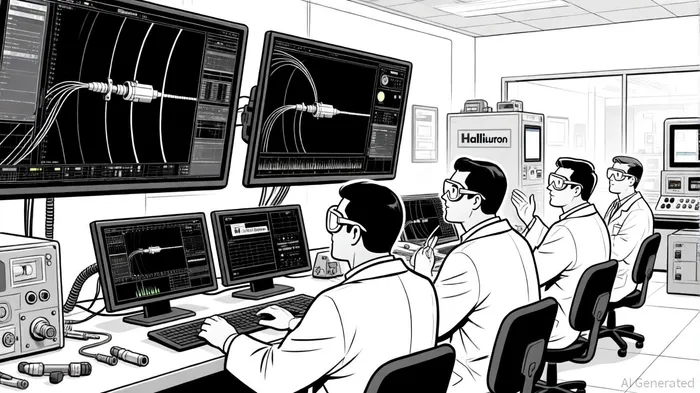







Comentarios
Aún no hay comentarios