
Hainan Free Trade Port's Strategic Role in Reshaping Global Supply Chains: Identifying High-Impact Industrial Clusters for Early-Stage Capital Allocation
The Hainan Free Trade Port (HFTP) has emerged as a pivotal node in the global supply chain, leveraging its unique policy framework to attract foreign investment and foster industrial innovation. Since the full-island customs closure on December 18, 2025, Hainan has established a "domestic but offshore" trade environment, enabling tariff-free imports for 74% of goods and streamlined customs procedures. This transformation, coupled with strategic incentives such as the 30% value-added rule and a 15% corporate income tax rate for encouraged industries, positions Hainan as a competitive hub for multinational corporations seeking to optimize production and logistics in the Asia-Pacific region. For investors, the island's focus on advanced manufacturing, clean energy, aerospace, and logistics presents a compelling case for early-stage capital allocation.
Advanced Manufacturing: A Tax-Efficient Hub for Semiconductors and Robotics
Hainan's advanced manufacturing sector is a cornerstone of its industrial strategy, with a particular emphasis on semiconductors, robotics, and biopharmaceuticals. The island-wide customs closure has expanded tariff-free import categories to 6,600 items, reducing tax costs on imported equipment by approximately 20%. Additionally, the 30% value-added rule allows goods processed in Hainan to be exported to the mainland duty-free, incentivizing companies to establish manufacturing operations on the island.
The "dual 15% tax" advantage further enhances Hainan's appeal: encouraged industries benefit from a 15% corporate income tax rate, while high-end talent enjoys a 15% cap on personal income tax. These incentives are particularly attractive for capital-intensive sectors like semiconductors, where firms can leverage low-cost inputs and streamlined regulatory environments to scale production. For instance, a foreign-invested enterprise importing raw materials through Hainan's "first line" can avoid import duties and taxes, significantly lowering initial investment costs.
Clean Energy: Pioneering Green Hydrogen and Solar Innovation
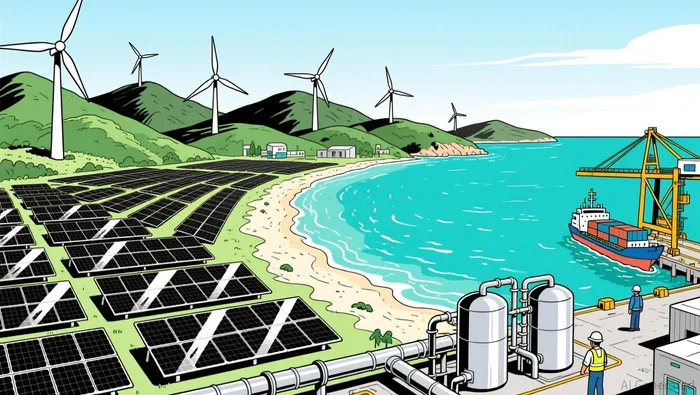
Hainan's commitment to low-carbon development has positioned it as a leader in clean energy innovation. The province's July 2025 low-carbon island construction plan outlines a vision for a zero-carbon energy system, with a focus on high-efficiency solar cells, electrochemical energy storage, and green hydrogen-to-methanol production. Government support for green hydrogen projects is evident in the approval of 41 clean-hydrogen initiatives eligible for state subsidies, aligning with China's broader strategy to expand renewable energy beyond the power sector.
Investors in Hainan's clean energy sector benefit from a combination of policy incentives and strategic advantages. The island's coastal geography and abundant sunlight make it ideal for solar energy projects, while its proximity to Southeast Asia offers opportunities for regional green hydrogen exports. For example, Hainan's "wind and solar power-hydrogen-ESS" industrial chain aims to create distinctive product chains for green hydrogen-ammonia-methanol, attracting firms seeking to capitalize on the global transition to decarbonized energy.
Aerospace: Building a Global Launch and Data Hub
Hainan's aerospace cluster, centered on the Wenchang International Aerospace City, is a strategic priority for the province. A three-year plan (2025–2027) emphasizes satellite launches, manufacturing, and data chain development, supported by infrastructure upgrades such as the expansion of launch pads from two to four. The island's low latitude and coastal location provide significant advantages for payload capacity and rocket recovery, reducing operational costs for aerospace firms.
International collaboration further strengthens Hainan's aerospace ecosystem. Partnerships with institutions like Tsinghua University and the national deep space exploration lab highlight the province's ambition to integrate into global supply chains. For investors, the aerospace sector offers long-term growth potential, particularly in satellite data services and commercial launch capabilities, which are critical for emerging markets in Southeast Asia and beyond.
Logistics and Supply Chain Integration: A Gateway to ASEAN
Hainan's strategic location as a gateway between China and Southeast Asia has amplified its role in global logistics. The island has opened 75 container liner routes, including 36 foreign trade routes, and its customs clearance times have been reduced from 5–7 days to 2–3 days. These improvements, combined with the "two-line" tariff system, make Hainan an attractive hub for multinational corporations seeking to restructure supply chains.
The 40% year-on-year increase in foreign investment since 2025 underscores Hainan's growing appeal. For logistics firms, the island's proximity to the Greater Bay Area and ASEAN markets, coupled with its liberalized trade regime, presents opportunities to optimize transshipment and distribution networks.
Conclusion: A Strategic Investment Opportunity
Hainan Free Trade Port's policy framework and industrial focus create a unique environment for early-stage capital allocation. Advanced manufacturing, clean energy, aerospace, and logistics are poised to benefit from a combination of tax incentives, tariff-free trade, and strategic geographic advantages. As Hainan aims to rival global hubs like Singapore and Dubai by 2030, investors who align with its high-impact industrial clusters stand to gain from the island's transformative trajectory.







Comentarios
Aún no hay comentarios